The Suit of Swords: Overview
Click here to go back to the Tarot Course Hub
Learn the Tarot Pips Through One Simple Story
Besides the detailed articles for each individual tarot card, this overview gives you a simple way to understand the whole suit of Swords at once.
The goal of this article is easy and fast memorization. Instead of treating every pip card as a separate meaning you have to force into your head, we follow one story from the Ace of Swords to the Ten of Swords.
Swords are the element of air. They represent the world of the mind. They speak of ideas, difficult decisions, conflict, truth, pressure, anxiety, fear, and the way our thoughts influence the choices we make. Many of the cards in this suit are challenging because the mind can become both our greatest strength and our greatest obstacle.
To make the Swords easier to remember, we follow one factory worker on his journey to escape a life that no longer fulfills him. He dreams of going back to college, building a different future, and creating new opportunities for himself. Along the way he faces difficult choices, unfair situations, inner conflict, anxiety, and eventually the consequences of trying to hold everything together at once.
The pictures in the cards are designed to help beginners remember the meanings quickly. Each image shows one chapter of the Swords story. The deeper articles for each card explain the meanings in much greater detail, but this overview gives you the whole journey in one place. Clicking on the card title will take you to the detailed article, and if you would like to see all lessons in one place, you can visit the Tarot Course Hub by clicking here.
Ace of Swords
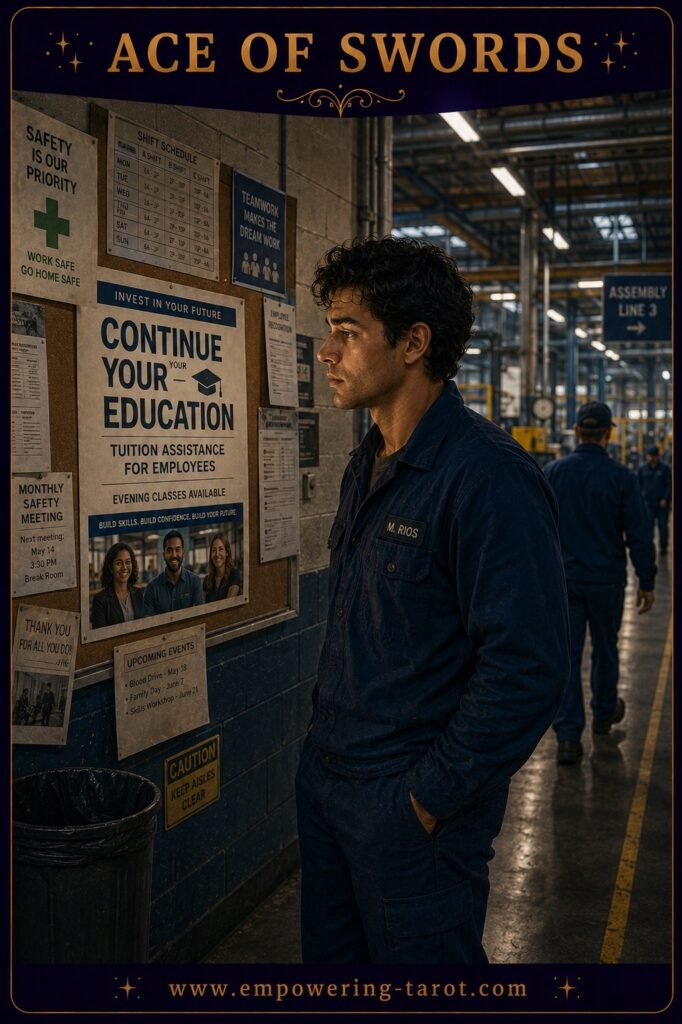
The Ace of Swords is the first thought.
Like the Ace of Wands, it marks a beginning. This beginning, however, does not come from passion but from the mind. It is a realization, a new perspective, or an idea that has the potential to change the course of our lives.
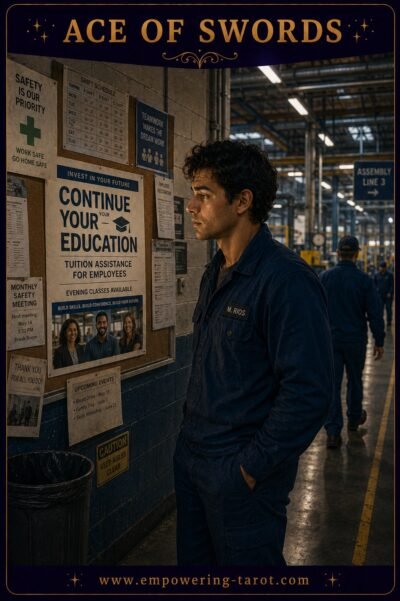
In our story, a factory worker sees an advertisement encouraging adults to go back to college. Until this moment, he simply accepted his daily routine. Now, a completely different future enters his mind. He begins wondering whether he could study, earn a degree, and eventually leave the factory behind.
The Ace of Swords does not tell us whether he will actually follow through. It simply shows the moment when a new possibility appears and changes the way he sees his future.
Two of Swords
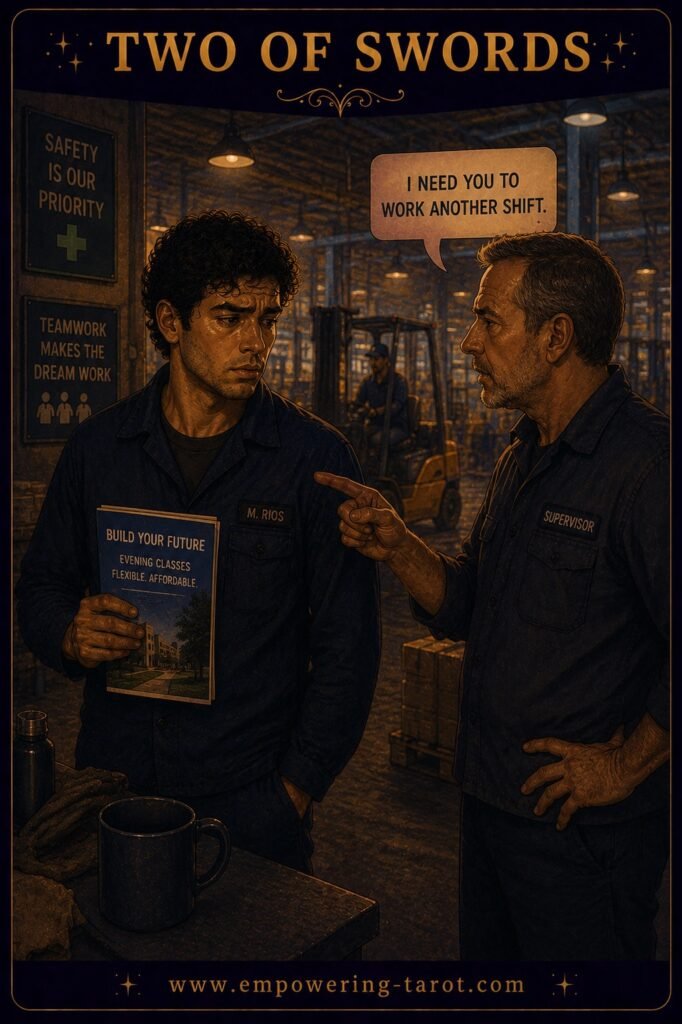
The Two of Swords introduces a difficult decision that cannot be made immediately and makes the querent put life on hold.
In our story, the factory worker has not given up on his dream of going back to college. Then his supervisor tells him that another overtime shift is required. Suddenly he finds himself caught between two competing priorities. He wants to study, but he also needs the income from his job.
Instead of choosing one path, he remains stuck. He cannot fully commit to college because of his job, and he cannot fully commit to his job because his thoughts are already on college. Just like the blindfolded woman in the traditional card, he does not know what to do next. The uncertainty creates a stalemate.
The Two of Swords reminds us that difficult decisions do not always have an obvious answer. Sometimes we wait because we hope the situation will resolve itself. Sometimes we simply do not know which path is right. Until a decision is made, life remains suspended between two possibilities.
Three of Swords
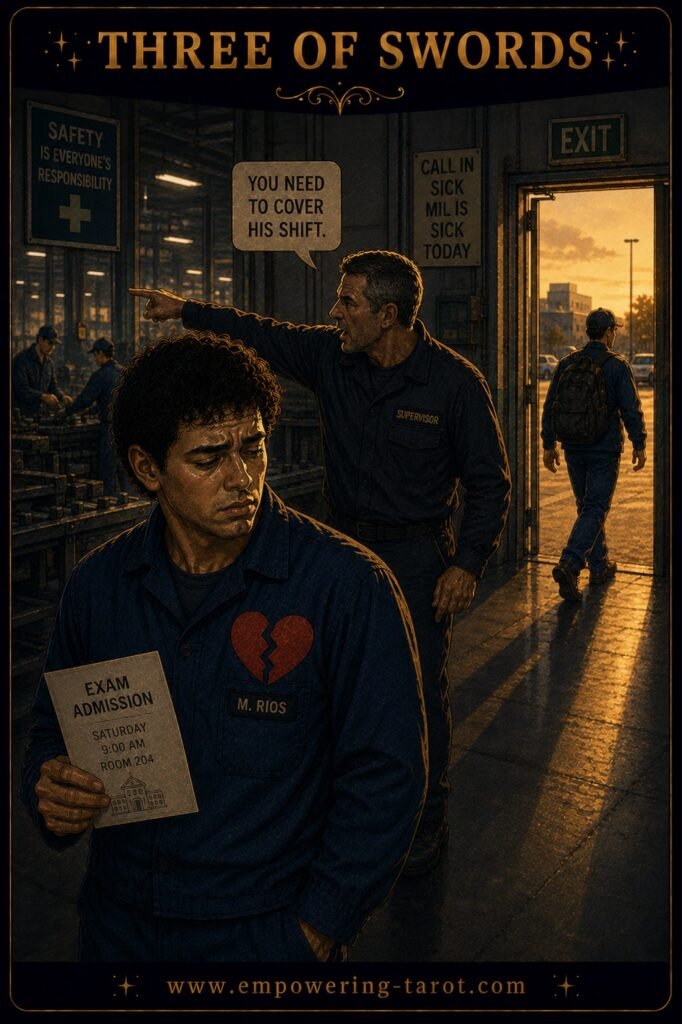
The Three of Swords is the card of the broken heart, it brings disappointment and emotional pain.
In our story, the worker has an important college exam coming up. He asks for time off but is denied because he has to cover another employee’s shift. It’s heartbreaking to see how another person gets a day off, while he has to show up and worry if he will ever be able to make his dream come true.
The situation breaks his heart. He worked hard, tried to do everything the right way, and still feels punished for it. The Three of Swords reminds us that life is not always fair. Sometimes painful truths hurt precisely because they expose injustice, disappointment, or betrayal.
Four of Swords
The Four of Swords brings a temporary pause.
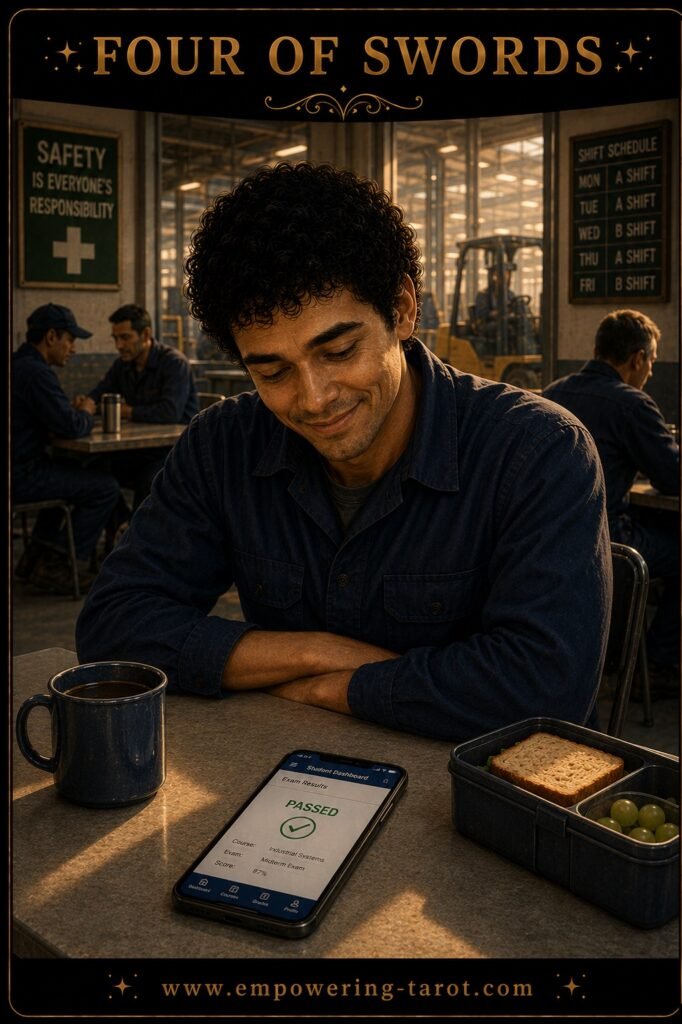
After the disappointment of the Three of Swords, the worker checks his student dashboard during his lunch break and discovers that he passed his exam despite all the overtime he had to work. Nothing about his situation has really changed. He still works at the factory. He still secretly attends college courses in his free time. He still has to juggle both worlds. Yet for the moment, he has been spared another setback.
The Four of Swords represents a period where life gives us a chance to catch our breath. The conflict is temporarily put on hold, allowing us to recover before the next challenge arrives. We remain where we are for the time being, protected from further damage while gathering the strength to continue.
In our story, passing the exam allows the worker to keep following his dream without making any major changes yet. His difficult situation remains the same, but he has bought himself a little more time. The journey continues.
Five of Swords
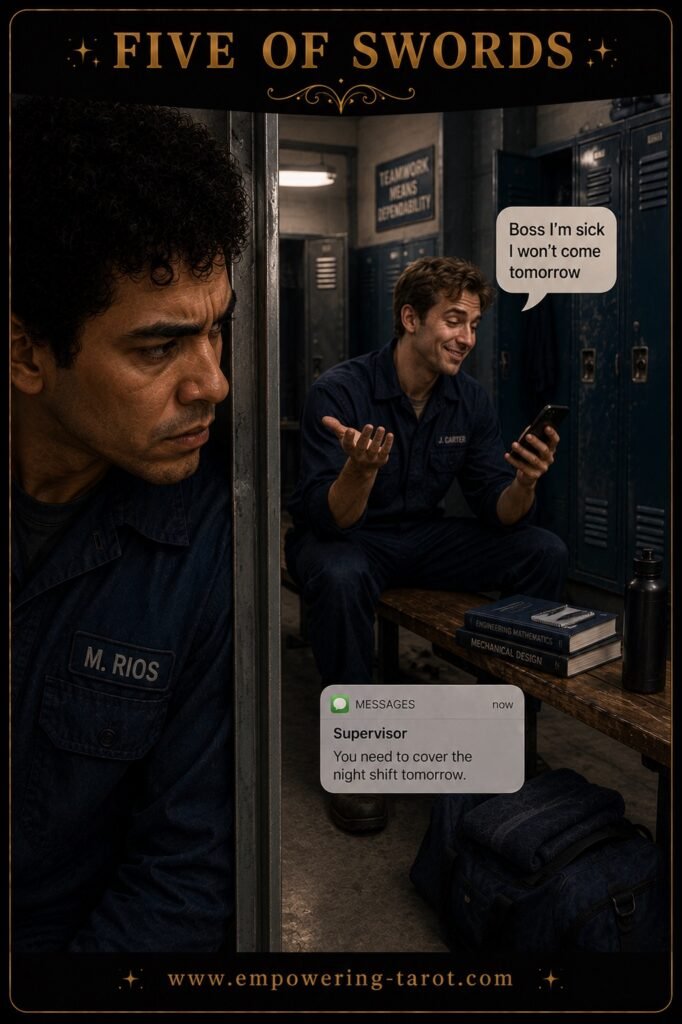
The Five of Swords brings conflict, but unlike the Five of Wands, this conflict is not an open argument between equals. The Five of Swords often carries an unpleasant feeling of unfairness. Somebody gains an advantage while somebody else pays the price.
In our story, the worker realizes that his coworker also attends college, but he regularly calls in sick whenever an important exam is coming up. As a result, he is the one who has to work the extra shifts. He has tried to do everything right, yet he feels like he is the one being punished for it.
The Five of Swords reminds us that life is not always fair. We sometimes encounter situations where honesty, kindness, or hard work do not seem to be rewarded. It is easy to become bitter when we watch others bend the rules while we carry the consequences.
Six of Swords
The Six of Swords is the decision to leave a difficult situation behind and move toward calmer waters.
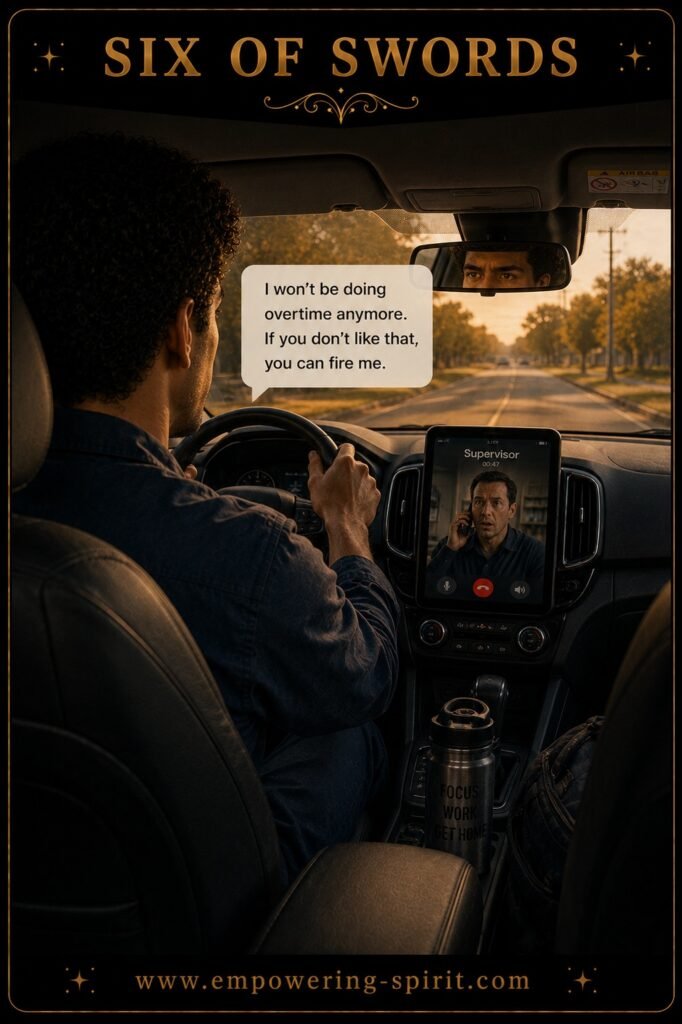
In our story, the worker is driving home after his shift when his supervisor calls. The supervisor’s name appears on the car’s display. During the conversation, the worker calmly explains that he will no longer work overtime. If the company cannot accept that decision, they are free to fire him.
Unlike the Two of Swords, he is no longer trapped by indecision. He has accepted that something has to change. He cannot continue sacrificing his future every time another overtime shift appears.
The image of him driving away perfectly reflects the meaning of the Six of Swords. He is quite literally moving forward and eventually leaving something behind. He does not know exactly where the road will lead, but he has finally chosen a direction, and he made up his mind about what not to take with him as he continues his journey. Sometimes the greatest relief comes from deciding that we are no longer willing to stay where we are.
Seven of Swords
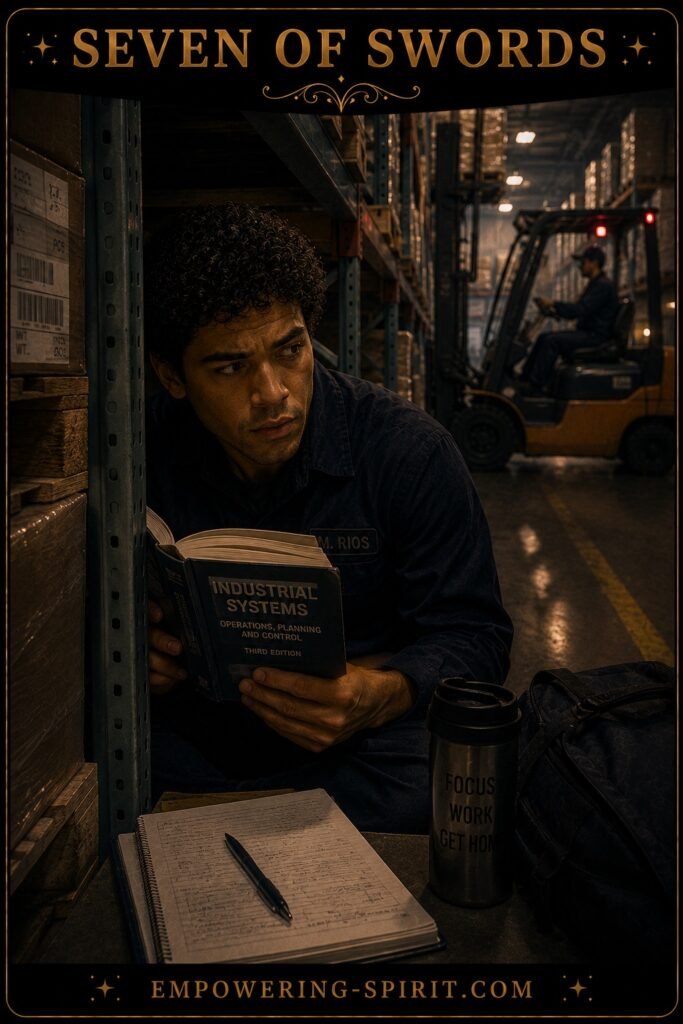
The Seven of Swords is strategy, secrecy, and quietly getting away with something sneaky.
In our story, the worker discovers that there are quiet moments during his shift when there is very little work to do. Instead of standing around waiting, he sneaks into a hidden corner of the warehouse with his college textbooks and studies until work picks up again. He keeps an eye on his surroundings to make sure nobody notices him.
For now, his plan works. He returns to work before anyone realizes he was gone, and he continues making progress with his studies. He believes he has found a clever solution to an impossible situation.
The Seven of Swords often shows someone relying on intelligence and strategy instead of confronting a problem directly. Sometimes that strategy is justified, sometimes it crosses an ethical line, and sometimes it eventually creates even bigger problems. In this moment, however, the worker gets away with it, making the Seven of Swords the calm before the consequences arrive later in the suit.
Eight of Swords
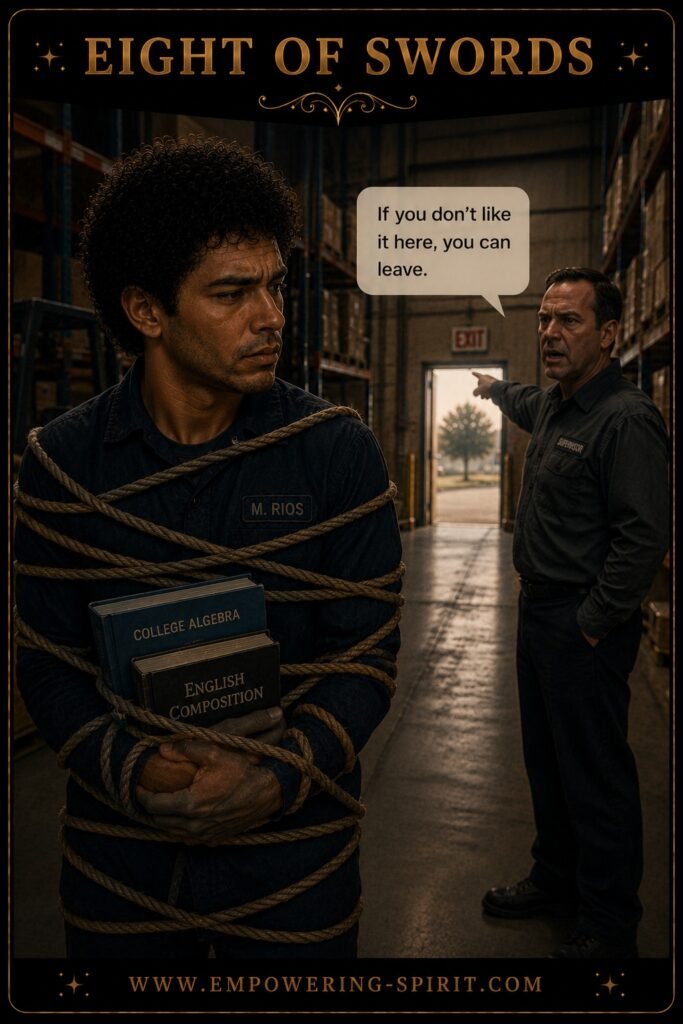
The Eight of Swords is feeling trapped.
In our story, the supervisor points toward the exit and says, “If you don’t like it here, you can leave.”
The worker does not move.
He wants a different life. He wants to graduate college. He wants to leave the factory behind. Yet when the opportunity to walk away is placed in front of him, fear keeps him exactly where he is.
This is what makes the Eight of Swords such a powerful card. The greatest obstacle is often not the situation itself but our own belief that we have no way out. The worker is free to leave, yet his worries about money, security, and the future keep him standing exactly where he is.
Nine of Swords
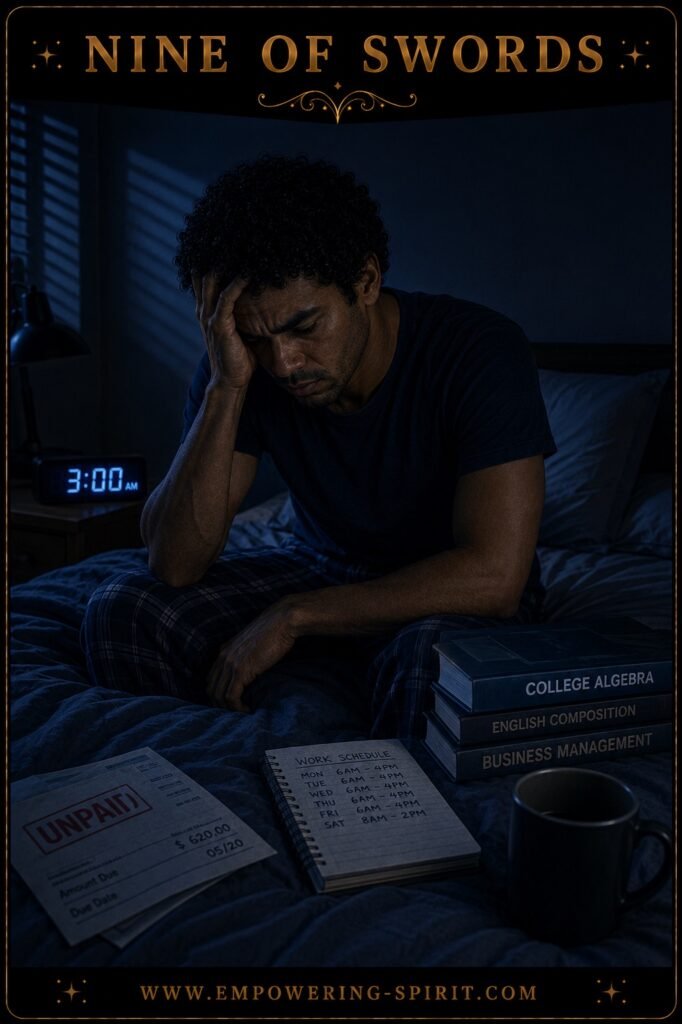
The Nine of Swords is anxiety.
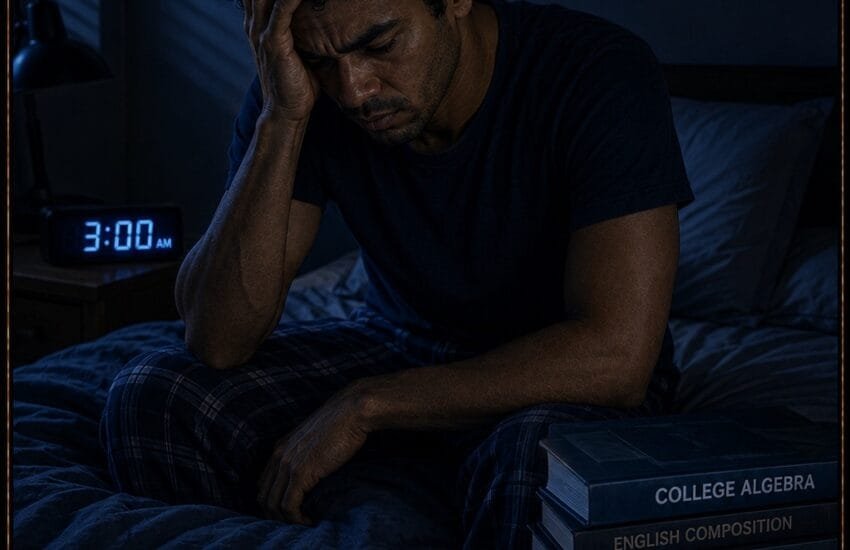
In our story, the worker lies awake in bed late at night. He thinks about work. He thinks about college. He worries that somebody might discover he has been studying during company time. He worries about failing his exams. He worries about his future. Every thought creates another one, making it impossible to find peace.
The Nine of Swords shows how exhausting our own minds can become when fear takes over. Nothing has happened yet, but the endless cycle of worry keeps us awake long before reality has a chance to decide what comes next.
Ten of Swords
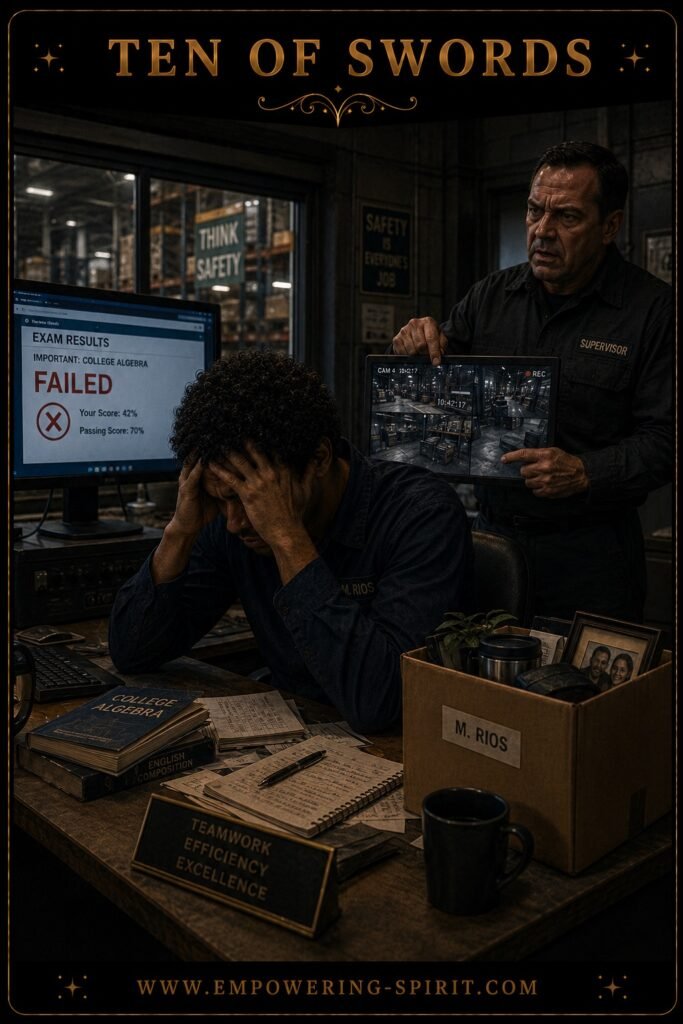
The Ten of Swords brings the painful ending of a difficult chapter.
In our story, everything catches up with the worker at once. His work computer displays the result of his latest college exam, showing that he has failed. At the very same moment, his supervisor stands beside him pointing at an iPad displaying security camera footage from the warehouse. The recordings clearly show that he has been studying during company time.
The worker’s greatest fears become reality in a single moment. His attempt to balance work and college has collapsed. The strategy that helped him get ahead in the Seven of Swords has finally caught up with him, and there is nothing left to hide.
The Ten of Swords often feels like rock bottom because several problems reach their conclusion at the same time. It marks the end of a chapter that can no longer continue. The situation is painful, but it also forces a fresh beginning. The worker’s old way of handling both worlds has come to an end, making room for a completely different future.
The Swords Story in One Flow
The suit of Swords begins with an idea.
A factory worker sees the possibility of going back to college and dreams of building a different future. He struggles to balance work and education, finds himself trapped between responsibility and ambition, suffers disappointment, catches his breath, grows frustrated by unfairness, chooses a new direction, secretly looks for ways to get ahead, discovers that his greatest prison is his own fear, spends sleepless nights worrying about everything, and finally watches the entire situation collapse around him.
This is the journey of Swords.
It begins with a new thought and ends with the consequences of trying to hold two different lives together for too long. Part of it is facing the consequences of trying to outsmart others.
That is why the Swords often feel more challenging than the other suits. Air represents the mind. Our thoughts help us solve problems, make decisions, and discover new possibilities. At the same time, they can fill us with fear, uncertainty, doubt, anxiety, and inner conflict. The greatest battles in the suit of Swords are often fought inside our own heads long before they become reality.
When you remember the factory worker’s journey, the numbered Swords become much easier to understand. You do not have to memorize ten disconnected meanings. You can follow the story of a man trying to escape his old life, one difficult decision at a time.
Thank you for spending time here and walking through the story of the Swords with me. I hope this overview made the suit easier to remember and helped the cards feel a little more alive, connected, and practical.
If you would like to continue learning, you can head over to the Tarot Course Hub and explore the deeper articles for the individual cards, meanings, combinations, exercises, and more.
If you enjoy my work and would like to support the website, you are very welcome to leave a small tip through the tip jar. On desktop, you can find it in the sidebar. On mobile, you will find it down in the footer.
You can also visit my shop at www.empowering-tarot.com to check out my readings, products, and other tarot offerings.
Thank you for being here, and happy learning. ⚔️