
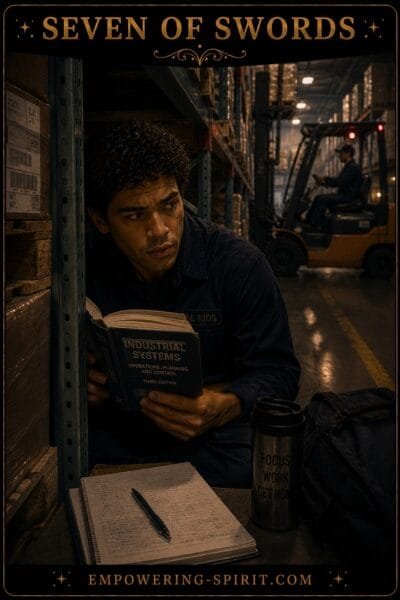
The Seven of Swords
Click here to go back to the Tarot Course Hub
Click here to go to the general article about the Suit of Swords
The Quietly Crooked Path
The Seven of Swords is the card of strategy in the shadows.
This is not the open humiliation of the Five of Swords. It is not the honest transition of the Six. The Seven does not confront directly if it can avoid it. It sneaks, calculates, maneuvers, hides, slips away, and tries to gain advantage without standing in the full light of consequence.
That is the heart of this card.
The Seven of Swords often appears where intelligence is being used sideways rather than openly. Someone is trying to get away with something. Someone is concealing motives. Someone is using cunning instead of clean confrontation. That can range from minor avoidance and half-truths to real betrayal, theft, manipulation, or deceit.
But that is only half the card.
The Seven of Swords is not only about cheating. It is also about plans that look clever in the mind but are built on unstable ground. The person thinks they know exactly what they are doing. They may even be proud of their sophistication. Yet something important has been overlooked. The rope is frayed. The timing is off. The plan has a weakness built into it, and that weakness may later bring the whole thing down.
That is why the Seven of Swords is such an unsettling card.
It carries a certain cool confidence, but the confidence may be false.
🖼 Symbolism in My Deck
In my deck, the Swords tell a continuous story through one man.
By the Six of Swords, the worker has finally made a decision. He will no longer sacrifice his future to endless overtime. He is moving away from passive suffering and into a more active phase of the story.
In the Seven of Swords, he begins solving the problem in a quieter and more questionable way.
He discovers that there are calm moments during his shift when very little work needs to be done. Instead of standing around, he sneaks into a hidden corner of the warehouse with his college textbooks and studies until work picks up again. He keeps watch so no one notices.
That is the Seven of Swords.
His plan is clever. It helps him survive an impossible situation. For now, it works. He returns before anyone realizes he was gone, and his studies continue moving forward. He believes he has found a smart solution that lets him win without open confrontation.
And that is exactly what makes the symbolism so good.
The card is not simple moral preaching. It shows intelligence used sideways. It shows strategy instead of direct action. It also shows the calm before consequences. In this moment, he gets away with it. Later in the suit, that may not remain true.
This image captures the heart of the Seven of Swords:
- secrecy
- strategy
- slipping around a problem
- getting away with something for now
- intelligence used in a morally gray way
The Seven of Swords reminds us that cleverness can solve a problem temporarily, but that does not mean the method is clean or safe.
🗝️ Keywords — Seven of Swords
Upright
Cunning
Deception
Strategy
Avoidance
Sneaking
Betrayal
Guile
Sophistication
A plan that may fail
Dishonesty
Stealth
Getting away with something
Reversed
Confession
Exposure
Good advice
Awareness
Cowardice
Slander
Chattering
Truth coming out
Cold feet
Reclaiming what was stolen
Honesty after deceit
A lie becoming impossible to maintain
🔄 Reversed does not always mean the deceit disappears. Often it means it is being exposed, admitted, undone, or turned back on itself.
🔍 Meaning — Seven of Swords
The Seven of Swords shows the shadow side of intelligence.
The mind here is sharp, but not clean. It thinks ahead, calculates, notices openings, and looks for loopholes. It can be brilliant, but the brilliance is being used in a sideways way. The person is not meeting the issue openly. They are trying to gain an advantage through concealment, manipulation, evasion, or strategic misdirection.
That is why betrayal and theft are such common meanings for this card.
But if you stop there, you miss an important layer.
The Seven of Swords also shows plans that are clever on paper but not as secure as they look. The person thinks they are prepared. They believe they have seen all the angles. Yet something has been missed. That is why this card can become a warning: not only against being deceived by others, but also against trusting your own sophistication too much.
This is the card of:
- “I can probably get away with it.”
- “No one will notice.”
- “I’ve thought this through.”
- “I know how to handle this.”
And sometimes that is true.
But sometimes the plan is already rotting in one unnoticed corner.
🪤 A Card of Crooked Advantage
One of the strongest themes in this card is the attempt to shape a situation to one’s own advantage without entering it honestly.
That can mean:
- lying
- stealing
- avoiding responsibility
- withholding information
- cheating in small or large ways
- emotionally dodging instead of confronting
- quietly taking what is not freely given
- slipping away from obligations
- playing both sides
This is why the card can feel so slippery.
Unlike the Five of Swords, the Seven does not want the dirty battlefield. It wants the backdoor. It wants the side route. It wants the clever maneuver that gets the prize without the full cost of direct engagement.
Sometimes that energy is malicious.
Sometimes it is desperate.
Sometimes it is almost understandable.
But it is still dishonest.
🪢 The Frayed Rope: Why Clever Plans Still Fail
This is the overlooked side of the card, and it matters.
The Seven of Swords often includes a weakness inside the plan itself. The person thinks they are being smart, but the structure is not stable enough to carry the trick forever. They may be too pleased with their own cunning to notice the flaw. They may ignore the fact that deceit has a way of becoming messier over time. They may underestimate how one small overlooked detail can unravel the whole performance.
That is why the card can be a warning against arrogance of intellect.
The person is not stupid. Quite the opposite. They are often clever enough to create a complicated strategy. But cleverness is not the same as wisdom, and sophistication is not the same as moral or practical safety.
The Seven of Swords says:
just because the plan is subtle does not mean it is sound.
🔄 Reversed Meaning — Seven of Swords
Reversed, the Seven of Swords often shows the hidden material becoming harder to hide.
A confession may come out. Someone may get cold feet and admit the truth. A trap may be seen in time. A lie may become unsustainable. What was being whispered may turn into slander, gossip, or exposure. The crooked path does not stay invisible forever.
This reversal can also have a more constructive side.
It may show a person finally telling the truth in order to free themselves. It may show reclaiming what was stolen, exposing someone else’s false game, or realizing just in time that you are the one being played. In some cases, it can even point to a justified lie or strategic concealment used for protection rather than harm. But those cases depend very strongly on context and surrounding cards.
Most often, the reversal says:
the hidden thing is becoming visible.
That is why the reversed card can feel both relieving and dangerous. The truth may come out, but truth coming out is not always tidy.
🛠 Practical Use — Seven of Swords in Readings
Knowing the card in theory is one thing. Seeing how it behaves in practice is another.
🌿 In Career & Work Questions
In work matters, the Seven of Swords often shows cheating, office politics, slipping out of responsibility, dishonest advantage, or environments where sharpness matters because straightforward honesty is no longer enough to stay safe. It can also show the person who quietly avoids tasks, works around rules, or tries to get ahead through dubious means.
The card advises a very critical look at both your surroundings and your own behavior. In such situations, people may become victims of intrigue, including intrigues of their own making.
🧠 In Self-Reflection & Spiritual Growth
In introspective readings, the Seven of Swords often points to self-deception. A person does not want to face an insight, does not want to admit what they are doing, or is building a life around convenient dishonesty. The card can become a very serious warning here, because the deepest lies are often the ones told inwardly.
This is one of the clearest cards for examining where you evade, rationalize, manipulate, or make excuses for yourself.
💞 In Relationship Spreads
In relationships, the Seven of Swords can range from emotional evasiveness and avoidance of necessary conversations all the way to hypocrisy, deceit, and betrayal. It can show a partner slipping away from accountability, someone hiding motives, someone lying, or a general lack of openness.
Sometimes it does not mean full betrayal yet. Sometimes it is simply the refusal to be honest. But even that poisons intimacy.
🧭 In Spread Positions
When it describes your inner state
You may be trying to maneuver your way around the truth, around a confrontation, or around the consequences of something you do not want to face directly. If the interpretation seems too harsh, the card may still be asking you to examine where you are not fully honest with yourself.
When it shows how others see you
Others may see you as covert, slippery, evasive, cunning, or not fully trustworthy. Even if you do not intend malice, your behavior may look unclear or strategic to them.
When it offers advice
Use your intelligence, yes, but not in a way that poisons the whole matter. Stay alert. Someone may be playing a crooked game, and you may need maneuvering skill to avoid being trapped. But the card also gives permission to leave. Sometimes the smartest move is not to become the better rogue, but to step out of the whole rotten setup.
🌌 Astrology & Elemental Correspondences — Seven of Swords
☿ Mercury
This correspondence fits perfectly. Mercury rules intellect, strategy, speech, adaptability, quick thinking, and maneuvering. In the Seven of Swords, those gifts move into shadow. Upright, Mercury becomes cunning, evasive, tricky, and overly clever. Reversed, it can become confession, exposure, or the return of truth through speech.
🌬 Air
As a Swords card, the Seven belongs fully to Air, but here Air is not being used to clarify. It is being used to sidestep, reshape, hide, and outmaneuver. In balance, Air can help a person notice traps and move carefully through them. In imbalance, it becomes deception, self-deception, and strategy detached from honesty.
💎 Final Message
The Seven of Swords is the card of crooked intelligence.
Sometimes it shows someone deceiving you.
Sometimes it shows you deceiving someone else.
Sometimes it shows the quieter lie that keeps your own life stuck.
And sometimes it shows a clever plan that works just long enough to make you trust it too much.
That matters.
This card reminds us that strategy is not the same as integrity, and intelligence is not the same as wisdom. Getting away with something for now is not the same as being safe.
The real question is this:
what in the situation depends on concealment,
and how long do you honestly think concealment will hold?
⚔️ Was this helpful?
If this lesson gave you a clearer understanding of the Seven of Swords, and if this course helps you connect with tarot in a deeper and more grounded way, you can support the work through the tip jar in the sidebar on desktop or the footer on mobile.
And if you want insight into deceit, hidden motives, manipulation, a plan that may not be as safe as it looks, or a situation where you need to know whether to maneuver, confess, expose, or walk away, you can also book a personal reading or explore my offers at www.empowering-spirit.com.
Thank you for reading.
Thank you for valuing depth.
And thank you for keeping this work alive.
Click here to go back to the Tarot Course Hub
Click here to go to the general article about the Suit of Swords