
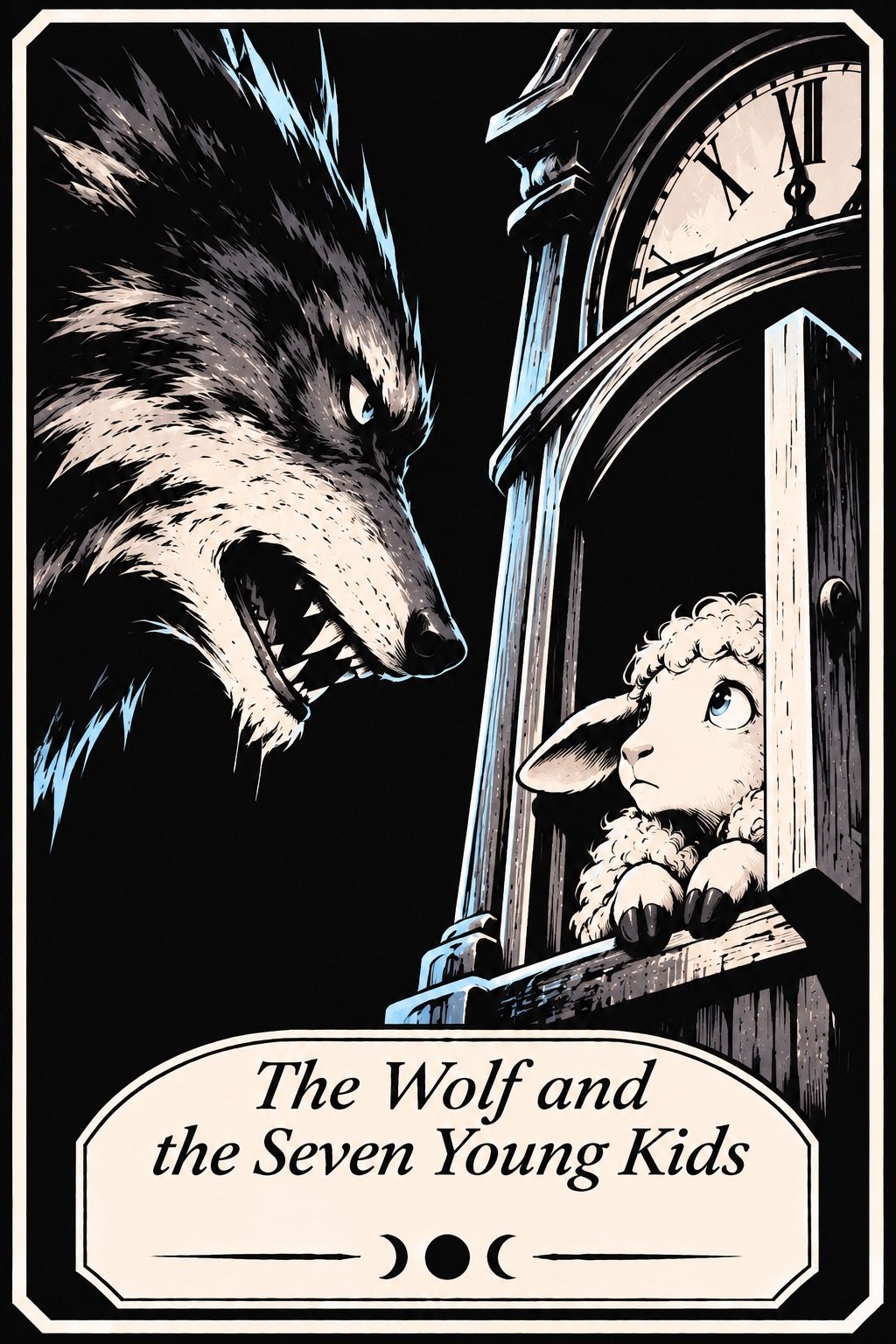
Fairy Tales: The Wolf and the Seven Young Kids
Click here to go back to the Fairy Tale Page and discover more articles like this one
The Wolf and the Seven Young Kids was my grandmother’s favorite Grimm tale. She knew it word for word and would tell it without even opening the book. She especially loved the scene in which Mother Goat sews the wolf’s stomach shut. Although, in my grandmother’s version, the scene was considerably longer, unnecessarily graphic, and made even worse by the way she moved her hands and fingers as though she were actually sewing while she told it.
I always assumed that this was because my grandma was a tailor. Perhaps she imagined herself sewing the wolf’s stomach shut. And I think she was quite certain that she would have done an excellent job.
More than that, there were two lines from the story that she regularly used completely out of context during everyday conversations:
“I’ll gobble you up, hide and hair!”
And:
“What is rumbling and tumbling inside my belly?”
Yes. My grandmother is actually a lovely person, and I am not trying to make her sound creepy. But that is what she did.
Personally, I never thought this was a particularly great tale. There are much better fairy tales than this one. Honestly, it is kind of boring.
More importantly, it fed my fear of losing my mommy.
I know that the story is not really about losing your mother, and I assume every child has a natural fear of something happening to theirs. For me, Bambi was the worst trigger. I never watched that film to the end, not once. I was presented with the movie and encouraged to try again on several occasions, but every time Bambi’s mother died, I began crying, switched off the television, and refused to continue. So I cannot tell you anything about the rest of the movie.
This article is not about Bambi, though. Let me explain.
My mommy was a teacher. (Yes, I know what people say about teachers’ children, but my husband’s daddy is a teacher too, so apparently we both found someone who came from a similarly afflicted family, and we are doing perfectly well in life, okay?!) When I was very little, my mother was unable to find a teaching position for quite some time, so she accepted a job at an orphanage. She took me to work with her once or twice, and there was a boy living there who was a little older than me, somewhere between six and eight years old at the time.
I cannot remember his exact age, but I still remember his name and his hairstyle, which I thought was extremely cool. I always loved playing with older children, and I admired him very much.
That boy told me his story. My mommy later confirmed it, and sadly, what he told me was exactly what had happened.
When he was about three years old, his mother took him to a pharmacy. She told him that she would be right back and left him standing in a corner. But she never returned. Eventually, he began to cry. The pharmacists looked after him and waited with him, expecting his mother to come back. When she still did not return, they finally called the police. The little boy did not know his last name. He did not know his address or his mother’s telephone number. When they asked for his mother’s name, he thought her name was Mommy. They never found her. He was placed in the very care facility where my own mommy began working a few years later.
That story unlocked an entirely new fear inside my little brain: being abandoned at a pharmacy.
Seriously, I still think about that boy frequently, even today, and I pray that he is doing well. I pray he found a good wife, created a beautiful and loving family, and has children of his own.
With that being said, this secondhand trauma added considerably to my natural fear of losing my mommy in one way or another. And for some reason, The Wolf and the Seven Young Kids always me think of the boy who was left behind in the pharmacy. Looking back, I think my little brain connected the two stories through one frightening sentence: Mommy said she would come back. Mother Goat really does return, of course. But after hearing about that boy, apparently the promise itself was no longer enough to make me feel safe.
So no matter how enthusiastically my grandmother tried to convince me that The Wolf and the Seven Young Kids was wonderful, it never worked.
Now, however, let’s read it again as adults. Let’s see what we find inside it and what we can turn into an oracle card.
You can read my retelling directly below this section. Or, if you are here for the oracle, you can scroll farther down to find the complete card meaning and the interactive tool.
The Wolf and the Seven Young Kids
Once upon a time, there was an old mother goat who had seven young kids, and she loved them as dearly as any mother loves her children. One day, needing to go into the forest to gather food, she called all seven of them together and said, “Dear children, I’m heading out into the woods. Be on your guard against the wolf! If he gets inside, he’ll gobble you all up, hide and hair. That villain often disguises himself, yet you’ll know him right away by his gruff voice and his black paws.”
“Dear Mother,” the kids replied, “we’ll be very careful. You can go without a single worry.” With a contented bleat, the old goat set off on her way.
It wasn’t long before someone knocked on the front door and called out, “Open up, my dear children! Your mother is home and has brought something back for each of you.”
Yet the kids could tell by the gruff voice that it was the wolf. “We won’t open the door!” they cried. “You’re not our mother! She has a soft, sweet voice, and yours is rough and raspy. You’re the wolf!”
So the wolf marched off to a shopkeeper and bought a large lump of chalk. He ate it all up, and sure enough, it made his voice soft and sweet. Then he came back, knocked on the front door, and called out, “Open up, my dear children! Your mother is home and has brought something back for each of you.”
However, the wolf had rested his black paw on the windowsill. Seeing it, the children shouted, “We won’t open the door! Our mother doesn’t have a black foot like you. You’re the wolf!”
So the wolf ran to a baker and said, “I’ve hurt my foot—spread some dough over it for me.” Once the baker had coated his paw in dough, the wolf trotted over to the miller and said, “Sprinkle some white flour over my paw.”
The miller suspected right away that the wolf was trying to trick someone and refused, yet the wolf snarled, “If you don’t do it, I’ll eat you alive!” Terrified, the miller dusted the paw white. Yes, that’s just how people are.
Now the villain went up to the front door a third time, knocked, and said, “Open up for me, children! Your dear little mother has come home and brought each of you something from the woods.”
“Show us your paw first,” the kids called back, “so we know you’re truly our dear mother!”
He laid his paw on the windowsill, and when they saw that it was white, they believed he was telling the truth and unlocked the door. Yet who stepped inside? The wolf!
Panic-stricken, they scrambled to hide. One darted under the table, the second into the bed, the third into the stove, the fourth into the kitchen, the fifth into the cupboard, the sixth under the washbasin, and the seventh inside the tall case of the grandfather clock. Yet the wolf found them all and wasted no time—one after another, he gulped them straight down his throat. Only the youngest, tucked away inside the clock case, escaped his eyes. Once the wolf had eaten his fill, he lumbered off, stretched out under a tree in the green meadow outside, and fell fast asleep.
Not long afterward, the old mother goat returned home from the woods. Oh, what a sight met her eyes! The front door stood wide open; the table, chairs, and benches were overturned; the washbasin lay shattered in pieces; and the blankets and pillows had been dragged off the bed. She searched high and low for her children, yet they were nowhere to be found. She called out each of their names one by one, but nobody answered. At last, when she called the youngest, a tiny voice piped up: “Dear Mother, I’m hiding inside the clock case!”
She lifted him out, and he told her how the wolf had broken in and swallowed all the others. You can just imagine how bitterly she wept for her poor children.
Finally, heavy with grief, she walked outside with the youngest kid trotting beside her. When they reached the meadow, there lay the wolf against the tree, snoring so loudly that the branches shook. She looked him over from every side and noticed something squirming and kicking inside his bulging belly. Good heavens, she thought, could my poor children, whom he gulped down for supper, still be alive?
At once, she sent the youngest kid racing back to the house for scissors, a needle, and thread. Then she snipped open the monster’s belly, and barely had she made the first cut when one little kid poked its head out. As she snipped further, all six came leaping out one after another, every single one alive and without a scratch—for in his greed, the beast had swallowed them whole. What joy there was! They hugged their dear mother tightly and skipped about like a tailor on his wedding day.
“Now go and gather some heavy cobblestones,” the old goat told them. “We’ll fill this wicked beast’s belly with stones while he’s still fast asleep.”
In a flash, the seven kids hauled back as many stones as they could carry and stuffed them inside the wolf’s stomach. Then the mother goat sewed him back up so swiftly that he never noticed a thing and didn’t even twitch.
When the wolf finally woke from his nap, he climbed to his feet, and because the stones in his stomach made him terribly thirsty, he set off toward a well to get a drink. Yet as soon as he began walking and swaying from side to side, the stones inside his belly knocked against one another and rattled loudly.
“What is rumbling and tumbling,” he cried, “inside my belly? I thought they were six little goats, yet they feel like cobblestones!”
When he reached the well and leaned over the water to drink, the heavy stones dragged him straight down, and he drowned miserably. Seeing this, the seven young kids came running up, shouting aloud, “The wolf is dead! The wolf is dead!” and danced for joy around the well with their mother.
Let’s turn The Wolf and the Seven Young Kids into an Oracle Card
At least this one finally starts with “once upon a time.” And no, that’s not me changing the beginning. It’s a fact that most Grimm fairy tales don’t actually start with “once upon a time.” Not that this is relevant to our oracle card, but I wanted to mention it.
With that being said, let’s see what meaning we can find for the card. Deception is the obvious choice, but we are going to encounter deception many, many times throughout the fairy tales. If we turn it into a card every time it appears, our oracle will become repetitive very quickly.
Of course, what we encounter here is not just simple deception. It is adaptive manipulation: the victims know what is going on, and every time an attempt fails, the wolf learns from it, becomes smarter, and tries again, until he finally finds a way to deceive the little goats. That is actually a lot deeper than someone simply telling a lie. Still, as good and interesting as that meaning would be, we cannot use deception for every other card in the oracle. So we need to look a little closer and go a little deeper.
For the upright meaning, I want to choose something that is still rather obvious. The smallest goat kid seems completely powerless. It has the best hiding place, but that is mostly pure luck. It is so powerless that all it can do is hide and listen while its siblings are swallowed by the wolf.
And actually, if we are being completely honest, Mother Goat should be powerless too. A wolf is still a goat’s natural predator, even when the goat is fully grown. She has to be extremely careful not to wake him while she cuts open his belly, frees her children, fills him with stones, and sews him shut again.
By every reasonable measure, she should be powerless—but she isn’t. She is smart, she is brave, and she recognizes the one thing she can still do.
And the smallest goat kid is not as powerless as it first appeared either. It tells its mother what happened, and then it helps as best it can by fetching the scissors, needle, and thread she needs. It cannot fight the wolf. It cannot rescue its siblings alone. But it can survive, tell the truth, and place the right tools into the hands of someone who knows how to use them. Without that, the story would have ended very differently.
So the upright meaning of this card should be: Powerlessness is an illusion. You are not powerless. There is something you can do—and now you need to find the courage to actually do it.
For the reversed meaning, I always dig a little deeper. This time, I kept coming back to this one sentence: “Yes, this is how people are.”
That sentence is not mine. It comes directly from the original Grimm tale, straight from the Brothers Grimm’s own pen. And I thought: This does not really sound as though it belongs inside the story. It sounds more like somebody desperately wanted children to hear this sentence and attached it wherever it fit loosely enough, just to make sure it ended up in the tale. And, unfortunately, people really are like that. If you have ever lived in a big city and depended on its public transportation system, you probably already know what I mean.
Sometimes, people do bad things, not because they want to do them, and not because they don’t know they are wrong, but because they believe the personal cost of doing the right thing instead would be too high.
Maybe that coworker who joins in whenever someone is bullied is not a bully at heart, but is terrified that they will become the next target—or lose their job—if they refuse to participate. Maybe your team leader knows perfectly well that forcing people to work unpaid overtime is wrong and shady, but is under pressure from their own boss. Maybe your sister-in-law secretly knows that you are right in an argument with the family, but does not dare to defend you because she is afraid of the consequences.
Or maybe it is you who knows the difference between right and wrong, but feels that the disadvantage, punishment, or rejection waiting for you if you do the right thing is simply too much to bear.
That is what the miller represents in this story. He knows that helping the wolf disguise his paw is wrong. He even refuses at first because he suspects that the wolf intends to deceive someone. But when the wolf threatens to eat him, the miller helps him anyway. His fear is understandable. The threat is real. That does not make him wicked, and it certainly does not make him the same as the wolf. But the flour on the wolf’s paw still helps to open the door.
So the reversed meaning of this card is not that everyone who participates in something harmful is secretly evil. It is a reminder that people can know something is wrong and still help it happen because protecting themselves feels safer than resisting it. Their fear may explain their choice, but it does not erase its consequences.
And perhaps this card is asking an uncomfortable question: Are you relying on someone who privately agrees with you but will not stand beside you when doing so carries a price? Or are you the one who knows what is right but remains silent because speaking up would cost you something?
Not everyone who helps the wolf is a wolf—but the door opens all the same.
And now, that we found our oracle meaning inside the tale, we’re ready for the guidebook section.
The Wolf and the Seven Young Kids
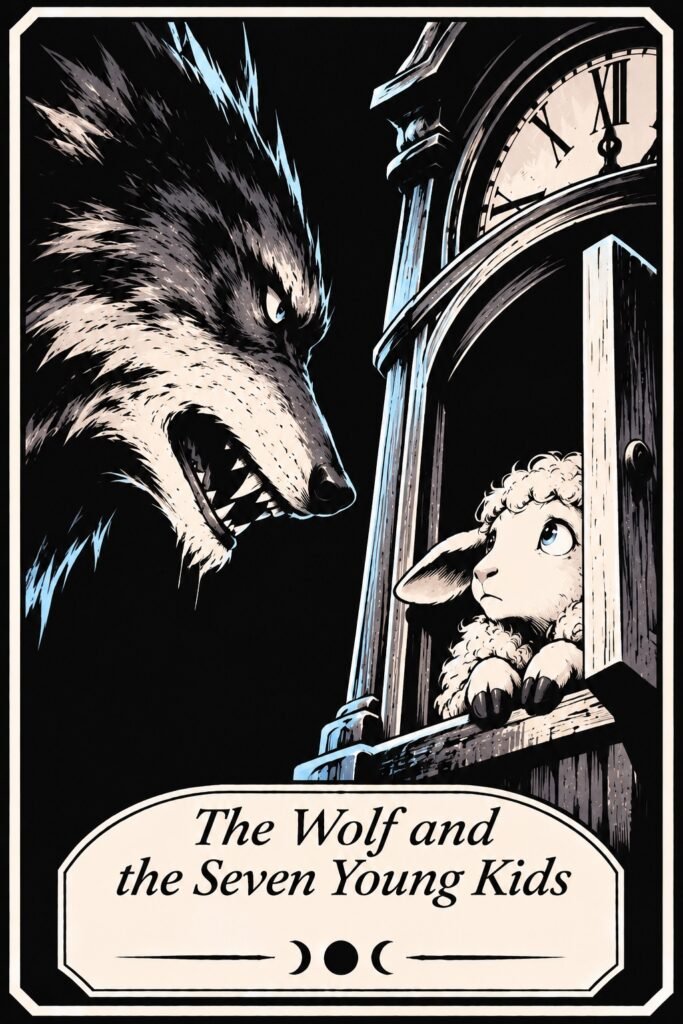
Upright: Hidden strength · Courage · Resourcefulness · Taking action · Recognizing your power
Reversed: Fearful compliance · Silent complicity · Unreliable support · Self-preservation · Knowing better but doing it anyway
Upright Meaning
You are not as powerless as you believe.
The Wolf and the Seven Young Kids appears when a situation has left you feeling small, overlooked, or completely outmatched. You may be focusing so heavily on everything you cannot do that you have failed to recognize the power you still possess.
The youngest goat kid cannot fight the wolf or rescue its siblings alone. What it can do is survive, tell its mother what happened, and bring her the tools she needs. Mother Goat should be powerless against the wolf too, but courage, intelligence, and careful timing allow her to accomplish what strength alone could not.
This card asks you to look at the resources already available to you. You may hold essential information, notice something others have missed, or be able to reach the person who can help. Your contribution does not have to be dramatic to change the outcome.
Do not confuse a lack of control with a lack of power. You may not be able to fix everything by yourself, but there is still something you can do. Find that action and have the courage to follow through.
Message: Powerlessness is an illusion. Work with what you have, take the step available to you, and trust that even a small action can change the ending.
Reversed Meaning
Knowing that something is wrong does not guarantee that a person will refuse to participate in it.
Reversed, The Wolf and the Seven Young Kids warns of people who recognize harm but cooperate with it because resisting would carry a personal cost. Someone may privately agree with you, sympathize with your situation, or admit that you are being treated unfairly, yet still refuse to stand beside you when their own comfort, safety, or reputation is at risk.
This card may also ask you to examine your own choices. Perhaps you are remaining silent because speaking would make you unpopular. Perhaps you are following an unfair instruction because refusal could threaten your position. Your fear may be understandable, and the consequences may be real, but your cooperation can still help the harm continue.
The miller is not the wolf. He knows that disguising the wolf’s paw is wrong and initially refuses, but he gives in when the wolf threatens him. His motives are different from the wolf’s, yet the flour on the paw still helps to open the door.
Do not rely on private agreement as proof of dependable support. Pay attention to what people are willing to do when doing the right thing requires courage or sacrifice. If this card reflects you, consider whether self-protection has quietly turned into complicity, and whether there is a safer way to refuse, speak up, or withdraw your cooperation.
Message: Not everyone who helps the wolf is a wolf, but the door opens all the same. Understand the fear behind the choice, but do not ignore its consequences.
Click here to go back to the Fairy Tale Page and discover more articles like this one
Fairy Tale Oracle
Draw a card for free!
2 thoughts on “Fairy Tales: The Wolf and the Seven Young Kids”