Fairy Tales: The Youth Who Went Forth to Learn What Fear Was
Click here to go back to the Fairy Tale Page and discover more articles like this one
The Youth Who Went Forth to Learn What Fear Was was my favorite Brothers Grimm fairy tale when I was a child, and I think there may have been several reasons for that.
One of them, which I remember vividly, was that my neighbor’s daughter loved it too. She was two years older than me, and I always looked up to her as one of the big girls. Two years, after all, seem like a very big age gap when you are little.
Then there is the fact that the tale starts insulting its protagonist almost immediately, calling him stupid and useless in the second sentence. And it continues like that. I mean, the whole thing is absurdly funny. You could summarize the entire story by saying that its protagonist is so stupid that he does not recognize danger even when it hits him directly in the face. He is not fearless because he is brave. He is fearless because he is too stupid to understand anything that is happening around him.
And the third reason is that this is one of the longest fairy tales in the entire Grimm collection. That meant that, whenever I asked my mommy to read it to me at bedtime, I could cheat an extra five minutes out of the evening simply because the story took so long to finish.
I also vividly remember the moment when the tale first mentioned the castle where the boy would have to spend the night. I became so frightened in advance every single time that I instantly regretted my choice. I would start thinking about interrupting Mommy and telling her that she could stop reading and that I promised to go to sleep immediately.
Of course, I never actually said it.
After a while, I knew the tale word for word. I knew exactly what was going to happen inside that castle—and still, the mere promise of it made me shiver and regret choosing the story all over again.
That memory is burned so deeply into my mind that I thought about it every time my daughter watched Moana and began crying shortly before Te Fiti appeared. She watched that movie every day for about a year (and parents of small children will know that this is not an exaggeration) and yet she cried at exactly the same moment every single time, even though she knew perfectly well what was going to happen.
I have always wondered why this tale is relatively unknown and not far more popular. Because I genuinely think that, if you read it to a group of children alongside the better-known fairy tales, there is a good chance that at least half of them would choose it as their favorite.
Anyway, if you have never read it (or if you have forgotten half of what happens) you can discover it in the next section. And if you are here for the oracle, you can scroll farther down to find the complete guidebook meaning and the interactive fairy-tale oracle.
The Youth Who Went Forth to Learn What Fear Was
There was a father who had two sons. The older one was clever, sensible, and handy at just about everything. The younger one, however, was simple-minded—he couldn’t grasp or learn a thing, and whenever people saw him, they would shake their heads and say, ‘That boy is going to be a real burden to his father!’
Whenever there was work to be done, the older brother had to handle it. Yet if it was late at night and their father wanted to send him out to fetch something, and the path led past the churchyard or some other spooky spot, the older boy would answer, ‘Oh no, Father, I’m not going out there! It gives me the shivers!’ For he was terribly frightened.
Or in the evenings, when folks sat around the fire telling ghost stories that made your skin crawl, the listeners would sometimes say, ‘Oh, that gives me the shivers!’
The younger son would sit in the corner listening, completely baffled by what they meant. They’re always saying, ‘It gives me the shivers, it gives me the shivers!’ It never gives me the shivers. Shivering must be some kind of special skill that I’m too dim-witted for once again.
One day, his father said to him, ‘You over there in the corner, listen up. You’re growing big and strong, and you need to learn a trade so you can earn your own keep. Look at your brother and how hard he works! As for you… oh dear, you’re a hopeless case.’
‘But Father,’ the boy replied, ‘I’d gladly learn something. In fact, if it’s possible, I’d most like to learn how to get the shivers, because I don’t understand a thing about it.’
His older brother burst out laughing when he heard that, thinking to himself, Good Lord, what a blockhead my brother is. Nothing will ever come of him. You have to bend a twig while it’s young.
His father let out a sigh and answered, ‘Oh, you’ll learn the shivers soon enough, all right—but you won’t make a living off them.’
Not long afterward, the sexton stopped by for a visit. The father poured out his troubles, explaining how hopeless his youngest son was at everything—he knew nothing and couldn’t seem to learn a thing. ‘Just imagine: when I asked him how he planned to earn his bread and what trade he wanted to learn, he said he wanted to learn how to get the shivers! Since when is shivering a trade you can make money from? How a dim-witted boy comes up with something like that is beyond me.’
‘If that’s all,’ replied the sexton, ‘he’s more than welcome to learn the shivers with me. Let him be my apprentice, and I’ll soon knock some sense into him.’
The father was pleased, thinking, That ought to straighten the boy out a bit.
So the sexton took him home and put him to work ringing the church bells. After a few days, he woke the boy at midnight and ordered him to climb the church tower and ring the bell.
You’ll soon find out what the shivers are, the sexton thought, slipping up the tower ahead of him in secret.
When the boy reached the top of the tower and turned around to grab the bell rope, he spotted a white figure standing on the stairs across from the sound hole.
‘Who’s there?’ he called out.
The figure didn’t answer and didn’t move a muscle.
‘Answer me!’ the boy shouted. ‘Or get out of here—you have no business being up here in the middle of the night!’
The sexton stood completely still, hoping to make the boy think he was a ghost.
The boy called out a second time: ‘What do you want here? Speak up if you’re an honest man, or I’ll throw you down the stairs!’
Figuring the boy was bluffing, the sexton didn’t make a sound and stood as rigid as stone. The boy called out a third time, and when he still got no reply, he took a running start and shoved the ghost down the stairs so hard that it tumbled ten steps and landed in a heap at the bottom. Afterward, he rang the bell as if nothing had happened, went home, climbed into bed without a word, and slept like a log.
The sexton’s wife waited and waited for her husband, and when he didn’t come back, she grew worried sick. She woke the boy and asked, ‘Do you have any idea what happened to my husband? He went up the tower ahead of you.’
‘No,’ the boy answered, ‘but someone was standing on the stairs across from the sound hole. Since he wouldn’t answer and wouldn’t leave, I figured he was a crook and pushed him down the stairs. Go have a look and see if it was the sexton. If it was, I’m truly sorry.’
The woman raced over to the church tower and found her husband lying in the corner, groaning with a broken leg. She hauled him down the stairs and marched straight over to the boy’s father, wailing at the top of her lungs. ‘Your boy!’ she cried. ‘He’s caused a terrible disaster! He threw my husband down the stairs and broke his leg! Get that good-for-nothing out of my house!’
Horrified, the father ran out and scolded the boy. ‘What kind of wicked stunt is this? Unbelievable—the devil himself must have put you up to it!’
‘Father,’ the boy replied, ‘hear me out. I’m completely innocent. The sexton was standing there in the dead of night looking like someone up to no good. I had no idea it was him. I even called out three times and warned him to speak up or leave.’
‘Ah,’ groaned his father, ‘you bring me nothing but grief. Get out of my sight—I never want to lay eyes on you again.’
‘Fine by me, Father. Just wait until daybreak, and I’ll set off into the world to learn how to get the shivers. That way I’ll have a skill I can earn my living with, too.’
‘Learn whatever you please,’ answered his father. ‘It makes no difference to me. Here are fifty talers—take them and go out into the wide world, somewhere nobody knows us, and don’t tell a soul where you’re from or who your father is. At least then I won’t have to be ashamed of you anymore.’
‘Yes, Father. If that’s how you want it, and that’s all you ask, I can easily do that for you.’
At daybreak the next morning, the boy pocketed his fifty talers, stepped out onto the open road, and muttered to himself, ‘If only I could get the shivers! If only I could get the shivers!’
A man walking along the road overheard him talking to himself. A little farther on, when the gallows came into view, the man pointed and said, ‘Look over there—that’s the tree where seven men are hanging. Go sit underneath their bodies and wait for nightfall, and you’ll learn what the shivers are soon enough.’
‘If that’s all it takes,’ said the boy, ‘that’s easy. If I learn the shivers that fast, you can have my fifty talers. Come back and see me tomorrow morning.’ With that, the boy walked over to the gallows, sat down beneath it, and waited for evening.
As the air turned chilly, he built a fire. Around midnight, however, the wind picked up so fiercely that even the fire couldn’t keep him warm. When the wind knocked the hanged men against one another, setting them swaying back and forth, the boy thought, If I’m freezing down here by the fire, imagine how cold those poor fellows must be, dangling up there in the wind. Taking pity on them, he fetched a ladder, climbed up, untied the corpses one by one, and carried all seven down. Then he stoked the fire, blew the embers bright, and sat the hanged men in a circle around it so they could warm up. They sat there without moving a muscle, though, and before long their clothes caught fire. ‘Watch out,’ the boy warned them, ‘or I’ll hang you right back up!’ The dead men didn’t listen, stayed silent, and let their rags keep burning. Annoyed, the boy said, ‘If you won’t be careful, I can’t help you—I’m not going to burn to a crisp with you.’ So he strung them back up one by one in a row. Once that was done, he sat back down by his fire and fell fast asleep.
The next morning, the man returned to collect his fifty talers. ‘Well,’ he asked, ‘do you know what the shivers are now?’
‘No,’ replied the boy. ‘How could I? Those fellows up there never opened their mouths. They were even dumb enough to let the rags on their backs catch fire.’
Seeing he wouldn’t be getting the fifty talers today, the man walked off muttering under his breath, ‘Well, I’ve never met the likes of him before.’
The boy set off down the road again, muttering to himself as before: ‘Oh, if only I could get the shivers! If only I could just get the shivers!’
A wagon driver walking behind him overheard and asked, ‘Who are you?’
‘I don’t know,’ the boy answered.
‘Where are you from?’ the driver asked next.
‘I don’t know.’
‘Who’s your father?’
‘I’m not allowed to say.’
‘And what are you muttering under your breath all the time?’
‘Oh,’ said the boy, ‘I wish I knew how to get the shivers, but nobody seems able to teach me.’
‘Quit talking such nonsense,’ said the driver. ‘Come along with me, and I’ll see what I can do to teach you.’
The boy traveled with the driver, and by evening they reached an inn where they planned to spend the night. As he stepped into the taproom, the boy said aloud once more, ‘If only I could get the shivers! If only I could get the shivers!’
The innkeeper overheard him, laughed, and said, ‘If you’re that eager for it, I have just the opportunity for you!’
‘Oh, hush now,’ snapped the innkeeper’s wife. ‘Plenty of nosy fools have already lost their lives there. It would be a crying shame if those handsome eyes never saw the light of day again.’
‘No matter how hard it is, I want to learn,’ the boy insisted. ‘That’s the whole reason I left home.’
He pestered the innkeeper until the man finally told him about a haunted castle not far away where he could surely learn what the shivers were. All he had to do was spend three nights inside. What’s more, the king had promised his daughter’s hand in marriage to anyone brave enough to pull it off—and the princess was famously the loveliest maiden the sun had ever shone upon. The castle was also brimming with treasure guarded by evil spirits, waiting to be freed to make the boy a wealthy man. That way, he could learn the shivers and earn a fortune at the same time, even if his father had doubted him. Of course, many men had entered the castle before to try their luck, and not a single one had ever walked out again.
The boy didn’t need to be told twice. The very next morning, he went before the king and said, ‘With your permission, Your Majesty, I would like to keep watch in the haunted castle for three nights.’
The king looked him over, and taking a liking to the lad, replied, ‘You may bring three things into the castle with you, provided they are lifeless objects.’
‘In that case,’ said the boy, ‘I’d like a fire, a lathe, and a carving bench with a drawknife.’
During the day, the king had everything carried up to the castle for him. When night fell, the boy headed up, lit a roaring fire in one of the chambers, set the carving bench and knife beside it, and took a seat on the lathe. ‘Oh, if only I could get the shivers,’ he muttered. ‘Though I can already tell I won’t learn it here either.’
Around midnight, he went to stoke the fire, and as he blew on the coals, a voice suddenly wailed from a dark corner, ‘Ow, meow! Oh, how freezing cold we are!’
‘You silly fools!’ the boy called back. ‘What are you howling about over there? If you’re cold, come on over, sit by the fire, and warm yourselves up!’
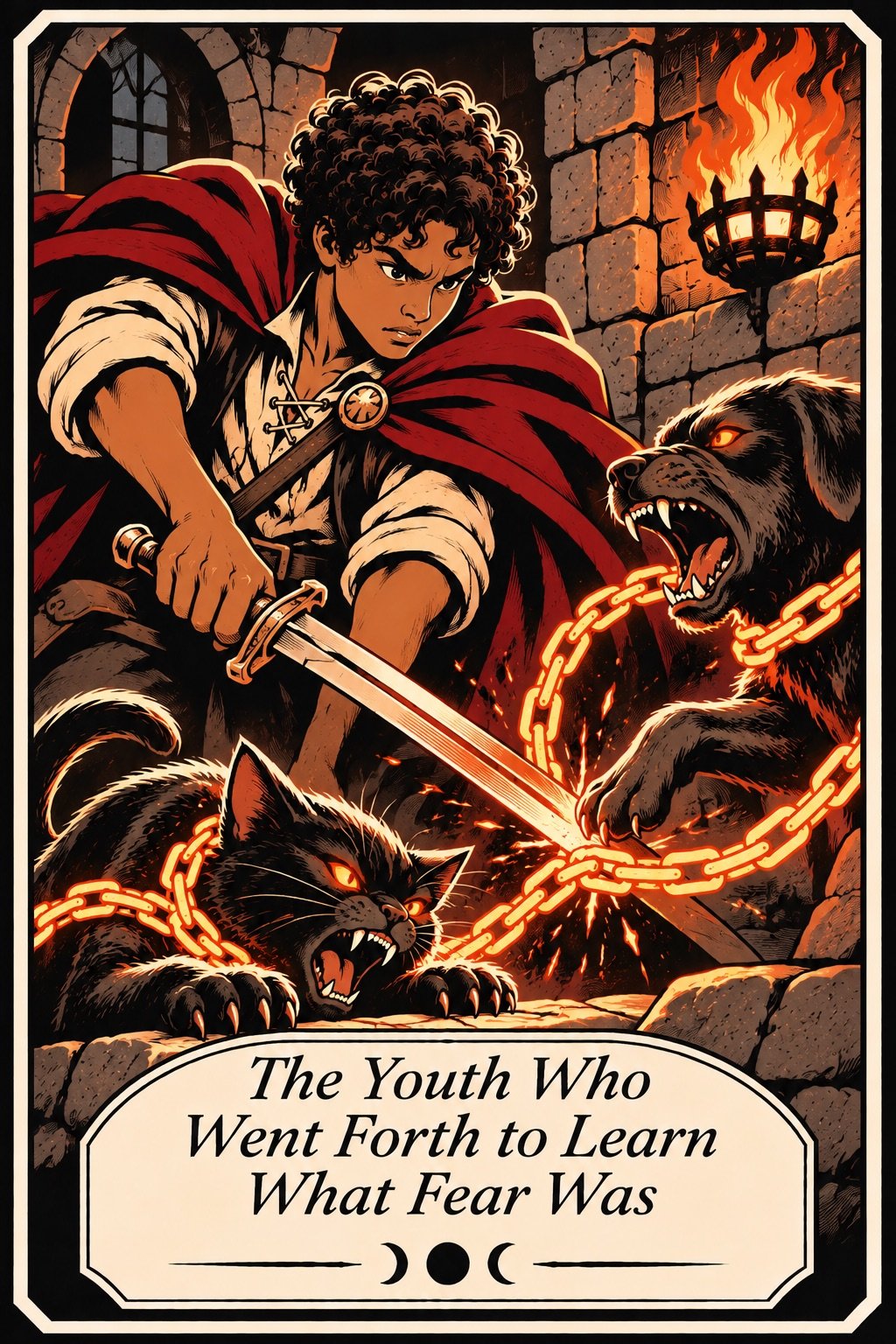
Hardly had he spoken when two enormous black cats bounded across the room in a single leap, perched on either side of him, and glared wildly at him with eyes like burning coals. After warming up for a bit, they asked, ‘Say, pal, care for a game of cards?’
‘Why not?’ he answered. ‘Show me your paws first, though.’
Out came their claws.
‘Well, well,’ said the boy, ‘what long nails you have! Hold on—I’ll have to trim those down for you first.’ With that, he grabbed them by the scruff of their necks, hoisted them onto the carving bench, and clamped their paws down tight. ‘Now that I’ve gotten a good look at your fingers,’ he said, ‘I’ve lost all interest in playing cards.’ Then he knocked the cats dead and tossed them out the window into the moat.
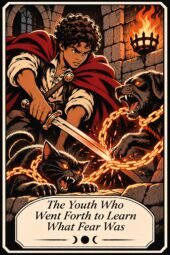
No sooner had he dealt with those two and turned back toward his fire than black cats and black dogs on red-hot chains came swarming out of every nook and cranny—more and more of them, until he could barely move. The beasts shrieked blood-curdlingly, trampled all over his fire, kicked the logs apart, and tried to snuff it out. He watched quietly for a moment, until he’d finally had enough. Grabbing his drawknife, he yelled, ‘Clear out of here, you rabble!’ and charged straight at them. Some of the creatures bolted away; the rest he struck dead and threw out into the pond. Returning to the hearth, he blew the remaining sparks back into a lively flame and warmed himself. Before long, his eyelids grew heavy and he felt ready for sleep. Looking around, he spotted a huge bed standing in the corner. ‘That’ll do nicely,’ he said, and crawled right in.
Just as he was closing his eyes, however, the bed began rolling on its own, careening all through the castle. ‘Now we’re talking!’ he cheered. ‘Faster, even better!’ Off the bed zoomed as if pulled by six galloping horses, rattling up and down stairs and crashing over thresholds. Suddenly—hop, hop!—it flipped completely upside down, pinning the boy underneath. Completely unfazed, he tossed the blankets and pillows aside, crawled out, and said, ‘Whoever wants a ride can take a turn now—I’ve had enough.’ Then he curled up by his fire and slept soundly until morning.
At daybreak, the king arrived. Seeing the boy stretched out motionless on the floor, he assumed the ghosts had finished him off. ‘What a shame,’ the king sighed, ‘such a fine young fellow.’
Hearing this, the boy sat right up and said, ‘Thankfully, it hasn’t come to that yet!’
Startled yet delighted, the king asked how the night had gone.
‘Pretty well,’ the boy replied. ‘That’s one night down, and the other two will pass just as easily.’
When he walked back into the inn, the innkeeper’s jaw dropped. ‘I never thought I’d see you alive again!’ the man exclaimed. ‘Did you finally learn what the shivers are?’
‘No,’ said the boy. ‘No luck at all. If only someone could just tell me what the shivers are!’
The second night, he climbed back up to the old castle, sat down by the fire, and started up his familiar refrain: ‘If only I could get the shivers!’
At the stroke of midnight, a rumbling racket broke out—soft at first, then growing louder and louder. Everything went dead silent for a moment, and then—crash!—half a man came tumbling down the chimney and landed right in front of him.
‘Hey, you!’ the boy shouted. ‘Half of you is missing—half a man isn’t nearly enough!’
The uproar started all over again, roaring and howling until the other half came crashing down the chimney too.
‘Hold on a second,’ said the boy. ‘Let me give the fire a quick puff first.’ When he turned back around, the two halves had snapped together, and a hideous-looking man was sitting right in his spot.
‘Hold on, that wasn’t the deal!’ said the boy. ‘That’s my bench—I sit there.’
The man tried to shove him off, but the boy wasn’t having any of it. He pushed the stranger aside with all his strength and reclaimed his seat. Soon, more men came tumbling down the chimney one after another. They brought out nine shinbones and two skulls, set them up like bowling pins, and started a game of ninepins. Eager to join in, the boy asked, ‘Hey there, mind if I play too?’
‘Sure, if you’ve got money.’
‘I’ve got plenty of money,’ the boy replied, ‘but your bowling balls aren’t quite round.’ He picked up the two skulls, mounted them on his lathe, and shaved them smooth and round. ‘There—now they’ll roll properly,’ he said. ‘All right, let’s get this game going!’ He played alongside them and lost a few coins, until the clock struck twelve and everything vanished into thin air. He lay down and slept peacefully through the night.
The next morning, the king stopped by to check on him. ‘How did you fare this time?’ he asked.
‘I played a round of ninepins,’ answered the boy, ‘and lost a couple of pennies.’
‘Didn’t you get the shivers at all?’
‘Not a bit. It was good fun, though. If only I knew how getting the shivers actually works.’
On the third night, he sat back down on his bench, muttering glumly, ‘If only I could get the shivers!’
Late in the night, six tall men marched in carrying a coffin. ‘Ha, ha,’ said the boy, ‘that must be my cousin who passed away just a few days ago!’ Crooking a finger, he called out, ‘Come on over, little cousin, come on!’ The men set the coffin down on the floor, and the boy walked over and lifted the lid. Inside lay a dead man. Touching his cheek, the boy found it cold as ice. ‘Hang on,’ he said, ‘let me warm you up a bit.’ He walked over to the hearth, warmed his hand by the flames, and pressed it against the corpse’s face, yet the dead man remained freezing cold. So he lifted the body out, sat down by the fire, propped the corpse on his lap, and rubbed its arms to get the blood flowing again. When even that didn’t work, a thought struck him: When two people share a bed, they warm each other up. He carried the dead man over to the bed, tucked him under the covers, and climbed in beside him. After a while, the corpse finally grew warm and began to stir. ‘See, little cousin?’ the boy said cheerfully. ‘Good thing I warmed you up!’
Suddenly, the dead man sat bolt upright and snarled, ‘Now I’m going to strangle you!’
‘What?’ cried the boy, taken aback. ‘Is that the thanks I get? Then you can march right back into your coffin!’ He hoisted the corpse up, dumped him back into the box, and slammed the lid shut. At once, the six men returned and carried the coffin away.
‘I just can’t get the shivers,’ the boy sighed. ‘I’m clearly never going to learn it here.’
Just then, an enormous old man with a flowing white beard strode into the room—taller than all the others and terrifying to behold. ‘You wretched little worm!’ he boomed. ‘Now you’ll finally learn what the shivers are, because you’re about to die!’
‘Not so fast,’ replied the boy. ‘If I’m going to die, I have to agree to it first, don’t I?’
‘I’ll get my hands on you soon enough!’ roared the monster.
‘Easy now, easy,’ said the boy. ‘Don’t puff yourself up so big. I’m every bit as strong as you are—and probably stronger!’
‘We’ll see about that!’ barked the old man. ‘If you’re stronger than I am, I’ll let you walk free. Come on, let’s put it to the test!’
He led the boy through pitch-dark corridors down to a blacksmith’s forge, seized an axe, and drove an anvil deep into the earth with a single mighty blow.
‘I can beat that easily,’ said the boy, stepping up to a second anvil. The old man leaned in close to watch, his long white beard dangling down. Swinging the axe with all his might, the boy split the anvil clean in two—and wedged the old man’s beard right inside the crack.
‘Aha, got you now!’ cried the boy. ‘Looks like it’s your turn to die!’ Grabbing an iron bar, he beat the old man until the giant whimpered and begged him to stop, promising to hand over great riches in return.
The boy pulled the axe free and released him. True to his word, the old man led him back into the castle cellar and pointed out three chests brimming with gold. ‘One share is for the poor,’ he said, ‘one share is for the king, and the third share belongs to you.’
The clock struck twelve, the spirit vanished into thin air, and the boy was left standing alone in the dark.
‘I’ll find my way out of here somehow,’ he muttered, feeling his way along the walls until he made it back to his chamber, where he curled up by the fire and went to sleep.
The next morning, the king arrived and asked, ‘Well, surely by now you’ve learned what the shivers are?’
‘No,’ the boy answered. ‘What is it, anyway? My dead cousin dropped by, and a bearded old fellow showed me piles of gold down in the cellar, but nobody ever told me what the shivers are.’
Then the king declared, ‘You have lifted the curse from the castle, and you shall marry my daughter.’
‘That’s all well and good,’ the boy replied, ‘but I still don’t know what the shivers are!’
The gold was brought up from the cellar and a grand wedding was celebrated. Yet fond as the young king was of his new bride, and happy as his life had become, he still sighed constantly, ‘If only I could get the shivers! If only I could get the shivers!’
This made the young queen terribly sad, until her clever chambermaid said, ‘Leave it to me, Your Majesty—I’ll teach him what the shivers are soon enough.’ She slipped out to the brook running through the palace garden and had a bucket filled to the brim with little minnows. That night, while the young king lay fast asleep, the queen gently pulled back his covers and dumped the entire bucket of icy water and wriggling fish right over him.
As the cold minnows flopped and squirmed all around him, the young king bolted upright and shouted, ‘Oh, how I’m shivering! How I’m shivering, my dear wife! Yes—now I finally know what the shivers are!’
What does this tale mean as an Oracle Card?
Obviously, the moral of this story is that violence is the answer.
There is nothing to fear if you are violent enough, and it is never too early to teach children that valuable lesson. Therefore, the meaning of our oracle card should simply be: Beat the shit out of anyone standing in your way.
Nah. Just joking.
That would be far too easy. But I felt that we needed to acknowledge all the casual murdering in this tale rather than politely pretending it wasn’t there. Now that we have taken care of that, let’s see what else the story might be trying to tell us.
Now, let’s be serious. For the upright meaning, I think we should choose the most obvious lesson.
We have laughed at the protagonist. We have laughed about how stupid he is, and about the constant insults coming from both the other characters and the all-knowing narrator. Yet, by the end of the story, we have learned something important: he may be stupid, but he is by no means useless.
He sets out with one particular goal. He wants to learn what fear is because he believes that, somehow, this will become a skill he can use to earn a living. How exactly that is supposed to work remains unclear, but he is very committed to the idea.
He never achieves his goal during the journey. Instead, without even realizing it, he completes a series of extremely useful tasks. Most importantly, he frees an entire castle from its curse, survives what killed everyone who tried before him, discovers a hidden treasure, and becomes wealthy.
This reminds me of myself. I wanted to become a YouTuber. Instead, I ended up building this website and accidentally learning a great deal about how websites and computers work. I had always believed that I was terrible with computers, but apparently that is no longer true (if it ever was). Eventually, I became the IT lady for the entire company at my day job. I took on the responsibility, fixed everybody’s outlook settings, saved my boss a lot of money by maintaining the company’s homepage myself, and received a promotion. (I still work part-time in a small office, and I was initially hired to pick up the phone and do the usual back-office paperwork.)
I did not become a YouTuber. But while trying to move toward one goal, I became capable in an entirely different field without noticing it at first.
That is what I want the upright meaning of this card to be about.
Perhaps there is something you desperately want. Perhaps you only think you want it because you do not yet understand what having it would actually mean. Maybe you have fought for it for years, and because you still have not achieved it, you have begun to feel unsuccessful or even useless.
But what else have you been doing along the way?
What have you learned while pursuing that goal? Which problems can you solve now that once would have overwhelmed you? What responsibilities have other people begun to trust you with? What have you achieved without recognizing it as an achievement simply because it was not the achievement you originally had in mind?
If you opened your eyes to what is already there, you might discover that you have developed real mastery in a completely different field. And that this unexpected ability could take you somewhere your original plan never would have.
It happened to me, and I am willing to bet that, in one way or another, it happens to many other people too.
Sometimes you fail to become the person you intended to be because, without noticing, you have become someone else who is far more useful.
There is one more obvious meaning hidden in this tale: fear has a purpose. The boy survives mostly through pure luck. Under normal circumstances, he should have died during almost every one of his adventures, especially the last one. A little fear might have encouraged him to assess the danger before touching corpses, challenging monsters, or climbing into bed beside a dead man. Fear could have saved his ass.
But that would be too easy for our reversed meaning. Instead, I want to look at another lesson hidden in the very last lines of the story: sometimes, a problem that appears incredibly difficult—and may have followed you for years—has a ridiculously simple solution.
The boy travels out into the world in search of the shivers. He spends the night beneath seven corpses, enters a haunted castle, fights demonic animals, plays ninepins with dead men, shares his bed with a corpse, and defeats an enormous spirit. None of it works. In the end, all it takes is a bucket of cold water and a few small fish dumped into his bed while he is sleeping.
Perhaps there is a problem that has been following you for a long time. You have approached it from every direction you can think of, tried increasingly complicated solutions, and begun to believe that it may be impossible to solve. But what if the solution is so simple that you have dismissed it without trying?
It may help to ask someone who can look at the situation with fresh eyes. They are not trapped inside all the explanations, failed attempts, assumptions, and frustration you have gathered over the years. They may notice the obvious answer precisely because they do not know enough to believe it cannot work. And perhaps the easiest solution will finally be the one that succeeds, even if you can hardly believe that you suffered for so long beneath the weight of something that was surprisingly easy to lift.
You may not need another ghost, corpse, or demon. You may simply need a bucket of fish.
The Youth Who Went Forth to Learn What Fear Was
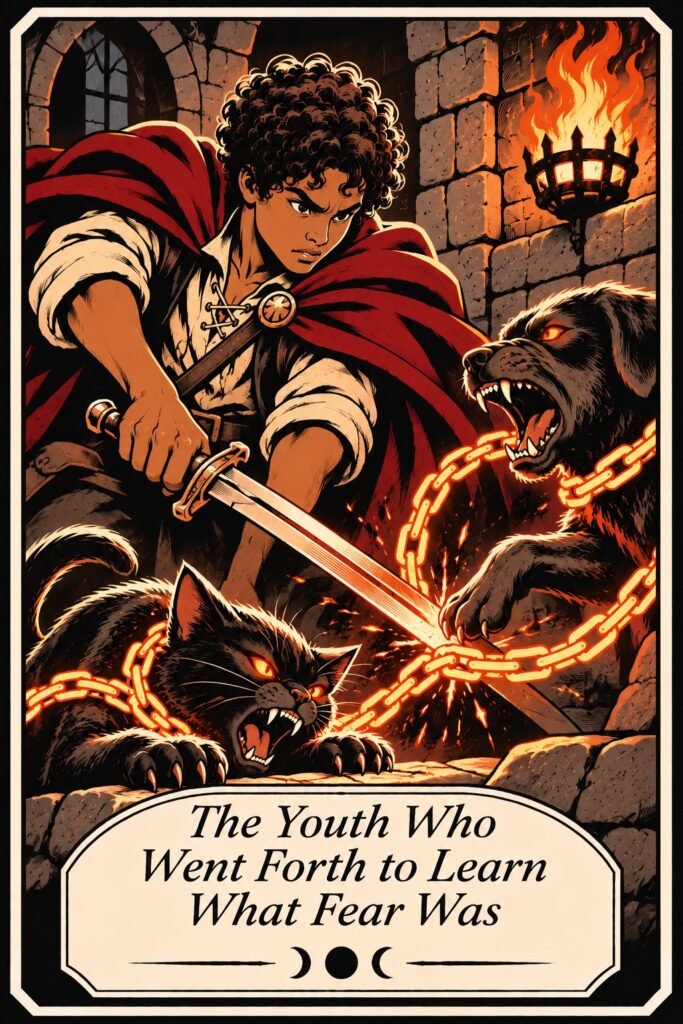
The Youth Who Went Forth to Learn What Fear Was
Upright: Hidden abilities · Unexpected mastery · Unrecognized success · An alternative path · Discovering your usefulness
Reversed: Simple solutions · Fresh eyes · Overcomplication · Returning to basics · An unexpectedly easy answer
Upright Meaning
You may be succeeding in a way you have not yet learned to recognize.
This card appears when you are measuring your worth against one particular goal, qualification, or idea of success. Because you have not achieved the thing you originally set out to do, you may believe that you have failed—or that you simply do not possess anything valuable to offer.
Look again.
The youth leaves home believing that he must learn one specific skill. He never learns it during his journey. Instead, he survives impossible trials, frees an enchanted castle, discovers a hidden treasure, and succeeds where everyone before him failed. He becomes extraordinarily capable without realizing that the abilities he developed along the way may be more valuable than the goal he continues to pursue.
Your path may be unfolding in the same way.
Perhaps an abandoned dream led you to knowledge you now use every day. Perhaps a failed plan revealed an ability you never knew you possessed. Other people may already rely upon, admire, or reward a skill that you still dismiss because you did not deliberately set out to acquire it.
Do not define yourself solely by the thing you have not accomplished. Pay attention to the person you became while trying.
Ask yourself what now feels easy to you that once seemed impossible. Notice the problems you can solve, the responsibilities others entrust to you, and the knowledge you have gathered almost accidentally. Your original destination may not be where your greatest value lies.
Message: You have not necessarily failed to become who you intended to be. You may have become someone unexpectedly capable instead.
Reversed Meaning
The solution may be much simpler than the problem has led you to believe.
Reversed, this card appears when a difficulty has followed you for so long that you can no longer imagine an uncomplicated answer. You may have tried increasingly elaborate methods, searched for hidden causes, or convinced yourself that only a dramatic breakthrough could finally resolve the situation.
Yet the youth is not taught the shivers by corpses, demons, ghosts, or a cursed castle. After everything he endures, the answer is nothing more than cold water and a bucket of small fish.
Return to the beginning. What is the most obvious action you have not tried? Which possibility did you dismiss because it seemed too easy, ordinary, or even ridiculous? Have you become so accustomed to struggling that you no longer trust a solution unless it feels difficult?
Someone with fresh eyes may be able to help. They are not carrying the weight of your previous attempts, and they may see what frustration, habit, or expertise has made invisible to you. Be willing to ask a simple question, and willing to receive a simple answer.
This card does not promise that every serious problem has an effortless solution. It asks you to stop assuming that complexity is proof of wisdom. Sometimes the answer has been nearby all along, waiting for you to become open enough to try it.
Message: You may not need another ghost, corpse, or demon. You may simply need a bucket of fish.
Click here to go back to the Fairy Tale Page and discover more articles like this one
Fairy Tale Oracle
Draw a card for free!