Pick a Pile: What would you forgive instantly in someone else, but not in yourself?
One of the strangest things about this existence is how differently we judge ourselves than the people we love.
A friend makes a mistake, and we remind them that everyone has bad days. A family member loses confidence, and we encourage them to keep going. Somebody apologizes for an awkward conversation, and within five minutes we’ve forgotten it ever happened.
Then we turn toward ourselves. And suddenly, the rules change.
The mistake from three years ago still deserves another hour of overthinking. The opportunity we didn’t take becomes proof that we always make the wrong decisions. A single embarrassing moment somehow earns a permanent place in our memory, as though the rest of our life should quietly revolve around it.
It’s maddening, isn’t it? The compassion we offer so freely to other people often disappears the moment we’re the one who needs it.
Maybe that’s because we’re present for every one of our own thoughts. We hear every doubt, every fear, every second guess. Other people’s inner worlds remain invisible, making it much easier to remember that they’re wonderfully imperfect human beings. Our own imperfections, on the other hand, always have a front-row seat.
This Pick-A-Pile reading explores that difference.
We’re going to look at something you would forgive almost instantly in somebody else, yet continue holding against yourself. Sometimes seeing that contrast is enough to ease the way we speak to ourselves.
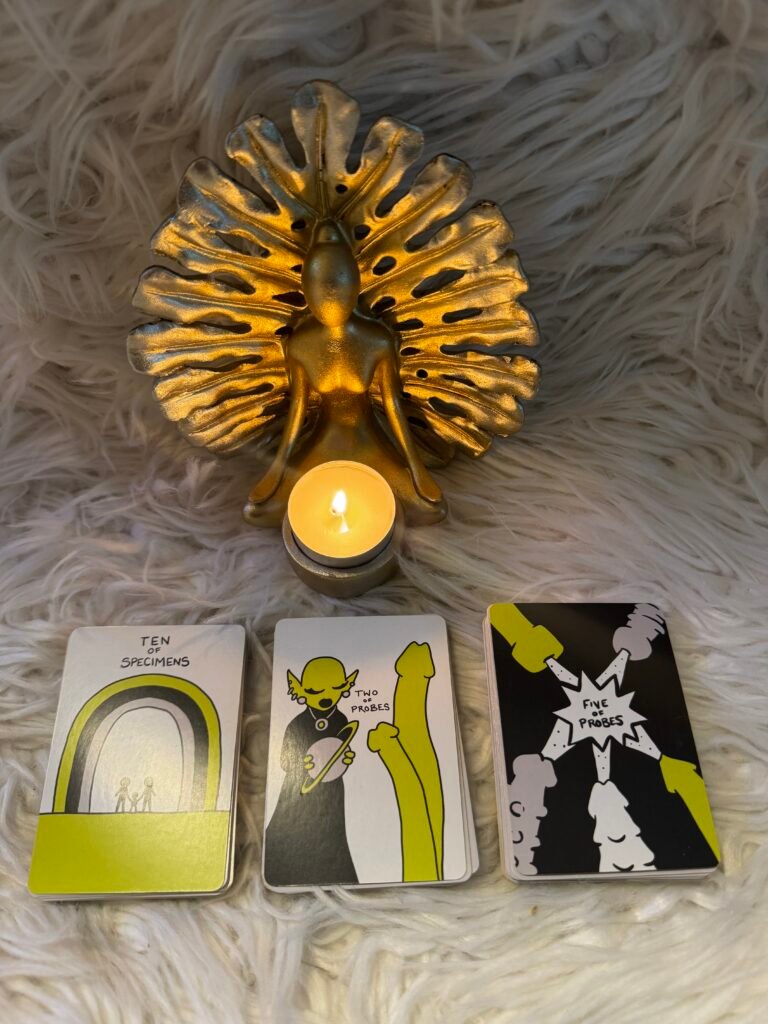
Take a moment to look at the piles in front of you and notice which one quietly catches your attention (from left to right: 1, 2, 3) You don’t have to search for the right answer. More often than not, the pile finds you first.
When you’re ready, click on the spoiler below to receive your message.
Pile 1
Pile 1 – Ten of Cups
When I look at this card, I think about how easily you forgive other people’s imperfections.
If somebody you love is tired, overwhelmed, or struggling to hold everything together, you probably don’t question whether they’re worthy of love. You don’t expect them to be cheerful every minute of every day. You don’t assume one difficult season defines their entire character. You simply see a human being having a hard time. Yet when the same thing happens to you, the standards quietly change. Somewhere inside you lives the idea that you should always have more to give. More patience. More energy. More understanding. More emotional availability. When you fall short of that ideal, you’re much harsher with yourself than you would ever be with somebody you care about.
The Ten of Cups asks a surprisingly gentle question: Why? Why is everybody else allowed to be imperfect while earning your love, your understanding, your compassion… but you have to earn those things first? Because I don’t think that’s a rule you consciously chose. I think it’s simply a habit you’ve carried for a long time.
This card is deeply connected to belonging, love, family, and emotional safety. Looking at it in the context of your question, I think the small truth hiding here is that you already know how to love people through their imperfect moments. You’ve probably done it many times. You’ve understood somebody who was exhausted. You’ve forgiven somebody who made a mistake. You’ve stayed beside somebody who doubted themselves. You’ve reminded people that one difficult chapter doesn’t erase everything beautiful about them.
If somebody you loved came to you today and said, “I feel like I’m not enough,” I doubt your first response would be to list all the reasons they had failed. You’d probably remind them of everything they’re overlooking. Your kindness would appear almost automatically. The question is why that kindness stops at your own front door. Because the person sitting there deserves to hear the same words.
The Ten of Cups suggests that one of the hardest things for you isn’t loving other people. It’s allowing yourself to become one of the people you treat with that same warmth. And maybe that’s the small truth you’ve been missing. You don’t need to become more worthy of compassion. You already believe in compassion. You simply haven’t realized that you belong inside it too.
Pile 2
Pile 2 – Two of Wands
When I look at this card, I think about all the grace you would extend to somebody who was genuinely trying.
Imagine a friend who has applied for jobs for months without receiving the one they really wanted. Or somebody who has been building a business that grows slowly, studying for a difficult degree, learning a new skill, or trying to rebuild their life after a setback. Would you call them a failure? I don’t think you would.
You’d probably notice something else entirely. You’d notice their persistence. You’d admire the fact that they haven’t stopped believing in the future. You’d remind them that meaningful goals often take longer than expected. Yet when you find yourself standing in exactly that position, your inner voice tells a completely different story.
Somehow, every delay becomes evidence that you should have been further ahead by now. Every unfinished goal feels like proof that you’re falling behind. Every dream that hasn’t fully materialized yet quietly transforms into a reason to question yourself.
The Two of Wands makes me wonder where that standard came from. Because life is full of people who spend years building something before the results finally become visible. Nobody looks at the architect halfway through construction and asks why the building isn’t finished yet. Nobody expects a tree to bear fruit the week after it’s planted. Progress has always had its own rhythm. I think you’ve forgotten that when it comes to your own life.
The truth is that you’re already doing something you would admire in almost anybody else. You’re still trying. You’re still planning. You’re still looking ahead instead of giving up on the future. That deserves far more credit than you’re giving it.
The Two of Wands has always been a card about standing on the edge of possibility. It belongs to people who are building toward something they cannot fully hold in their hands yet. That’s an uncertain place to stand, but it’s also a courageous one.
Maybe the small truth you haven’t seen is this: If somebody you loved had come as far as you already have, you’d probably tell them they were doing remarkably well. Perhaps it’s time to let yourself hear those same words.
Pile 3
Pile 3 – Five of Wands
When I look at this card, I think about disagreements. Not because I believe you enjoy conflict. Quite the opposite. I think you’ve become very good at understanding why other people react the way they do. If somebody is irritable, you wonder whether they’ve had a difficult week. If somebody snaps at you, you imagine they may be carrying problems you know nothing about. If somebody becomes defensive, impatient, or difficult, your first instinct is often to look for the reason behind the behavior.
In other words, you make room for their humanity. What surprises me is how quickly that understanding disappears when the roles are reversed. If you lose your patience, you replay the conversation afterward. If you stand up for yourself, you worry that you’ve been too much. If you disagree with somebody, part of you starts wondering whether you’ve become difficult to be around. It’s almost as though you believe everyone else is allowed to have complicated days, while you have to remain endlessly easygoing in order to deserve your place.
Where did that rule come from?
Conflict is part of every healthy relationship. Every family disagrees sometimes. Every friendship experiences misunderstandings. Every workplace contains different opinions. Two people can care deeply about each other and still see the world differently from time to time. You already understand that when it comes to everybody else. You know that one argument doesn’t define a person’s character. You know that frustration doesn’t automatically make somebody unkind. You know that emotions sometimes get the better of people. The strange thing is that you seem unwilling to offer yourself that same generosity.
The small truth you may not see is that expressing a different opinion, setting a boundary, or admitting that something isn’t okay doesn’t make you “difficult.” It makes you human. In fact, I think some of the people in your life would be surprised to hear how much energy you spend worrying about this. They probably see somebody thoughtful, considerate, and eager to keep the peace. They don’t see the quiet voice that questions every disagreement long after it’s over.
Perhaps that’s the part that deserves your forgiveness. You don’t have to earn the right to take up space by agreeing with everyone all the time. The compassion you naturally extend to other people’s difficult moments belongs to you as well.
If this message resonated with you, remember that Pick-A-Pile readings speak to shared themes. They can reflect what many people are experiencing at the same time, but they can’t look directly into your personal situation.