
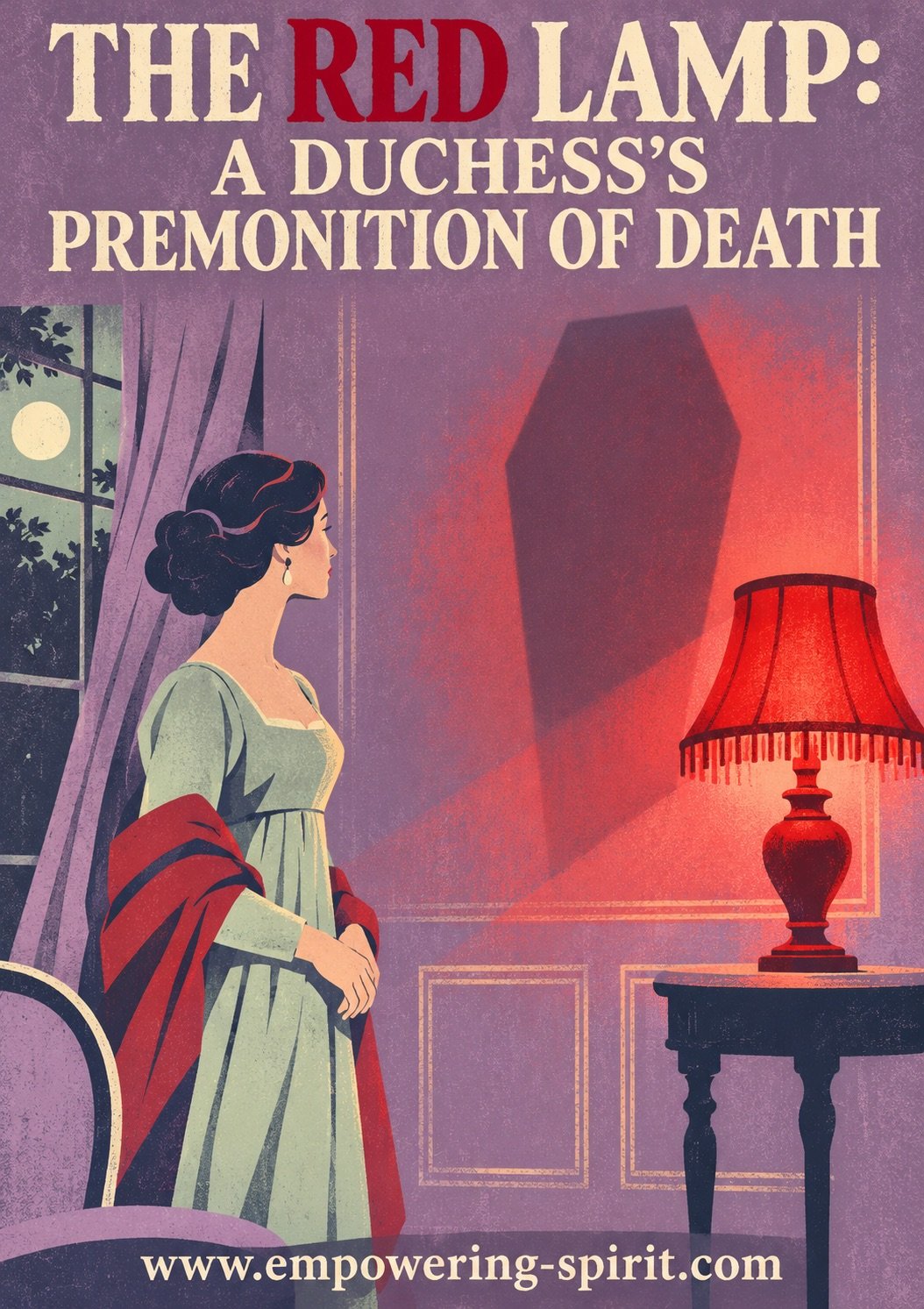
The Red Lamp: A Duchess’s Premonition of Death
Click here to go back to the Hub Page
The Duchess of Hamilton put out her lamp and lay down in the ordinary dark of her bedroom. She was tired after supper with her father and a few letters she had meant to answer, but her mind still moved in small circles. She closed her eyes. She was not asleep, only settling.
Then the dark changed. A scene appeared before her, entire and steady, as if it occupied the space where the ceiling should have been. She saw Lord L., a man she knew by sight, seated or half propped beside a bath. His head had fallen to one side, and his body was caught in the awkward postures of a fit. A man with a red beard stood over him, one hand behind Lord L.’s shoulders, the other reaching for his arm. Above the bath burned a red lamp. The glass was round and dark red, and the light it threw lay over the white rim of the bath and the upper part of the wall. The scene made no sound.
She opened her eyes to make it go. Her room was as it had been: the pale rectangle of the window, the dim shapes of the dressing table and wardrobe, the bed curtains tied back. She lay still for a moment, then closed her eyes again.
The scene returned. Lord L. was beside the bath. The red-bearded man stood over him in the same posture. The red lamp burned above the bath. Everything remained as it had been, fixed and silent. She did not struggle to see it clearly; it was already clear. That was what disturbed her.
She opened her eyes once more and did not close them for a long while.
In the morning she told her father. She described the room exactly as she had seen it: Lord L. beside a bath, a red-bearded man attending him, and a red lamp above them. Her father listened without interrupting. He asked only if she had been asleep. She said no, and that the vision had returned when she closed her eyes a second time. He said she had better keep a note of it. She wrote it down, dated it, and put the paper in her desk.
A fortnight before Lord L. died, Dr. Alfred Cooper called on the Duke of Hamilton in a professional capacity. When the consultation was finished, the two men went into the drawing room, where the duchess was reading near the window. She put down her letter. The talk moved from the duke’s health to the weather and then to the illnesses that always seemed to gather in London during the spring.
“How is the earl?” the duke asked.
“Which earl?” the duchess asked.
“Lord L.,” Cooper said.
The duchess looked up. “I did not know you were attending Lord L.”
Cooper said that he had been for several days.
She was quiet a moment. Then she said, “I saw him last month. Not in person. A vision, before I slept.”
Cooper did not smile. The duke watched her with the same calm attention he had shown that morning. She described it briefly: Lord L. beside a bath, a man with a red beard standing over him, a red lamp above the bath. The vision had repeated when she closed her eyes a second time.
Cooper considered it. “There is little seriously wrong with Lord L.,” he said. “He has been unwell, but I expect him to recover shortly. Red lamps are not common, but they are used in sickrooms. It may have been a chance arrangement of impressions.”
He said it kindly. The duchess accepted his judgment. A red bearded man and a red lamp were unusual details, but not impossible. She was glad to be told the earl was improving. She did not press the matter. All the same, when she thought of the scene, the red lamp stayed clear in her mind.

For the next week Cooper’s judgment seemed correct. Lord L. improved. His fever left him, his appetite returned, and he was soon well enough to sit up and receive a few visitors. Cooper saw him twice and found nothing to alter his opinion.
Then a message came before dawn. Lord L. had woken with pain in his chest and difficulty breathing. By the time Cooper reached the house, inflammation had taken hold in both lungs. He sent for Sir William Jenner. Jenner came, examined the earl, and agreed that the illness had become serious. Two male nurses were engaged. Within two days one of them was taken ill and could not continue. The remaining nurse stayed on.
Several days into the illness, Cooper entered the sickroom in the late afternoon. Lord L. had been helped to a low chair beside the bath, his head propped on a cushion, his mouth open, his hands loose in his lap. The remaining nurse stood over him, one arm behind the earl’s shoulders, the other adjusting the blanket beneath his knees. The nurse had a red beard, full and neatly trimmed. Above the bath hung a red lamp. The glass was round and dark red, and its light lay across the white rim of the bath and the upper part of the tiled wall.
Cooper looked from the earl to the nurse to the lamp. He remembered the duchess in the drawing room, her voice low and certain, saying that she had seen Lord L. beside a bath, a red-bearded man standing over him, and a red lamp above them. The arrangement before him was not approximate. It was the same.
He did not speak of it. He crossed the room, set his bag down, and began his examination. The nurse moved aside to give him room. The lamp remained lit.
Lord L. died within six days. Cooper attended him until the end, but there was nothing new to do. Afterward, his mind returned again and again to the earlier evening in the sickroom. He remembered the duchess saying that she had opened her eyes to dismiss the image, then closed them and seen it again, exactly as before. He looked up at the red lamp above the bath. It was an ordinary red lamp, burning quietly in its red glass.
This story is based on a true account included in Andrew Lang’s The Book of Dreams and Ghosts. You can read the original account in the free Project Gutenberg edition. And if you are interested in fresh and modern content about dreams that came true, you can find them in my book “Dreams That Wake You Up”, a collection of real dreams and real outcomes, directly from my clients, printed with their consent.
For more articles and stories from us, click here to go back to the Hub Page

One thought on “The Red Lamp: A Duchess’s Premonition of Death”