
Queen Mary’s Secret Jewels
Click here to go back to the Hub Page
Major Buckley set the lamp at the corner of the writing table and moved the inkstand clear of the blotter. The fire had burned down to a steady glow behind the grate. Lieutenant Edward Hale stood near the window, turning an old ring in his fingers.
“Is this the patient?” he asked.
“That is the object,” Buckley said. “You are the patient, if you insist on a clinical word.”
Hale smiled. “Must I see its whole history? I would rather not be responsible for Cleopatra.”
The ring held a small engraved medallion of Antony and Cleopatra, worn smooth at the edges, with no maker’s mark. Buckley had bought it years earlier, admired the workmanship, and never learned much about its earlier owners. It was worth perhaps sixty pounds. He held out his hand, and Hale gave it back.
“Are you comfortable?” Buckley asked.
“Reasonably.”
“Then sit, and we will make the experiment.”
Hale sat in a high-backed chair turned away from the direct lamplight. Buckley set the ring on the table beside his notebook. He had kept records of similar experiments and did not let his own expectations run ahead of what a subject said. He asked Hale to loosen his shoulders, unclench his hands, and let his breathing lengthen. His instructions were low and unhurried. Hale’s eyes closed. After several minutes his face lost its mild amusement and became still.
Buckley placed the ring in Hale’s open palm.
“What do you find there?”
Hale’s voice came slowly but clearly. “It is valuable. It has belonged to royalty.”
“Which country or court?”
“Scotland. The court of Mary Stuart.”
“Who owned the object?”
“Mary.”
“Who presented it to her?”
“A foreign musician. He brought other things from Italy or Naples.”
“Can you identify him?”
“Rizzio.”
Buckley wrote the name and paused. David Rizzio was the Italian musician and secretary who had served Mary until his murder at Holyrood. The name was not beyond an educated officer’s reach, but nothing in the quiet experiment had pointed toward it.
“What else do you see?” Buckley asked.
“The setting is not the original. The stone has been moved. She wore it only once.”
“Wore what? The ring?”
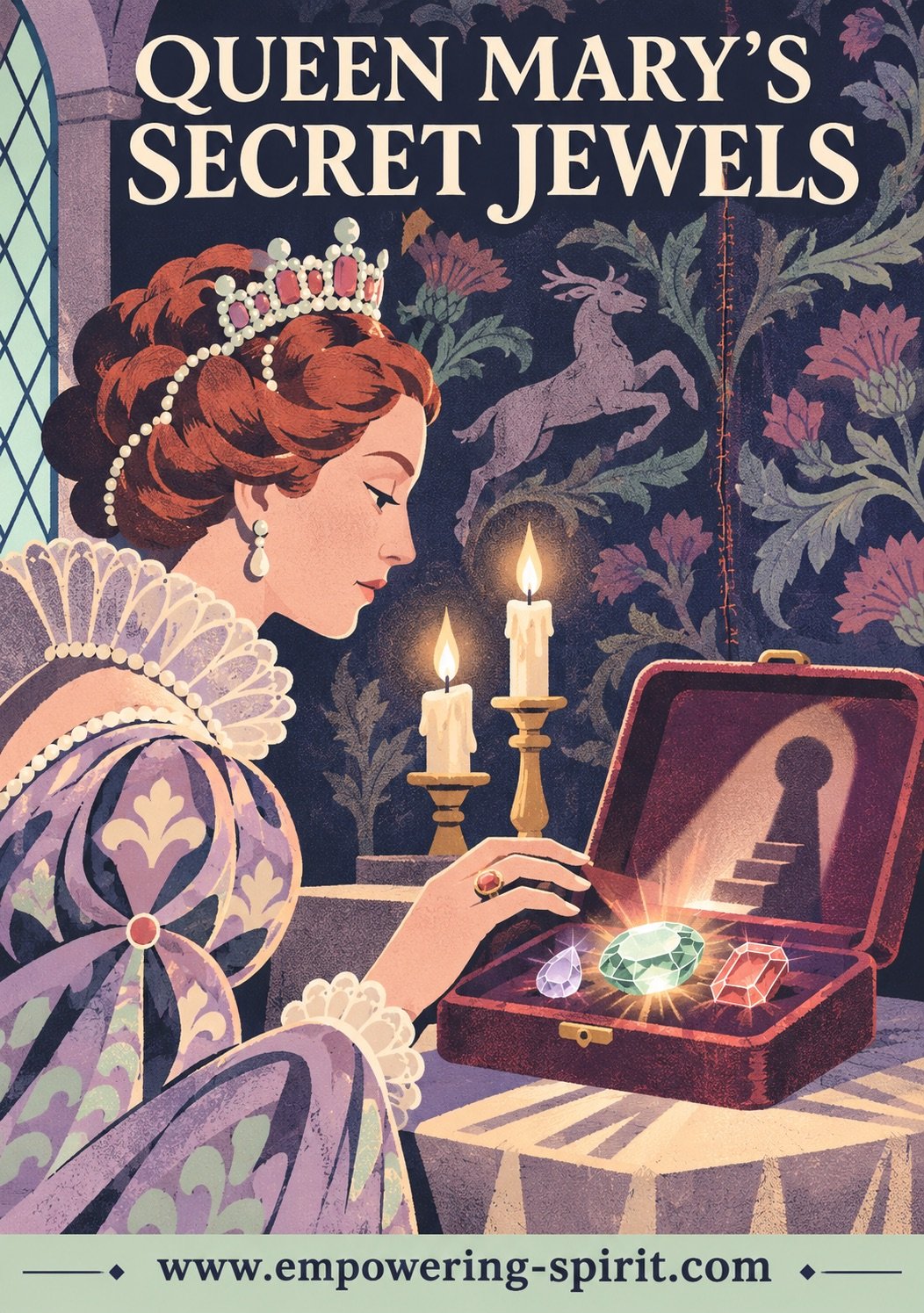
“Part of it. A larger jewel.” Hale’s hands moved as if smoothing a sheet of paper. “I see vellum. It is decorated with gilded thistles. In the centre there is a cross of diamonds. They are of different sizes. Even the smallest stones are large.”
“Who wore the cross?”
“Mary. Hidden beneath her clothing. It was connected with Rizzio and with a private matter that could not safely be written openly.”
“Can you see any writing?”
“Only part.” Hale reached toward the table and took up the pencil. He drew without opening his eyes. His hand shaped a piece of vellum, its border of thistles, and a jewelled cross at the centre. Below the drawing he wrote:
AMDE LA PART
The pencil stopped. Hale’s breathing quickened.
“What follows?” Buckley asked.
“I cannot read it.”
“Look further back. What else is shown to you?”
Hale frowned. “She is being carried in a curtained litter. A man is angry. Jealous. He pulls a ring from her hand and throws it into water.” His hand closed and opened. “It sinks.”
“Does this concern the cross?”
“I do not know. The water is dark.” Hale’s head turned sharply. “There is shouting.”
Buckley set down the ring. “You need not remain there. We will leave this now.” He counted backwards from five in the same calm voice and told Hale to return to the room. Hale opened his eyes and blinked at the ceiling.
“Did I sleep?” he asked.
“After a fashion.” Buckley turned the paper toward him. “Do you recall drawing this?”
Hale looked at it without recognition. “I recall sitting down. And Cleopatra.” He frowned at the uneven letters. “What does it mean?”
“I cannot say.” Buckley blotted the drawing and placed it inside his notebook.
Three weeks later, in the same room, Buckley repeated the experiment. He did not show Hale the earlier drawing. Hale again described the vellum, the gilded thistles, and the diamond cross. This time he added the number of stones and their arrangement before the image faded. Buckley compared the drawings. They matched in every main particular, though the second contained details absent from the first.
Buckley wrote a dated account of both sessions, fastened it to the drawings, and kept the bundle in his desk. In 1851, Dr. William Gregory published the testimony and the drawings. No known inventory of Mary’s jewels confirmed the private diamond object or its connection with the Rizzio family.
In 1854, researchers in the British Record Office opened a bundle of old legal papers that had been tied and shelved for a long time. The bundle had no label, and the papers had been filed among other Scottish legal records. They laid the folded sheets flat and worked through faded French writing, some of it legible only when the light was brought close. Near the middle of the bundle was an inventory of jewels belonging to Mary, Queen of Scots. It had been prepared in 1566, while she was pregnant with the future James VI and feared she might die in childbirth. She had listed her treasures and set down who should receive them.
The document had not been known or available when Buckley conducted his experiment or when Dr. Gregory printed the account. The researchers copied out the entries. Among Mary’s possessions was a valuable jewelled object that David Rizzio had given to her. Another entry involved David’s brother Joseph Rizzio, who became her secretary after David’s death. Mary directed Joseph to carry a jewel to a person whose identity she had told him privately but would not put in writing.
The inventory’s wording was short: “To Joseph Rizzio, to carry and deliver secretly, according to that which I have made known to him alone.”
The object was a ring or jewel set with twenty-five diamonds, both large and small. That entry echoed the central elements of Hale’s trance: a diamond jewel with stones of different sizes, connected with the Rizzio family, meant for a secret recipient whose name could not safely appear on paper.
For a few years the inventory remained known only to a small circle of antiquaries. In 1863 it was published. Copies of the page were printed beside engravings of the original. A reader could now set Hale’s drawing and Buckley’s dated notes next to the published inventory. On one document was the cross of large and small diamonds that Hale had described in 1845. On the other was Mary’s secret jewel of twenty-five diamonds, large and small, to be delivered by Joseph Rizzio to a person she would not name.
This story is based on a true account included in Andrew Lang’s The Book of Dreams and Ghosts. You can read the original account in the free Project Gutenberg edition. And if you are interested in fresh and modern content about dreams that came true, you can find them in my book “Dreams That Wake You Up”, a collection of real dreams and real outcomes, directly from my clients, printed with their consent.
For more articles and stories from us, click here to go back to the Hub Page
One thought on “Queen Mary’s Secret Jewels”