
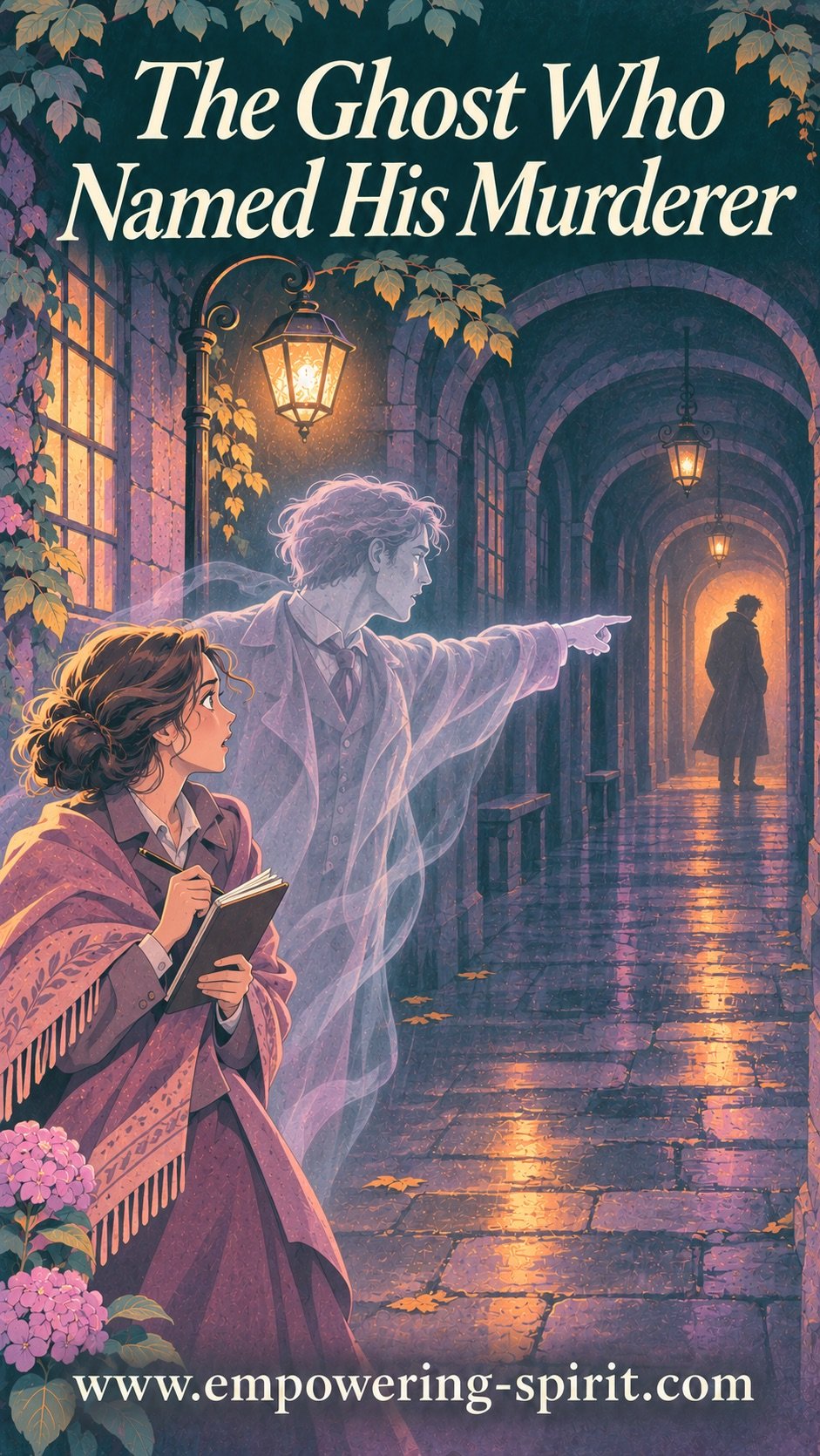
The Ghost Who Named His Murderer
Click here to go back to the Hub Page
By evening on the twenty-fourth of October 1828, Mary Edden had stopped telling herself it was nothing. Her husband William, a market gardener, had gone to Aylesbury that morning with a cartload of roots and cabbages. The road between Aylesbury and Thame was his road, and he was rarely late without sending word. At first Mary had been merely cross. She thought he had stopped for a cup and let the dark come on. She set a plate near the fire and moved it twice to keep it warm.
The mahogany table stood in the middle of the room. Mary had laid it for him hours before: a cloth, a knife, a wedge of bread. Now she sat beside it with one hand resting on the edge. The lamp burned steadily. Outside, the lane had gone quiet.
Something rushed past her. It was not a wind, for the door stayed shut and the lamp flame did not sway. It passed over her shoulders and the backs of her hands, quick and difficult to name. Mary looked up.
William stood beside the mahogany table. He looked himself, not a corpse. He wore his brown coat with the patched elbow, and his face was drawn with effort. His hands were raised before his chest, the fingers curled loosely, as if he wanted to protect his ribs or hold something broken inside him. Beside him stood Tyler, a man Mary knew from the town. Tyler held a hammer, or an object heavy and shaped like one, down against his leg.
Mary did not hear William speak the way a man speaks across a room. The words came to her all at once, near the table: William, Tyler, ribs. She understood what he meant.
She became certain of three things. William had been murdered. Tyler was involved. William’s ribs were broken.
Then the room was empty again. There was no fading, no second look. Only the lamp, the cloth, the knife, and the plate still waiting by the fire.
Mary pushed back the chair and ran outside without a shawl. In the lane she cried, “O dear God! My husband is murdered, and his ribs are broken.”
A woman from the next cottage opened her shutter and called Mary’s name. She told her to come in, that she had been dreaming. Mary would not go in. She repeated the words until other voices gathered in the dark. Someone asked if William was home and taken ill. Someone else put a coat over her shoulders. But no one had yet come from the road, and one of the men said plainly that she could not know what she was saying.
The following morning William was found dead on the road between Aylesbury and Thame. The men who carried him home kept their voices low. His chest had been struck repeatedly. The surgeon said the ribs were broken by blows from a hammer or something very like one. The woman from the next cottage remembered what Mary had cried in the lane the night before, and she looked at Mary with a new unease. Mary did not explain.
She did not immediately accuse Tyler. She knew what she had seen, but she also knew that a court would not convict a man because she had seen him standing beside her dead husband in a vision. Still, she wanted Tyler to come and look at William’s body. She wanted to see his face near the corpse and hear what reason he would give for staying away. She sent for him the next day, and then again, and then again. Five or six times in all, the boy from the next cottage carried the same message: Mrs Edden asks that Mr Tyler come and see William. Each time the boy returned alone. Tyler would not come. The refusals settled in Mary like a fact. They were not proof, but they were something.

In August 1829, a man named Sewell accused Tyler of William Edden’s murder. Under questioning, Sewell knew things that had not been made public: the hammer, the stretch of road, the hour. That knowledge made the magistrates look at Sewell as well. On the twenty-second of August, both men were brought before the Aylesbury Petty Sessions, and Mary Edden was called to give evidence.
Tyler sat across the room with his cap rolled in his hands. Mary did not look at him until the clerk asked her about the summonses. She told the court that after William’s death she had sent for Tyler five or six times, asking him to come and view the body. The clerk asked why she had sent for him so often.
“I had particular reasons,” she said, “which I have not disclosed.”
The magistrates asked what the reasons were. Mary looked at Tyler then. “I will tell you my reasons, gentlemen, if you ask me, in the face of Tyler, even if my life should be in danger for it.”
The room went quiet only in patches. Somebody near the back shifted. A clerk’s pen stopped. A woman drew her shawl across her chest. Lord Nugent, seated among the magistrates, asked her to continue.
Mary told them about the night of the twenty-fourth of October. She said that something had rushed past her, that she had looked up and seen William beside the mahogany table. She said Tyler had stood beside him. She said Tyler held a hammer or something resembling one. She said William had raised his hands before his chest, and that in that moment she had known he was murdered and his ribs broken.
Lord Nugent asked what made her think the ribs were broken.
Mary lifted her own hands the way William had held his. She kept her fingers slightly curled before her chest. “Because he stood so. The knowledge came to me then, before the body was found.”
The magistrates did not speak for a short while. One of them set down his papers. Another examined Tyler’s face. A man to the left shook his head, not as if he disbelieved her, but as if he wished the evidence had come from somewhere else. Then Tyler denied everything in a voice too loud for the room. Sewell said the killing had been committed with a hammer. His words did not help him. In September, for lack of enough to hold them, both men were discharged.
Mary left the Sessions House with the words still in her mouth. She had told the truth in public, and Tyler had walked free. The vision had entered the record, but it had convicted no one. She was not defeated. She was certain the matter was not over.
By March 1830 the case had hardened around ordinary evidence. At the Buckingham Lent Assizes, the stories Tyler and Sewell told did not fit one another. Sewell’s knowledge of the hammer could not be explained away, and witnesses placed them on the road near the time William Edden was killed. Mary gave evidence about Tyler’s refusal to come to the body and about the summonses she had sent. The apparition was not put before the jury. The published report of the trial said nothing of what she had seen at the mahogany table.
The jury found Tyler and Sewell guilty. They protested their innocence until the end. On the eighth of March 1830 they were hanged.
After the final trial Mary returned home alone. She went into the room where she had waited on the night William did not come. The mahogany table stood where it had always stood. She crossed to it and stood beside it, where William had appeared. She placed one hand flat on the tabletop.
This story is based on a true account included in Andrew Lang’s The Book of Dreams and Ghosts. You can read the original account in the free Project Gutenberg edition. And if you are interested in fresh and modern content about dreams that came true, you can find them in my book “Dreams That Wake You Up”, a collection of real dreams and real outcomes, directly from my clients, printed with their consent.
For more articles and stories from us, click here to go back to the Hub Page