
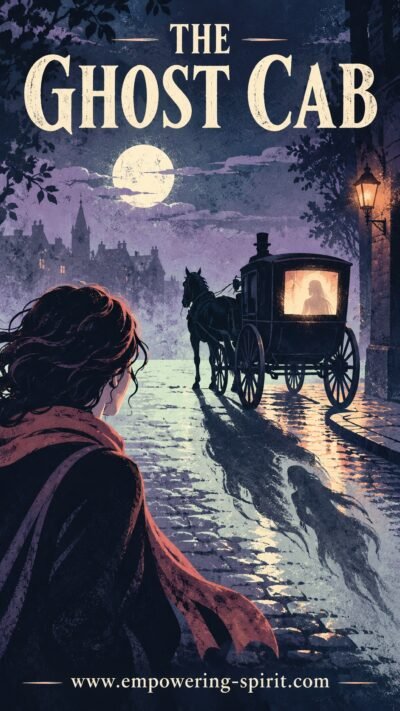
The Ghost Cab
Click here to go back to the Hub Page
Miss Riddell looked at the small watch pinned to her travelling coat for the fourth time in ten minutes and said, “If that man has forgotten the order, I shall have to walk to the station.”
She spoke lightly, but she was pulling the left glove tighter at the wrist, and her eyes kept going to the drive beyond the veranda rail. Mrs. Hamilton sat beside the open doors with her teacup balanced on the wicker arm of her chair. She did not look up.
“Then you will have a very warm walk,” she said, “and you will still miss the 4:15. He will not have forgotten. William always knows the timetable better than I do.”
I was sitting on the top step with my jacket off and my hat on the floor beside me. The afternoon was still and bright, the kind of Dumfriesshire summer day that made waiting not unpleasant. “Worrying will not make the horse travel faster,” I said. “It may, however, make the tea go cold.”
Miss Riddell gave me the look she usually gave when I tried to improve her mood. “I am not worrying. I am practical. There’s a difference.”
“Practical would be sitting quietly and listening for wheels,” I said.
She started to answer, then stopped. Her head turned toward the road. “There. That is him.”
We all listened. A faint sound came from beyond the hedge, something with a light rhythmic beat, but it was too quick and too thin for a horse. It passed, and the road went quiet again.
“That was a bicycle,” Mrs. Hamilton said mildly. “Or a dog trotting with a stick in its mouth. Drink your tea.”

Miss Riddell did not drink her tea. She set the cup down on the rail and stood, walking to the edge of the veranda to look along the side of the house. Her trunk and two cases had been waiting in the front hall since lunch. Crichton, the houseman, had been told to listen for the cab and bring them out the moment it entered the drive. From where we sat at the rear, we would hear any arrival as it passed around the side of the house toward the front door.
“If I had started at three, I could have done it comfortably,” she said, coming back. “Now I shall have to scramble, and I shall arrive flushed and cross.”
“You would have hated the walk,” I said. “You told me so at breakfast.”
“I told you I would have managed it.”
Mrs. Hamilton set down her cup with a small click. “You may still have to manage it. But not before the cab has failed to come. Sit down, Margaret. You are making the birds uneasy.”
That made her laugh, a little. She sat, but her foot tapped against the leg of the chair. The conversation moved on to a picnic planned for the following week, and for a minute or two she seemed to forget the train. Then another noise came from the road, lower this time and more deliberate. We all paused, listening. It was only a farm wagon, heavy and slow, taking the bend beyond the hedge. The sound faded.
“That was almost right,” Miss Riddell said.
“Almost,” I said, “but it did not turn in. You will know when it turns in.”
She looked at me for a moment, half smiling. “Will I?”
“Everyone will,” Mrs. Hamilton said. “Crichton will be at the door with your luggage before we have stood up.”
I leaned back on my hands and watched the road. The afternoon stayed bright and calm, and for a while there was no sound at all but the bees working the lavender along the veranda.
Then, in the middle of a sentence about the connection at Carlisle, Miss Riddell stopped. I heard it too. Somewhere beyond the hedge, on the road, a horse was coming. This was not a cart or a bicycle. The hoofbeats were even and distinct, and they came closer rather than passing. Then there was a slight change, a rolling sound as the wheels left the road and came through the gate. The turn was clean. A faint rattle of harness followed as the vehicle straightened up the drive.
The sound came toward the house, not toward the rear but along the far side, where the drive curved out of sight behind the yews. It grew louder. The iron edge of the wheels ground over the gravel with the particular creak of a hired cab, and the hoofbeats slowed. The whole carriage rounded the corner at a walk. For a moment the sounds were partly muffled by the side of the house, and then we heard them reach the front. There was a last grind of wheels, a small jingle and settle of harness, and then stillness.
“There,” Mrs. Hamilton said, rising. “Now you may gather your things.”

Ready for an adventure?
If you enjoy Tarot, symbolism, mystery, and strange encounters beyond ordinary reality, you might enjoy my novel series The Tarot Dimes. Step into a story of intuition, spirits, secrets, and unexpected turns. → Read more
Miss Riddell was already on her feet, smiling and pulling her hat straight. “I shall never doubt you again.”
I picked up my jacket and followed them along the path that led around the side of the house. The gravel at the front came into view before the front steps did, and the first thing I noticed was that the bed of the drive was empty. I thought we had misjudged the position. We came around the corner a step later, and the whole sweep of the front drive lay open to the road. There was no cab. There was no horse. The road beyond the gate was empty too, and the only sound was our feet stopping on the gravel.
Crichton was already at the front door. He had both straps of Miss Riddell’s trunk in his hands and one smaller case under his arm. He must have heard the horse from inside the hall, lifted the luggage, and opened the door as we arrived. He stopped just outside the doorway and looked from us to the empty drive. Then he set the trunk down carefully, as if it might make more sense from a lower position.
For several seconds none of us spoke. Mrs. Hamilton stepped past me and looked toward the gate. Miss Riddell took a few steps forward and shaded her eyes, though there was no sun in them. The drive was completely empty. The hedge stood still. The gate stood open, as it had all afternoon.
“You heard it,” Miss Riddell said finally. It was not a question.
“I heard a horse,” I said. “A horse and wheels. It came up the drive and stopped here.”
“As did I,” Mrs. Hamilton said quietly.
We turned to Crichton. He was still looking toward the road. “I heard it draw up at the front,” he said. “I had the trunk in my hands before any of you came round the corner.”
His tone was plain, as if he were speaking of a delivery. He looked at the empty gravel once, then back at the house.
“There’s no mark,” he said. “But I heard it clear as day.”
We stood there with the luggage at our feet. I remember that I looked at the ground myself, not for signs but because the eyes need somewhere to settle when nothing matches the ear. The wheel ruts from the day’s carriages were ordinary and dry. Nothing had changed.
“Perhaps something passed on the road and the sound carried,” I said, but I did not believe it. The turn into the drive had been too distinct.
Mrs. Hamilton folded her arms, in the manner of a woman checking an account. “Let us all say what we heard, plainly. No one adds anything.”
We did. Our accounts agreed on the order of sounds. Crichton’s was shorter than ours, but it contained the same close approach and the same final settling at the door. He had heard it from the hall, through the timbers and the glass, not from the veranda. He had heard it independently.
Miss Riddell sat down on the trunk, which was unlike her. “Then we have all imagined the same cab,” she said.
“That is one possibility,” I said.
“It is not a good one,” she said.
Crichton picked up the smaller case again. “I did not imagine the front door rattling on its hinges.”
Nobody argued. He said it the way he might have reported that the kitchen dog had barked. The fact hung there, plain and unmanageable, while the afternoon went on around us. We remained outside for several minutes, looking toward the road, but the road stayed silent. At last Mrs. Hamilton told Crichton to bring the cases inside and stand by the door until the cab came. He did so, and we all moved back into the front hall.
Inside the front hall, the luggage sat against the wall. Crichton closed the door but stayed near it, as if he had decided not to trust another sound from the drive until he could see it with his eyes. Mrs. Hamilton led us into the hall’s shadow, and we all stood rather than sat. Miss Riddell checked her watch again, but this time she only frowned at the face and let her hand fall.
“Another carriage may have turned on the road,” I said, more to break the silence than to settle it. “Sound travels strangely in warm weather. We expected a cab, and every sound was fitted to that expectation.”
“I know what I heard,” Miss Riddell said, not sharply. She was looking at the front door. “I know what I listened for. The turn came off the road. You can’t confuse that with a wagon passing.”
“You would be surprised what the ear will supply,” I said, but I said it without much force.
Mrs. Hamilton touched the brim of her hat, though she had not yet taken it off. “We may never know. Crichton, open the door again in a few minutes and look. I do not intend to be found standing in my own hall listening for a horse that may have gone to another house.”
Crichton nodded. “Very good, ma’am.”
The house settled into its usual small noises. Somewhere a window sash tapped in the light breeze. Then, from beyond the hedge, there came the sound of a horse on the road.
All four of us turned toward the door. The hoofbeats came closer, even and steady. They did not pass. There was a small rolling pause as the wheels left the road and came through the gate, and then the soft grind of gravel as the vehicle straightened up the drive. It followed the curve behind the yews, grew louder, and slowed around the side of the house. The harness jingled and settled as the cab drew up at the front door.
Nobody moved.
Miss Riddell looked at me. I looked at Crichton. He raised his eyebrows a fraction, and his hand stayed at his side.
“Well,” Mrs. Hamilton said quietly, “one of us had better open the door.”
Crichton undid the latch and pulled it wide. This time the drive was not empty. A tired bay horse stood at the step, its breath stirring the dust on its chest. The cabman was already leaning down from his box, and the vehicle looked very solid and rather dusty. He touched his cap.
“I’m later than I meant,” he said. “If the lady is for the 4:15, she’ll make it but only just.”
Miss Riddell did not wait for her trunks to be carried. She went straight down the steps and said, “I am. Thank you. Please keep the horse as quick as you can without laming him.”
The cabman nodded. “I know the run.”
Crichton brought the luggage out, and I helped lift the trunk onto the tray. The farewells lost all form. Miss Riddell kissed Mrs. Hamilton on the cheek, took my hand for only a moment, and climbed into the cab. Her coat caught once on the step, and she pulled it free with a small impatient sound. The cabman gathered the reins. The horse raised its head and leaned into the harness.
“Write before Tuesday,” Mrs. Hamilton called.
Miss Riddell lifted her hand from the window. The cab began to move, the wheels crunching over the gravel in the same careful pattern as before. We watched it make the curve around the side of the house and then straighten back down the drive toward the gate. At the road the cabman turned right, and the horse moved from a walk into a faster trot. The sound of the wheels grew thinner. Mrs. Hamilton and I stood at the front step, while Crichton remained beside the open door. We listened until the wheels were no louder than the insects in the hedge and then were gone beneath the ordinary afternoon. Mrs. Hamilton turned back into the house first. Crichton stood a moment longer, then stepped inside and closed the door with the same plain care with which he had opened it.
This story is based on a true account included in Andrew Lang’s The Book of Dreams and Ghosts. You can read the original account in the free Project Gutenberg edition. And if you are interested in fresh and modern content about dreams that came true, you can find them in my book “Dreams That Wake You Up”, a collection of real dreams and real outcomes, directly from my clients, printed with their consent.
For more articles and stories from us, click here to go back to the Hub Page
3 thoughts on “The Ghost Cab”