
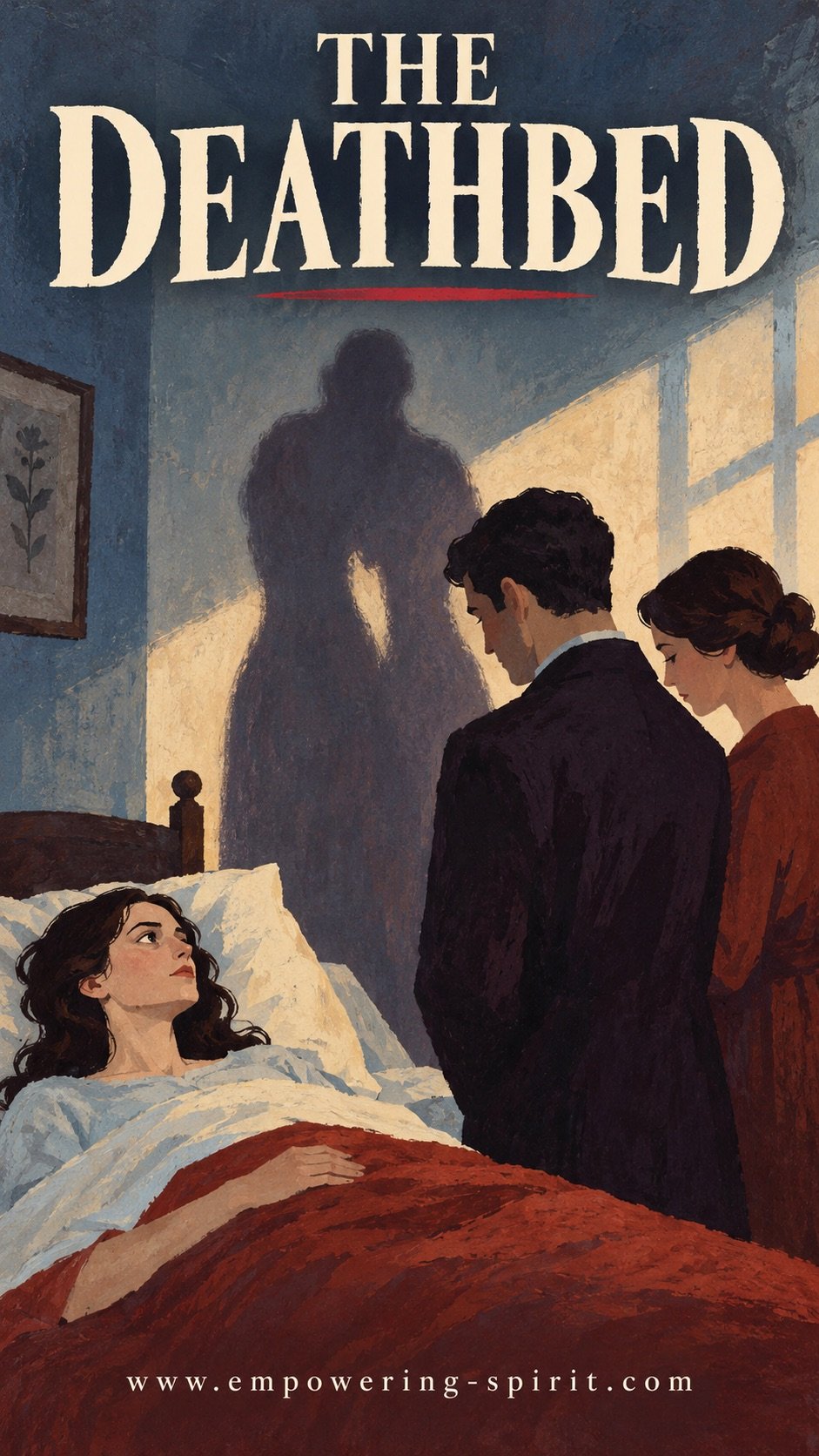
The Deathbed
Click here to go back to the Hub Page
Charlotte had been living in her uncle’s house in Paris since October, when the doctors in the country had said that her mother must no longer be left to manage the stairs or the garden alone. The house was calm, but letters came every few days. The latest had said that there was no immediate change, which was meant to comfort her and did not.
One night, after a long evening spent rereading an old letter of her mother’s, she dreamed she was in a room she knew.
It was her mother’s bedroom. The afternoon light lay flat across the bed. Her mother was propped against the pillows, pale, but not altered beyond recognition. Two women stood at the foot of the bed. A man in a dark coat waited near the window with a book in his hand. Her mother’s eyes moved slowly, as though she were looking for someone who was not there.
One of the women said, “She asked again for her son, as though she forgot he’s living in spain.”
“And for Mademoiselle Charlotte,” the man said.
Then someone near the door called, “Charlotte!”
The door to the adjoining room opened, and a woman led in a little girl of perhaps seven. The child was Charlotte’s niece, her godchild, and she bore the same name. She crossed the room hesitantly, her hand held out in front of her.
The sick woman watched the child come. Her face did not soften. She raised one hand a few inches from the coverlet and let it fall, not in welcome, but as if to say, no, not this one. The little girl stopped. The woman beside her turned the child back toward the adjoining room.
Her mother’s gaze remained on the empty air near the door. Her lips parted, and she seemed to be trying to say the name again. Then her chin lowered. Her hand went still. The man at the window stepped forward. The two women lowered their heads.
The dream ended there.
Charlotte woke with her face pressed into the pillow. The room was dark and ordinary. She told herself that it had been a dream, and she was surprised by how little the words settled her. The shapes of the room remained where they ought to be, and still the dream stayed with her, exact and unyielding, like something she had been made to witness. She did not sleep again. She lay still until the first grey light came through the curtains, and then she dressed.

At breakfast, Charlotte sat with a piece of bread broken on her plate. Her uncle had a letter open beside his cup, and he had read it twice before she came down. He looked at her over the rim of the cup.
“You have not slept,” he said. “Or you have slept badly.”
“Badly,” Charlotte said.
He set the cup down. “Tell me.”
She gave him the dream as she remembered it. She told him about the pale face against the pillows, the two absent children, the son in Spain, and the call for Charlotte. She told him that her little niece had been brought from the adjoining room, and that her mother had moved her hand to show that it was not the right Charlotte.
“Then she fell back,” Charlotte said. “It was only a dream.”
Her uncle had not interrupted. When she finished, he folded the letter and put it into his coat pocket. Then he came around the table and put his arms around her. She felt the stiff wool of his coat against her cheek.
“Charlotte,” he said. “A letter came this morning. Your mother died last night.”
She did not cry out. She rested her forehead against his shoulder while the words settled. After a moment she said, “I knew she could not wait for me.”
He kept his arms around her and did not answer. He did not tell her anything else. Later, she assumed he had spared her the details because that was his way.
Three months later, Charlotte was alone in her uncle’s house. He had been called to a patient in the faubourg, and she had gone into his study to close a window because the morning wind had come up. She could hear papers moving before she opened the door.
A stack on his desk had shifted. Several sheets had slipped to the floor. She knew he disliked anyone touching his papers, but the damage had already been done by the wind. She knelt to gather them.
The pages were not all the same. Some were bills, and some were notes in her uncle’s hand. Near the bottom, a letter written on thin grey paper had fallen half under the desk. She pulled it out and looked at the top corner. There was a country postmark. The date was the morning of the day she had told her uncle her dream.
She sat back on her heels and began to read.
The letter was from a woman who had attended her mother in her last hours. It was written plainly, as an account for the family. But as Charlotte read, she stopped seeing the paper.
The woman wrote that her mother had been restless in the afternoon, and that she had asked for her son again, and then for Charlotte. Then came the sentence Charlotte knew: someone called Charlotte, and the little girl was brought from the next room. Madame made a sign. It was not the child she wanted. It was her daughter in Paris.
Charlotte’s hand remained steady. She read the next line twice. Her mother had turned her face away, made that small useless movement of her hand, and had died before the child was led from the room.
Her uncle had already read these words when she told him the dream. He had let her finish, had held her, had told her only that her mother was dead, and then had folded the letter into his papers.
She sat on the floor of the study for some time. Twice she read the passage about the little girl being brought from the adjoining room. Then she put the pages back into order. She did not cry. She did not call for the servant. She turned the letter over in her hands.
She stayed where she was, holding the letter, until the church bell at the end of the street struck the hour.
This story is based on “The Deathbed,” a true account recorded by the French physician Alexandre Brierre de Boismont and later included in Andrew Lang’s The Book of Dreams and Ghosts. You can read the original account in the free Project Gutenberg edition. And if you are interested in fresh and modern content about dreams that came true, you can find them in my book “Dreams That Wake You Up”, a collection of real dreams and real outcomes, directly from my clients, printed with their consent.
For more articles and stories from us, click here to go back to the Hub Page


One thought on “The Deathbed”