Click here to go back to the Tarot Course Hub
Introduction
When you’re learning tarot, the Queen of Swords can be one of the most uncomfortable court cards to work with, especially if you are used to softening every card until it becomes harmless.
In this course, we take a sharper view of her.
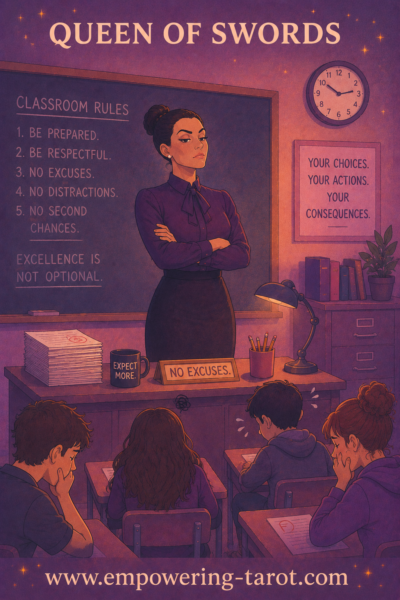
The Queen of Swords can be intelligent, perceptive and verbally skilled, but when her energy turns cold, she becomes icy, judgmental, cutting and unfair. She may use cleverness as a weapon. She may treat other people’s feelings as weakness. She may believe she is “just being honest” while leaving others bleeding from words that were designed to sting.
This Queen can show a person who criticizes without compassion, who hides behind logic, who assumes she sees everything clearly while dismissing anything that does not fit her view. She can also describe the querent’s own behavior: a moment where pain, bitterness or defensiveness has made them colder than they realize.
That is what we’ll practice here.
For this exercise section, we’ll work with situations where words hurt, judgment becomes unfair, and someone has to decide whether to protect themselves from another person’s cruelty or examine the ways they have become cruel themselves.
Here’s how it works: you’ll receive a mock email from a fictional querent, written like the kind of message a professional reader might receive. Your job is to step into the role of the tarot reader and answer as if this were a real client.
You can always pull your own cards, use a different spread, or return to the email later for extra practice. For the structure of this course, we’ll first imagine that you draw the Queen of Swords on her own. Then we’ll revisit the same question with the Queen of Swords plus two additional cards.
After each exercise, you’ll find my sample answer hidden in a spoiler. These examples are here to show how one professional might speak about a difficult, hurtful card with honesty and care.
Let’s begin.
Exercise 1
Fictional client email
Subject: My boss keeps humiliating me in meetings
Hi,
my name is Hannah. I work as a marketing coordinator at a mid-sized company in Chicago. My manager, Karen, is very smart and everyone knows she is good at her job. The problem is that she can be incredibly cold.
She corrects people in meetings in a way that feels humiliating. If someone makes a mistake, she will point it out in front of the whole team and say things like, “I assumed this was obvious,” or “Did you actually read the brief?” She has done this to me several times now.
Last week, I presented a campaign idea, and before I even finished, she interrupted me and said, “This sounds like something an intern would pitch.” Everyone went quiet. I laughed awkwardly, but I went home and cried in my car.
I keep telling myself maybe I’m too sensitive. She does get results, and upper management seems to respect her. But I dread meetings now, and I feel myself becoming smaller at work.
Can the cards show me what I’m dealing with and how I should handle her?
Thank you,
Hannah
🎯 Your Exercise
For this reading, imagine you draw the Queen of Swords.
Write your own answer first. In this course, the Queen of Swords can point to a person who is clever, sharp and articulate, yet emotionally cold and unnecessarily hurtful. Your task is to help Hannah see the dynamic clearly without making her feel weak for being affected by it.
When you’re ready, open the spoiler below.
Hi Hannah,
Thank you for trusting me with this. What you describe sounds painful, and I want to say very clearly that being hurt by public humiliation does not make you too sensitive. Most people would feel shaken if their work was dismissed in front of a room like that.
The card that comes forward is the Queen of Swords, and in this reading, she describes Karen’s energy very strongly.
This Queen can be intelligent, competent and quick with words, but she can also become cold, critical and unfair. She may believe that because she is smart, her delivery does not matter. She may confuse sharpness with excellence and treat other people’s feelings as if they are irrelevant. That is the difficult side of this card: a person who speaks from the head while leaving the heart outside the room.
In your situation, the Queen of Swords suggests that Karen’s criticism has more sting than it needs to have. She may be accurate sometimes about work details, but the way she delivers feedback is damaging. There is a difference between correcting a campaign idea and humiliating the person who presented it.
The advice here is to protect your confidence and become more strategic. If she interrupts you publicly, you can answer in a calm, professional way that brings the conversation back to the work. For example: “I hear that this direction is not landing for you. Could you clarify which part of the strategy you want revised?” That kind of response gives her less room to make it personal.
You may also want to document specific incidents, especially if this pattern continues. Dates, comments, witnesses and context matter. If you eventually speak to HR or another manager, concrete examples will be stronger than saying she makes you feel bad, even though your feelings are completely valid.
The Queen of Swords asks you to stay clear, steady and precise. Do not absorb her coldness as truth about your worth. Her words may be sharp, but they are still her words. They do not get to define your talent, your future or your right to take up space at work.
Exercise 1.2
Now imagine you draw three cards for Hannah:
Queen of Swords, Five of Swords, Strength
Take a moment to feel how these cards work together. We have cold criticism, verbal harm and the need for inner control. How would you help Hannah protect herself without entering the same sharp, cruel energy?
Hi Hannah,
For your question, I drew the Queen of Swords, the Five of Swords and Strength. Together, these cards describe a difficult workplace dynamic, but they also give you a way to handle it without losing yourself.
The Queen of Swords shows Karen’s style: intelligent, precise and verbally powerful, but also cold and harsh. She may value efficiency and correctness so much that she ignores the human being receiving the feedback. In this spread, her words feel less like guidance and more like a blade.
The Five of Swords adds the damage. This card often appears when communication becomes about winning, embarrassing or dominating rather than solving the actual problem. It suggests that the meeting environment may have become psychologically unsafe, because people are watching someone be cut down and learning to stay quiet so they are spared.
Then Strength appears as your medicine. Strength does not ask you to become louder, crueler or more defensive than she is. It asks you to hold your ground without letting her behavior turn you into a mirror of it. This card gives you composure, dignity and emotional control. It says you can be firm without being vicious.
Together, these cards suggest that Karen’s behavior has a real edge, and your reaction is understandable. You are dealing with a pattern of sharp criticism that can chip away at confidence over time. The answer is to respond with controlled strength rather than raw hurt.
That could mean preparing a few calm sentences before meetings so you are less likely to freeze if she cuts in. It could mean redirecting her criticism toward concrete feedback: “Which part needs revision?” or “What would you like the final result to achieve instead?” It could also mean keeping records and looking for support if the pattern continues.
The deeper message is this: her harshness belongs to her. Your strength belongs to you. You do not need to become icy to survive an icy person. You need to become grounded enough that her words cannot keep pushing you out of your own center.
Exercise 2
When the Queen of Swords describes the querent
The Queen of Swords can show someone outside the querent: a boss, mother, teacher, coworker, ex-partner, friend or critic who uses words like weapons.
But sometimes she shows the querent.
That can be delicate. A client may write in feeling wronged, exhausted or convinced that everyone else is the problem. The cards may show that their hurt is real, yet their way of speaking has become harsh, unfair or emotionally punishing. In those readings, your job is to be honest without shaming them. You help them see where their words have started creating distance from the very people they love.
That’s what we’ll explore now.
Fictional client email
Subject: My daughter says I’m too critical
Hi,
my name is Linda. My daughter Emma is 24 and recently moved back home after a breakup. I love her, and I’m trying to help her get her life together, but lately we keep fighting.
She says I criticize everything she does. I don’t see it that way. I tell her the truth because someone has to. If she sleeps too late, I say something. If she spends money on coffee when she should be saving, I say something. If she talks about going back to school for art instead of choosing a stable career, I say something.
Last night she told me, “You don’t actually help me. You just make me feel small.” That hurt me deeply. I feel like she doesn’t appreciate anything I do.
Can the cards show me what is really going on between us and how I can get through to her?
Thank you,
Linda
🎯 Your Exercise
For this reading, imagine you draw the Queen of Swords.
This time, the Queen may describe Linda’s own communication style. Write your answer in a way that honors her concern for her daughter while gently showing how constant criticism may be harming the relationship.
When you’re ready, open the spoiler below.
Hi Linda,
Thank you for sharing this so openly. I can feel that you love Emma and that you want her to build a stable, secure life. Your concern is real. At the same time, the card that appears here, the Queen of Swords, asks us to look very honestly at how that concern is being expressed.
In this reading, the Queen of Swords points to sharp communication. It suggests that your words may be coming from a place of worry, but landing as judgment. You may feel that you are telling the truth, while Emma feels that every part of her life is being inspected and corrected.
That difference matters.
The Queen of Swords can become very focused on what is practical, sensible and correct. She sees the flaw quickly. She names the risk quickly. She may even be right about some of the risks. But when her delivery becomes cold, the other person stops hearing guidance and starts hearing rejection.
Emma’s sentence, “You just make me feel small,” is important. I would take it seriously. She may need structure, yes. She may need to think about money, school and her future. But she also needs to feel that home is a place where she can heal, not only a place where every choice becomes another reason she has failed.
The cards are asking you to shift from criticism to connection. Before giving advice, try asking questions. “What kind of support would help you this week?” “Do you want advice, or do you just need me to listen?” “What is your plan, and where do you feel stuck?” These questions keep your wisdom available without making her feel attacked.
The Queen of Swords in her healthier form can speak truth with precision. In her harder form, she cuts. Your task is to keep the truth, but remove the blade.
You may find that Emma becomes more receptive when she feels respected. If she can feel that you believe in her ability to grow, your guidance will have a much better chance of reaching her.
Exercise 2.2
Now imagine you draw three cards for Linda:
Queen of Swords, Ten of Cups, Page of Cups
Take a moment to feel how these cards speak together. We have sharp communication, family love and emotional vulnerability. How would you help Linda understand that her daughter may need tenderness as much as advice?
Hi Linda,
For your question, I drew the Queen of Swords, the Ten of Cups and the Page of Cups. This spread shows that love is present in this family, but the way it is being communicated needs gentleness.
The Queen of Swords describes the sharpness in your approach. You may see yourself as realistic, honest and protective, but Emma may experience your words as cold or unfair. This card suggests that the issue is less about whether you care and more about how your care is coming across.
The Ten of Cups shows the deeper bond underneath the conflict. This is a family card, and it tells me that there is real love here. You want your daughter to be okay. She likely wants to feel safe and accepted by you. The relationship has emotional value to both of you, which is why the fights hurt so much.
Then the Page of Cups shows Emma’s emotional state. This Page is sensitive, raw and easily bruised. After a breakup and a return home, she may already feel ashamed, uncertain or exposed. In that state, repeated criticism can land much harder than you intend. What sounds to you like practical advice may feel to her like confirmation that she is disappointing you.
Together, these cards ask for a softer doorway into the conversation. The Queen of Swords alone might say, “Here is the truth.” The Ten of Cups and Page of Cups say, “Speak it in a way that protects the bond.”
This could mean choosing one important topic rather than commenting on everything. It could mean asking permission before giving advice. It could mean saying, “I’m worried because I love you, but I realize my words have been hurting you. I want to do better.” That kind of sentence can open a door that criticism keeps closing.
The message here is that your relationship can heal, but emotional safety has to come before correction. Emma may still need guidance, but she needs to feel loved before she can receive it. If you can bring warmth back into your words, the truth you want to share will have a much better chance of being heard.
Closing Thoughts
The Queen of Swords is a powerful card, and she must be read with care. She can bring intelligence, clarity and verbal precision, but she can also show coldness, unfair judgment, harsh criticism and words that leave marks.
In Hannah’s reading, the Queen of Swords appeared as a boss whose public criticism had become humiliating. In Linda’s reading, she appeared as the querent’s own communication style, asking her to see how concern can become cruelty when it loses warmth.
That is the real lesson of this card. Truth matters. Clarity matters. But when truth is delivered without compassion, it can become a weapon.
You can return to these fictional emails whenever you like. Pull one card, three cards or a full spread from your own deck and see how your interpretation changes. Each practice round helps you learn how to read difficult communication with precision and humanity.
✨ Support & Continue Your Journey
If you enjoyed working through these Queen of Swords exercises and would like a personal tarot reading with this same level of honesty and care, you can book one at www.empowering-tarot.com. Your own situation deserves guidance that can name the truth without using it to wound.
If this free course has helped you, you can also support my work through the tip jar in the sidebar on desktop or at the bottom of the page on mobile. Every contribution helps keep resources like this available for the tarot community.
Thank you for practising with me today. May the Queen of Swords remind you that words have power, and wisdom knows how to use them.
Click here to go back to the Tarot Course Hub