I Dreamed of a Murder Three Times. Nine Days Later, It Happened.
Click here to go back to the Hub Page
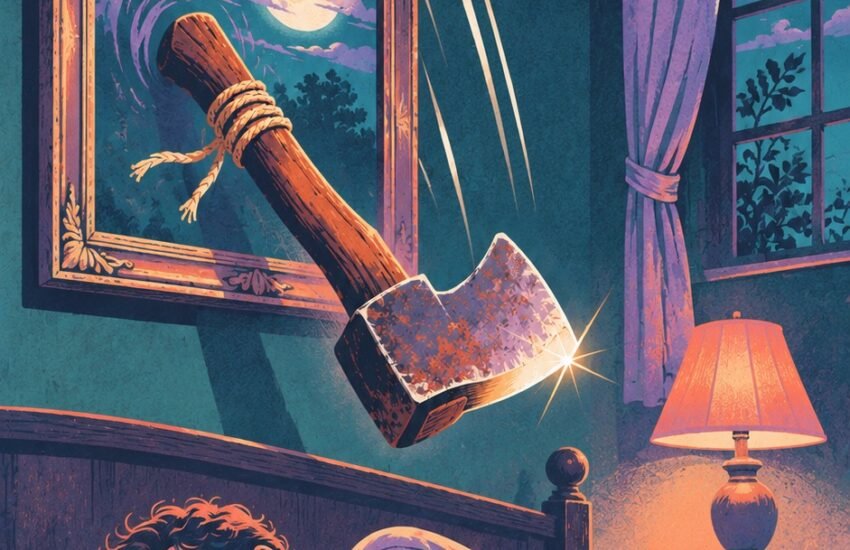
The windows of Scorrier House stood black against the night, and in the bedroom the darkness held the shape of a man sitting upright in bed. His breathing came fast and shallow, each breath audible in the still room, and the sheet lay twisted around his legs where he had kicked it free. Sweat stood on his forehead and along his neck, darkening the collar of his nightshirt, and his hands lay open on the blanket with the fingers curled as though they had only just released something. For a long moment he did not move. His chest rose and fell against the silence, and the sound of his own heartbeat filled his ears.
Outside, the Cornish dark pressed against the glass. No wind moved through the trees beyond the garden; the house itself made no sound beyond the small creaks of cooling timber. The man in the bed drew one long breath, then another, and lifted one hand to wipe the moisture from his brow. His fingers trembled as they crossed his forehead. He had woken this way three times in the same night, and each waking had left him in the same condition—shaking beneath the bedclothes, his nightshirt damp, his pulse beating at his temples—and each time he had closed his eyes only to find the same dream waiting for him on the other side of sleep.
In the kitchen the embers of the previous evening’s fire had guttered to ash, and the air held the faint smell of cold soot and old woodsmoke. He found the tinderbox on its shelf by muscle memory alone, and after a few attempts the spark caught, and the wick of the oil lamp bloomed into a small and steady flame. The light pushed the shadows back to the corners of the room, and for the first time since waking his face was visible: a long face, not young, with deep lines cut at the corners of the mouth and a heaviness around the eyes that owed as much to the hour as to the years. Mr. John Williams, of Scorrier House, stood in his kitchen in his nightshirt and examined his own hands in the lamplight. They were still trembling.
He sat at the kitchen table, drawing the lamp closer, and from a drawer in the sideboard he took paper and a pen. The pen was dry, and he worked the nib against the inkpot with the care of a man long accustomed to writing notes and reports, though at this hour the habit seemed slowed, as if each gesture required thought. The first line of ink blotted when he set the pen down, and he scraped the blot away with a fingernail. Then he began to write, and the only sounds in the house were the scratch of the nib and the occasional hiss of a moth against the lamp glass. The dark stood at the windows and did not enter.

The letter, or the record, or whatever name he gave to the document that took shape under his hand, ran as follows:
„Three times this night I have been shaken from my sleep, and three times I have awakened after dreaming of a murder. The dream did not state it directly, but as I am not an ignorant man, I understood that the victim was Mr. Perceval, Chancellor of the Exchequer.“
He had first woken, he wrote, in the deepest part of the night, with the image still sharp behind his eyes, and he had told his wife what he had seen. She had listened from her pillow, half asleep, and had told him it was only a dream and that he should return to his rest. And he had tried. He had lain back against the mattress and closed his eyes, and the dream had returned to him as though it had been waiting.
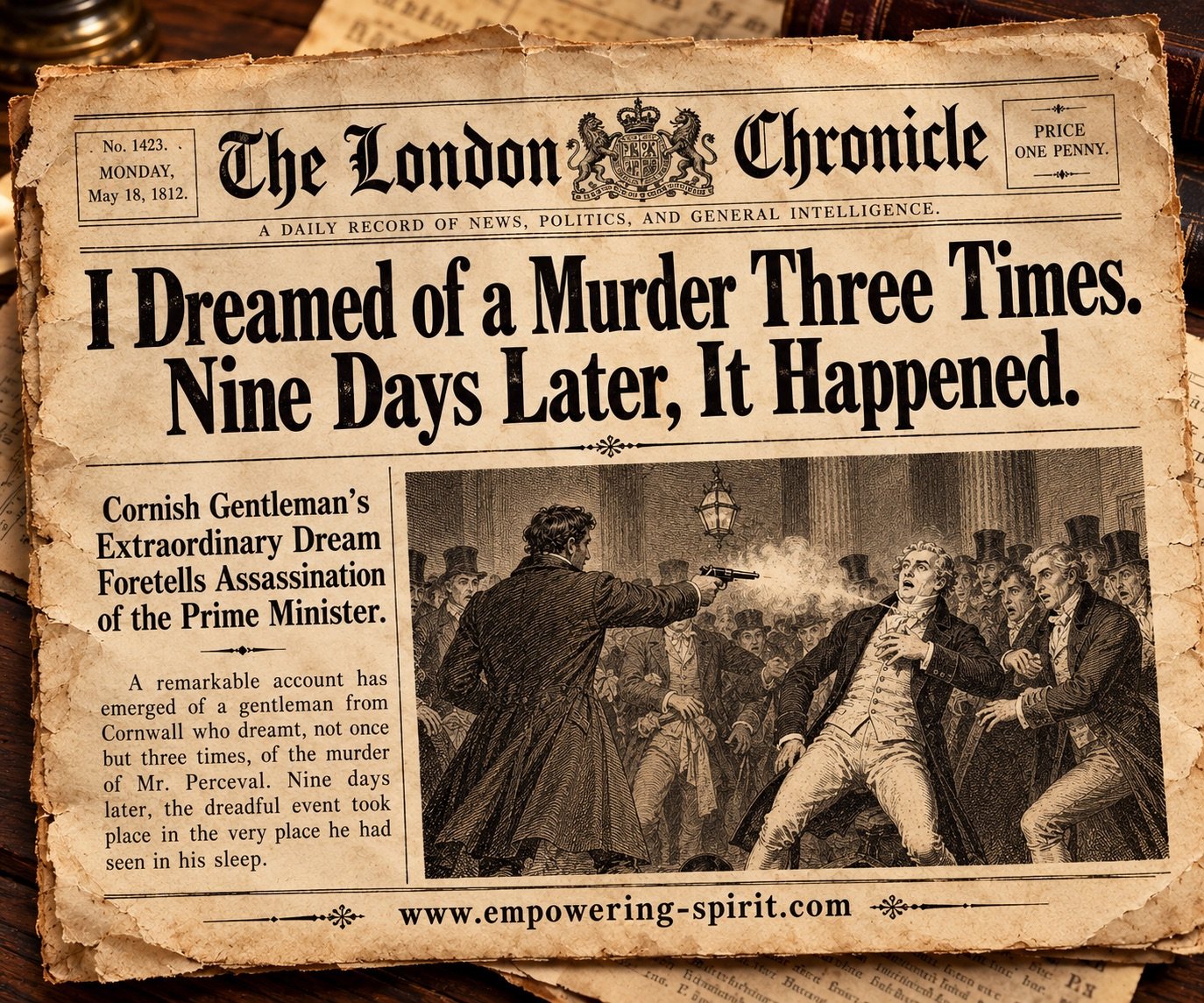
The dream was always the same. He entered the lobby of the House of Commons—the familiar lobby, with its stone floor and its benches along the walls and the doors that led away toward the chamber—and while he stood there, a small gentleman in a blue coat and white waistcoat came in through the far door. The gentleman walked with the air of a man about his ordinary business, unhurried, comfortable in those surroundings. And then another gentleman stepped forward. This second man wore a snuff-coloured coat. The buttons on that coat were of metal and caught the light as he moved. He drew a pistol from beneath his coat and shot the small gentleman beneath the left breast.
In the dream, Williams stood and watched the blood issue from the wound. The man in the blue coat did not cry out. He fell, the stain spread across the white waistcoat, and Williams asked, in the dream, who the fallen gentleman was. Somebody answered him. He learned that the victim was the Chancellor, Mr. Perceval. While he stood there in the dream, the nearby gentlemen seized the killer, who did not resist them. He let the pistol fall from his hand, they took him, and the dream ended. Williams woke in his bed with his heart beating so hard that the room seemed to pulse around him.
Who would believe a man who claims to have witnessed a murder in his dreams?
The written account lay folded on the kitchen table where he had left it. He picked it up, smoothed the creases with his thumb, and slipped it into the inner pocket of his coat. The paper settled there against his chest with a faint crackle. When he moved, the crackle came again with each step, a small sound that followed him through the house and out the door. His wife stood in the passage as he left. She asked him something about the night, about whether he had slept, and he answered her briefly without turning his head. The sound of the door closing behind him was final in the quiet house.
But the pressure did not lift. At midmorning, when the first rush of the day’s business had slackened, he left the office and walked out into the yard. There he stopped two men he knew well. He asked them to step aside with him for a moment. A third man joined them unprompted, drawn by their grave faces, and a fourth came over with a cup of tea in his hand. They stood near the wall of the engine house, out of the worst of the wind, and Williams faced them with his coat flapping around his legs.
He told them the story. Williams did not begin with the dream, but with the facts of the night: that he had woken three times, at intervals he could not mark, and that each waking had left him shaking and drenched. Then he told them the dream. He unfolded the paper from his inner pocket and held it in his hands, because he wished to be precise with his story.

The friends heard him out, and their faces as he spoke moved through several expressions—surprise, then a kind of embarrassed attention, and then the careful blankness of men who do not wish to laugh at their friend. The man with the cup of tea held it half-raised, forgotten in his hand. The wind moved through the yard and lifted the corner of the paper.
When Williams had finished, he said that he was considering the possibility of travelling to London. He said it plainly, without drama. He would see Mr. Perceval, or find someone in a position to carry a warning to the Chancellor, and he would tell him that a man in Cornwall had dreamed of his murder three times in a single night. The journey, he acknowledged, would take him away from his responsibilities for days, perhaps a week or more, but the mine would manage without him, though not as well. The dream had been so particular, so insistent, that the thought of doing nothing had begun to weigh upon him.
There was a silence then, broken by the sounds of the mine behind them. The first of the friends cleared his throat. He was a practical man, older than Williams, with hands like flat stones. He said that Williams should consider what would actually happen if he arrived in London with such a story. He would present himself at the House of Commons, a stranger, a mine superintendent from Cornwall, and announce that the Chancellor of the Exchequer was in danger. He would be asked his evidence, and would say that he had dreamed it.
The second friend spoke before Williams could answer. The officials would laugh at him, he said, and the laughter would follow him home. A man in Williams’s position did not survive such laughter. He had a name in Cornwall, a name built over years of honest work, and that name would become a joke among men who had never seen a mine shaft. They would call him a fanatic, or worse. They might decide he was unbalanced, and that word, once attached, did not detach.
The third friend, the one with the tea, set the cup down on a stone and said nothing for a moment. Then he said, more gently than the others, that a dream was a dream. He had dreamed of his own mother drowning once, and she had outlived the dream by thirty years. The mind made images. To set out for London on the strength of a nightmare was to hand over the government of one’s own life to a shadow.
They went on in this vein for some time, while the wind blew the dust from the ore piles across the yard, and the great beam of the engine house rose and fell without ceasing. Williams listened to them with the folded paper clenched in his hand, but he did not argue. He asked them whether a man should not act on what he believed, but one of his friends answered that a man should act on what he knew, not on what he had seen in his sleep. The others nodded, and the question hung in the air with the dust.
At the end of the conversation, Williams agreed to abandon the journey. He said the words clearly. He would not go to London, they all were right and he had been foolish to consider it. The friends received the words with visible relief, and one of them clapped him on the shoulder as a man does a friend who has stepped back from some precipice. Another stated that he had done the sensible thing. Then they dispersed, the four of them, back to their work. Williams was left alone by the wall of the engine house.
He did not look relieved. He stood with the paper still in his hand, but his face in the grey morning light was not the face of a man whose fears had been calmed. He folded the paper once, twice, until it was small enough to disappear into his pocket. Then he stood with his shoulders drawn in against the wind and watched the ore wagons moving across the yard. The beam of the engine house continued its steady rhythm, up and down, up and down. The mine went on around him as though nothing had disturbed it. After a while he walked back toward the office. His steps were slower than they had been that morning, and his head was bowed.
The days after the third of May passed over Scorrier House with the slow, even pace of a clock that no one has thought to wind too tightly. John Williams rose each morning at his accustomed hour, attended to his correspondence, walked to the Godolphin mine, and gave his attention to the hundred small matters that the workings demanded of him. The written account of the dream remained in the inner pocket of his coat, or in the drawer of the kitchen table, and from time to time he took it out and read it over, though he did not speak of what it contained. The rain that had begun on the evening of the third continued into the fourth, and the fields around the mine turned soft underfoot. The men went about their labour in oilskins and heavy boots, and the ore wagons left deep ruts in the yard that filled with brown water.
By the tenth of May, Williams himself had begun to consider whether his wife and his friends had been right. He did not say this aloud, but the lines of his face softened slightly, and he no longer reached for the paper in his pocket at every distant hoofbeat. The dream receded, as dreams do, and the vivid particulars of the blue coat, the white waistcoat, the snuff-coloured coat with the metal buttons grew a little faded in his memory, like cloth left too long in the sun. He had written them down, of course, but the urgency of the first night had dissipated. He was a practical man, after all, and practical men did not govern their lives by nightmares.
On the evening of the thirteenth of May, Williams was at home at Scorrier House. The day had been mild, the windows stood open to the evening air, and the sound of the birds in the trees beyond the garden came into the kitchen where he sat with a cup of tea and the day’s paper from Truro. The paper was two days old, and it contained the usual assortment of reports and notices. Williams read it without particular interest, turning the pages slowly. His wife was in the next room, occupied with some small domestic task.
The sound of a horse came from the road, moving fast. Williams lifted his head. His hand that held the tea set the cup down on the table. The hoofbeats grew louder. Then they stopped at the house. There was the creak of a saddle and the sound of boots hitting the ground. The door opened, and his son came through it.
The young man was flushed from riding, his coat was dusty, and his hair was blown across his forehead. He stood in the doorway for a moment, breathing hard. His eyes found his father at the table. The paper in his father’s hand lowered to the tabletop.
“O father, your dream has come true!” the son said.
The words hung in the quiet kitchen. The birds went on singing in the trees. The cup of tea sat cooling on the table.
“Mr. Perceval has been shot in the lobby of the House of Commons!”
Williams did not rise from his chair. His face, in the light of the evening, did not change expression, but the colour left it slowly, from the top downward, like water draining from a vessel. His hands, which had been resting on the paper, closed slowly into fists, then opened again. The written account lay in the drawer of the kitchen table, not three feet from where he sat.
His wife came in from the next room, drawn by her son’s voice. She stopped in the doorway with one hand against the frame. No one spoke for a long moment, and the only sounds were the son’s breathing and the birds and the faint rustle of the evening paper as Williams’s hand released it.
The son came further into the room, still speaking. The details came out of him in the jumbled order of a man who has ridden hard with terrible news. It had happened on the eleventh of May, two days before. On Monday evening. The Prime Minister had gone to the House of Commons as he always did, to attend a debate. In the lobby a man had stepped forward from among those who waited there. The man’s name, the son said, was John Bellingham. He had drawn a pistol from beneath his coat, fired a single shot, and struck Mr. Perceval in the chest.
The son’s account, as he delivered it in the kitchen of Scorrier House, matched the account that would appear in every newspaper in the kingdom within a week. Spencer Perceval, British Prime Minister and Chancellor of the Exchequer, had entered the lobby of the House of Commons at a little after five o’clock on the evening of May 11, 1812. He was a small man, neat and precise. He wore a blue coat and a white waistcoat. As he passed through the lobby, a man in a snuff-coloured coat—a coat with metal buttons on the front—stepped out from the crowd and raised a pistol. The shot took Perceval beneath the left breast. He staggered, fell, and the blood spread across the white waistcoat while those around him stood frozen. Bystanders seized the killer within moments, surrounding him before he could flee or fire again. John Bellingham did not resist. He stood with the pistol still in his hand, then he let it fall to the stone floor, and the men who held him did not let go.
Perceval was carried from the lobby, but the wound was mortal. He died shortly afterward, surrounded by men who could do nothing. The news spread out from Westminster with the speed of a rising wind. No British Prime Minister had ever been assassinated while in office. The fact itself was almost impossible to hold in the mind: that the first man of the kingdom, guarded by no more than the ordinary doorkeepers, should be shot down in the very entrance to Parliament. The public shock was immense. It did not pass over the country like another piece of news, to be read and folded and set aside. It settled into the national consciousness and stayed there, the way a deep wound stays long after the bleeding has stopped.
In the kitchen at Scorrier House, the son told all this, or as much of it as he had learned at Truro. The mother stood with her hand still against the door frame. The father sat with the evening paper spread beneath his unmoving hands. No one asked the son how he had heard the news, or what else he had learned. The details were the details, and they matched the written account in the drawer of the kitchen table as exactly as if the two documents had been copied from one another.
At last Williams moved. He opened the drawer of the kitchen table, took out the folded paper, and spread it on the table beside the cup of cold tea. He did not read it aloud. He did not need to. The lobby, the blue coat and white waistcoat, the snuff-coloured coat with metal buttons, the pistol shot beneath the left breast, the blood, the fall, the seizure of the killer—the paper said all of it, in his own hand, written in the dark of a night eleven days earlier. His son looked at the paper, and then at his father’s face. The mother came forward and stood behind her husband’s chair. The birds went on singing in the trees.
The fact that would be repeated for years afterward, that would appear in newspapers and in the recollections of men who had known him, was this: that John Williams had described this murder aloud at the Godolphin mine before it occurred. He had stood by the wall of the engine house with four of his friends, read from this same paper, and he had told them the blue coat, the white waistcoat, the snuff-coloured coat, the metal buttons, the pistol shot beneath the left breast. His friends had heard him, they had told him not to go to London, and he had agreed. He had agreed, the paper had gone back into his pocket, and with it, the dream had gone back into his chest, and on the evening of the thirteenth of May, the dream had become a fact that had a name: Spencer Perceval, shot dead in the lobby of the House of Commons, while the man who had dreamed it sat at his kitchen table with a cup of tea growing cold.
Business brought John Williams to London in the early autumn of 1812, some months after the assassination of Mr. Perceval. The journey from Cornwall took four days by coach and post. He travelled alone, with a leather case containing papers relating to the Godolphin mine and a small bag of personal effects. He spoke little to the other passengers, preferring to watch the country change outside the window as the coach rolled eastward. The hills of Cornwall flattened into the broad downs of Devon, and the downs gave way to the farmland of Somerset and Wiltshire. By the time the coach crossed into Middlesex the landscape had become a series of small fields and hedgerows, each one neat and ordered, as though the land itself had been brought to heel by the approaching city.
He came upon the print shop by chance, on a grey afternoon when the business of the day had ended earlier than expected. He had taken a wrong turn on his way back to the inn. The street was a narrow one, lined with shops whose wares spilled out onto the pavement. The window of the print shop was crowded with engravings, broadsheets and coloured lithographs, arranged on stands and hung from wires. Williams would have passed it without a second glance, but something in the arrangement of the images caught his eye, so he stopped.
In the centre of the window, propped against a velvet cloth, was a drawing of the assassination of Spencer Perceval.
The drawing was a good one, as such things went. It showed the interior of the House of Commons lobby, with the stone floor and the columns and the doors leading away toward the chamber. In the middle of that familiar space the scene was frozen at the moment of the shot. The small figure of Perceval stood with his chest turned toward the viewer, the white waistcoat was visible beneath the blue coat, and the pistol in the hand of the other man was still raised. The other man wore a snuff-coloured coat. The buttons on that coat were metal, and the artist had rendered them as small circles of white against the brown cloth, each one catching the light.
Williams stood before the window for a long time. The passersby moved around him as the noise of the street went on, but he did not move. His hand that held his case tightened on the handle, then loosened, and his face in the glass was pale and still. The scene in the drawing was the scene from the dream. The lobby was the lobby he had walked through three times in his sleep on the night between May 2 and May 3. The blue coat and the white waistcoat were the coat and waistcoat of the small gentleman who had entered through the far door. The snuff-coloured coat with the metal buttons was the coat of the man who had stepped forward with the pistol. And the positions of the figures—the way Perceval stood, the angle of the killer’s arm, the placement of the men who had moved to seize him—were the positions he had watched, unmoving, while the blood spread across the white cloth.
The drawing had been made after the event, from the accounts of witnesses and the reports in the newspapers, but the artist had never stood in the lobby during those moments. Yet the image matched the dream as precisely as if the artist had been shown a copy of the written account that Williams had made in the dark kitchen at Scorrier House.
He went into the shop. The bell above the door rang. A man came out from the back room, wiping his hands on an apron. Williams pointed to the window, asked the price of the drawing, and the shopkeeper named a sum. Williams paid it without haggling, and the shopkeeper took the drawing from the window, rolled it carefully and tied it with a piece of string. The transaction took only a few minutes. When Williams emerged from the shop the rolled-up paper was under his arm. The grey afternoon light had begun to fade toward evening. He walked back to the inn with the print under his arm, and the city went on around him without remarking on what he carried.
He took the print back to Cornwall. It travelled with him in the coach, rolled and tied and wedged into the corner of his case, and when he reached Scorrier House he did not hang it on the wall. He kept it in the drawer of the kitchen table, with the written account. He took it out from time to time and unrolled it to look at it, then rolled it up again and put it away. It was a physical likeness of a murder that he believed he had witnessed in sleep before it happened, and the paper held the image as the written account held the words. The two documents together made a claim that no one could explain.
Dreams can be remarkably powerful, especially when they return night after night and refuse to leave us alone. Most of us have experienced at least one dream that felt so real that we continued thinking about it long after waking, and perhaps you have even dreamed about something that later happened in your own life. If you enjoy exploring what your dreams might mean, have a look around our Dream Interpretation Library, where you can discover the symbolism behind hundreds of different dream images, or pick up our book Dreams That Wake You Up to learn how to decode your own dreams step by step.
And if you ever find yourself waking up three times in one night after dreaming about exactly the same dreadful event, perhaps you will remember the story of Mr. John Williams of Cornwall.
After all, he had been quite certain that somebody ought to be warned.
The only thing he could never decide was whether that somebody would believe him.
About this story
This retelling is based on The Books of Dreams and Ghosts by Andrew Lang. We’ve adapted the language and storytelling for modern readers while preserving the central elements of the original.
Curious about the original? Click here to read the historical collection on Project Gutenberg.