
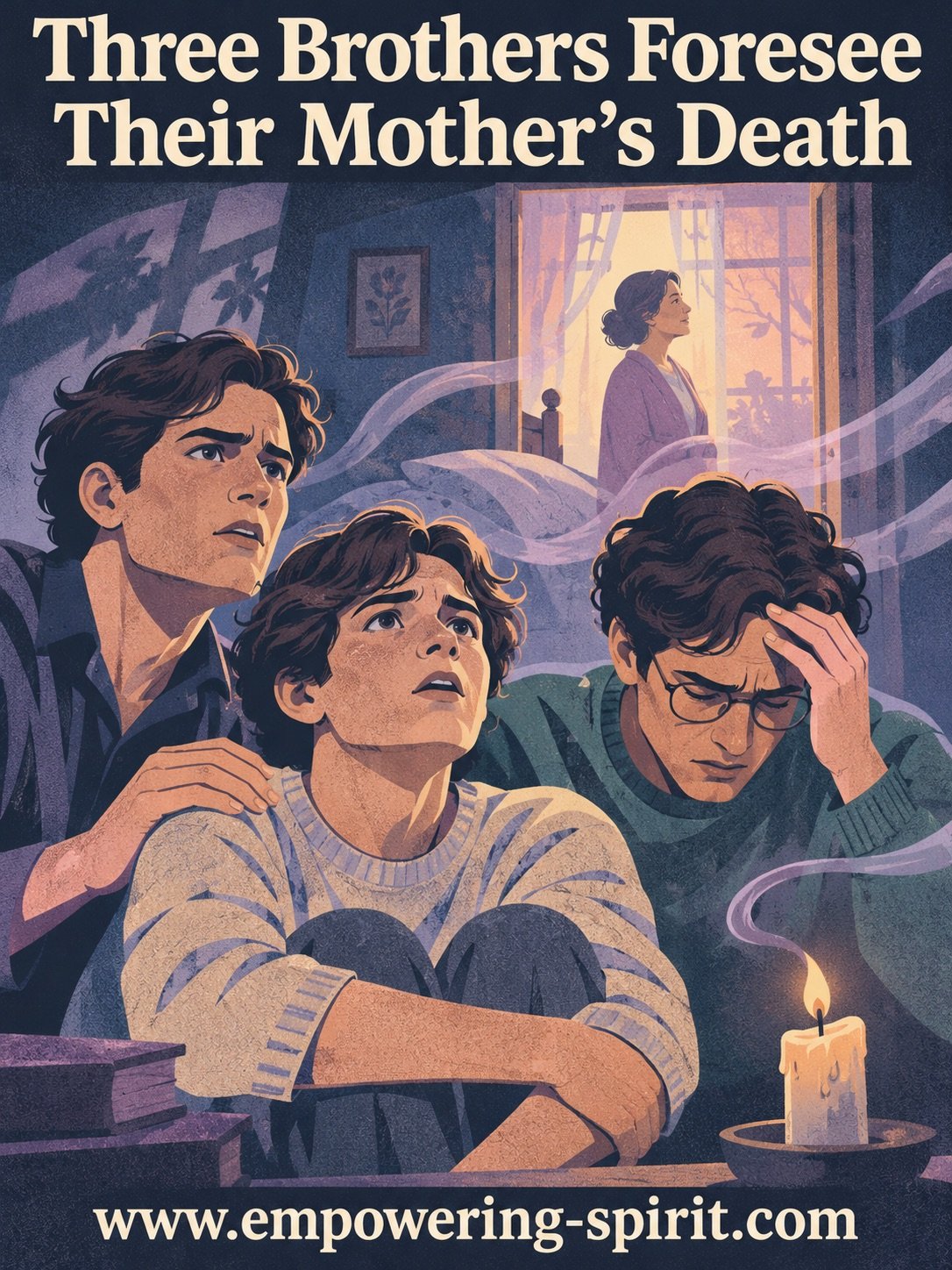
Three Brothers Foresee Their Mother’s Death
Click here to go back to the Hub Page
Thomas Swithinbank woke before the morning drum. The room was grey and close, the cots pushed so near one another that a man could not stand without disturbing his neighbour. He lay still on his back, holding the last of the dream. It had not been a nightmare. He had climbed the stairs of the house in Bradford and walked into his mother’s room. The curtains were drawn. She lay in the bed with her hands outside the coverlet, turned slightly toward the window. William stood near the chest of drawers. John stood in the doorway. No one spoke, and Thomas knew, without being told, that she was dead.
He sat up and reached for his coat. The dream stayed with him while he fastened the buttons, and he did one wrong and had to undo it. Outside, boots sounded on the hard ground. The sea air came through the door, cold and ordinary. He pulled on his shoes and joined the men forming for parade.
Through the drill his body went through the motions. The sergeant called the order; Thomas turned the correct way, halted in line, and kept his eyes on the man ahead. Once he missed the command to step off and stood a beat too long. The man beside him glanced over. Thomas shook his head and moved. He told himself that his mother was well. Her last letter had said as much, and no later word had come. His brothers slept in other quarters, two rows away. There was nothing to be done at Dover for a bad dream.
When the men dispersed after drill, Thomas walked toward the long stone building where William’s company quartered. He found William outside, tightening the strap of his knapsack. Thomas stopped beside him.
“O William, I have had a queer dream.”
William looked up. “Have you? I have had a queer dream too.”
Before either could speak again, John came around the corner. His coat was still unfastened at the collar, and he was frowning.
“I dreamed something last night,” he said. “I don’t like it.”
Thomas held up his hand. “Tell us first, and we will not interrupt. Then William can speak, and I will speak last.” He inclined his head toward the side of the building, away from the men still passing. “We ought not to be overheard making much of dreams.”
John waited until a pair of soldiers passed. Then he said, “I dreamed that mother was dead.”
The words had a plainness that Thomas had not expected. He felt the dream from his own sleep open again. William’s hands stopped on the strap.

“In my dream she was dead,” William said slowly. “I was in her room, and I could not move from the door.”
Thomas looked at William, then at John. “In mine, I went into her room. You were both there. And I knew she was dead.”
For a little while none of them spoke. The camp went on around them. A cart rumbled somewhere to the left, harness bells faint. Thomas became aware that he was standing very straight, as he did on parade.
“Have any of you had a letter from home that troubled you?” he asked at last.
“No,” William said. “Her last letter came together with mine. She wrote about the garden and asked if the sea had got into our boots. There was nothing amiss.”
“She had been tired in the spring,” John said. “But she said she was better.”
“Did you speak of her before you slept?” Thomas asked.
“I did not see either of you after supper,” John said. “We sleep apart.”
William folded his arms. “We are three brothers far from home. It is no extraordinary thing that we should dream of our mother.”
“But it is an extraordinary thing,” John said, “that we should all dream her dead on the same night.”
Thomas looked out past them toward the parade ground. The ground was beaten pale and hard by boots. He wanted to agree with William. He wanted to call the thing coincidence and put it away. But John’s words kept the day from settling.
“We can do nothing from here,” Thomas said. “If it was only a dream, then a letter will come in time and make us foolish for having been troubled. If it was not, we will know soon enough.” He kept his voice even. “We should not speak of it again before the men. It will become a story.”
They agreed. They drew apart to their duties. But Thomas did not put it from his mind as cleanly as he had promised.
He began watching for the post. The post came into the camp irregularly, carried in the same creaking cart that brought supplies from the town. When letters were distributed in the evening, Thomas looked for the shape of the bundle and the colour of the wax on the topmost letter. He did not hover. He stood near the wall of the quarterhouse and listened for his name. Twice a letter came for William, and Thomas caught his eye across the yard. William gave a small shake of his head. No news. John asked him quietly on the third day whether he had heard anything from Bradford.
“Nothing yet,” Thomas said.
“A letter takes four days,” John said. “Perhaps five.”
“Perhaps.”
On the fifth morning, a letter was brought to Thomas during the breakfast hour. He knew the seal before he knew the hand. The address was written in an unfamiliar slanting hand, but the seal was the small rose-coloured wax his mother kept in her writing box. He turned the letter over once. Then he went to find his brothers.
They met him behind the quarterhouse. William came without his coat, though the wind was cold. John’s face changed when he saw the letter in Thomas’s hand.
“It is the same seal,” Thomas said. He broke the wax with his thumb and unfolded the sheet.
The letter was short. Their mother had died in her sleep on the night of the fourteenth. She had been found in the morning, quiet in her bed, and no one had heard her call. Thomas read the lines twice. The noise of the camp went on around them, but he heard it as if from a long way off.
“What night was our dream?” William asked.
Thomas looked at him. “The same night.”
John turned aside and stood with his back to them. William took the letter and read it, then folded it and gave it back. He did not offer another explanation. There was none to make.
Thomas folded the letter along its creases and put it inside his coat. The men at the cookhouse were laughing about something. A sergeant shouted an order. The ordinary day was still running on, and he did not want it near him.
“Come away,” he said.
The three of them walked past the last row of tents, past the picket posts, to a low stretch of grass above the beach. The sea was grey and broken with white lines of foam. They stopped there. Thomas drew the letter out again, looked at it once, and returned it to his pocket. Then he stood between his brothers, and they watched the water, and for a long time none of them spoke.
This story is based on a true account included in Andrew Lang’s The Book of Dreams and Ghosts. You can read the original account in the free Project Gutenberg edition. And if you are interested in fresh and modern content about dreams that came true, you can find them in my book “Dreams That Wake You Up”, a collection of real dreams and real outcomes, directly from my clients, printed with their consent.
For more articles and stories from us, click here to go back to the Hub Page


One thought on “Three Brothers Foresee Their Mother’s Death”