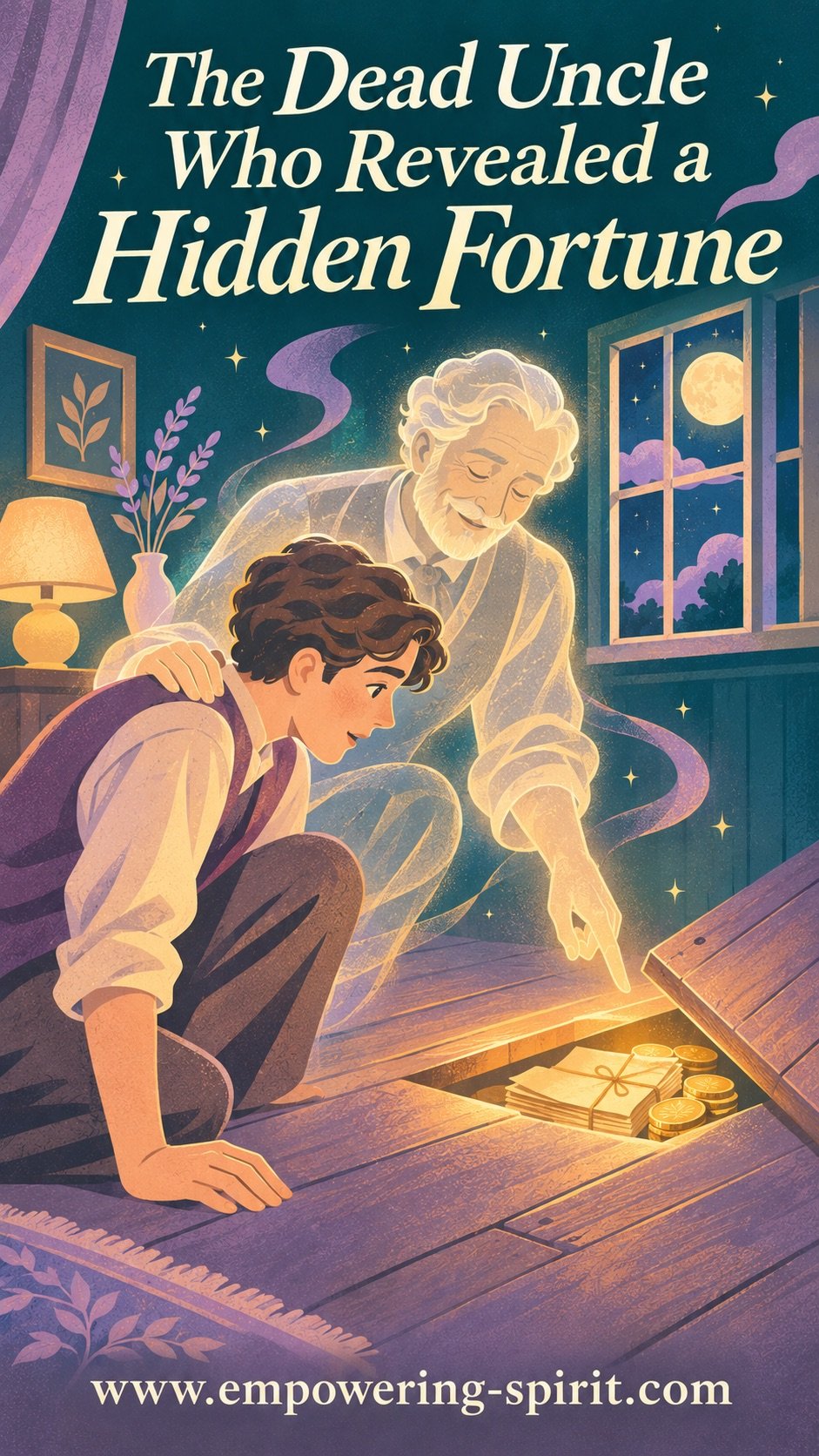
The Dead Uncle Who Revealed a Hidden Fortune
Click here to go back to the Hub Page
Eleanor Vale sat beside the window at the end of an autumn afternoon. The sun had gone, but a low red light still lay across the garden wall, and the room was beginning to gather shadows. She had been reading, or pretending to read, and the book rested open against her lap. She was aware of the room around her only as a familiar and comfortable stillness.
A knock sounded at the front door below. After a moment the maid came into the room. “Two visitors, miss,” she said. “They asked for you by name.”
Eleanor turned from the window. She did not feel surprise. “Show them in,” she said.
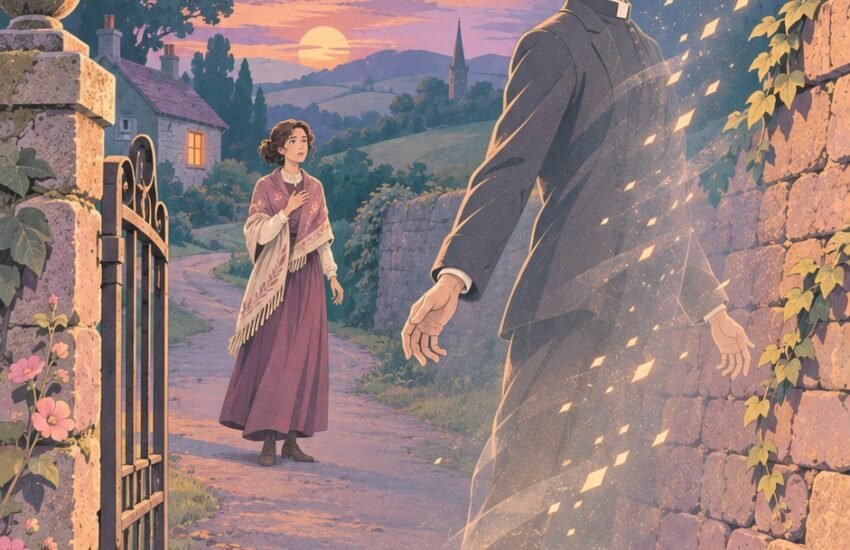
The maid went out, and the visitors came through the door. The first was her uncle Edmund. He wore a snuff-coloured coat cut in the fashion of the beginning of the century, with a high collar and a white neckcloth. His clothes were clean and respectable, only unfashionable. His face was older than she remembered, but not much changed. Eleanor recognized him at once, and the knowledge that he had been dead for years did not follow the recognition. It stayed somewhere behind her, as if it belonged to another room.
Beside him stood a woman Eleanor had never seen. She was beautiful in a quiet, unemphatic way, with dark hair dressed plainly beneath a black mantilla. The lace fell across her shoulders in the Spanish style. Her face was calm, and her mouth looked used to smiling in private. Her hand rested lightly on Edmund’s arm, and her manner toward him had the ease of long affection.
Between them they carried a steel box. It was deep and rectangular, not a jewel case but a strongbox, with worn iron handles at either end. The metal was chased around the edges with a pattern of leaves, and the lock was heavy and bright, though the lid sat slightly open.
Eleanor looked from her uncle to the woman and back again. “Why have you come, Uncle?” she asked. “And who is your companion?”
Edmund opened his mouth to answer. Before he could speak, the maid came in with Eleanor’s chocolate on a small tray. The door swung wide. At the same moment the two visitors and the steel box were gone. Eleanor sat alone in the chair. The room was just as it had been before they arrived.
The maid set the tray on the table by the window. “Your chocolate, miss.”
Eleanor looked toward the door. “Did you pass them in the hall?”
“Pass whom, miss?”
“The gentleman in the snuff-coloured coat. And a lady in a black mantilla. They came up a few minutes ago.”
The maid looked confused. “I saw no one, miss. There was nobody on the stairs.”
Eleanor did not press her. “You are quite certain?”
“Quite certain, miss. I came straight from the kitchen.”
The maid took a last glance at the door and went out. Eleanor remained by the table. She did not feel frightened. She felt only a faint perplexity, as if she had mislaid something small.
When the door had closed, Uncle Edmund and the woman reappeared beside the table. They stood exactly where they had stood before, as if no time had passed. The steel box was now open on the table between them. Edmund lifted out several stiff yellow papers. The writing on them was faded brown, in thin and careful columns. He held them the way a man might hold letters he had carried for a long time.

“These are lists of securities,” he said. “They were mine before I went abroad. You know that I was detained in France during the war.” He glanced at the woman. “While I was there, I became engaged. This was known to no one in England.”
The woman inclined her head. “It is true,” she said. Her accent was faint, not quite English. “We had agreed to wait.”
Eleanor looked at the yellow papers. A private chapter of her uncle’s life, unknown to his English family, had been set out in a few sentences in an autumn room. She wanted to ask more, but the papers held her attention. A list of securities could be verified. It could be traced.
“These securities were never destroyed,” Edmund said. “They were never spent. They are still held in the strongbox of a particular firm.”
Eleanor leaned forward. “Which firm?”
“The securities are now in the strongbox of Messrs—”
A loud knock interrupted him.
Eleanor opened her eyes. She was in her own bed, and the room was bright with early morning. The window showed a grey sky, not the red end of an autumn afternoon. There was no book on her lap, no chair by the window. A knock came again at the bedroom door, harder than the first.
“Your hot water, miss,” her maid called from outside. “It is time to rise.”
Eleanor lay still for a moment. The dream was still with her, whole and bright. She could see the low red light on the garden wall, the snuff-coloured coat, the black mantilla, the chased edges of the steel box, the yellow papers in her uncle’s hands. She could remember every part of his explanation. But after the word “Messrs” there was nothing. The sentence simply stopped, as though a hand had lifted from the page.
“Come in,” she said.
The maid entered with the hot water can and set it by the basin. Eleanor sat up against the pillows.
“Did you knock before?” she asked.
“Yes, miss. I knocked once and waited. When you did not answer, I knocked again.”
Eleanor understood. The first knock had entered her sleep and become the knock at the front door. The visitors had come through that sound. The whole long autumn evening had happened inside the few seconds before the maid knocked a second time.
She did not try to explain this to the maid. She only nodded and swung her legs to the edge of the bed. The maid moved about the room, folding a cloth and pouring water into the basin.
Eleanor sat with her hands in her lap and repeated the sentence silently to herself. “The strongbox of Messrs.” Nothing followed. The name was gone, if it had ever been there. The dream had given her visitors, romance, old papers, a steel box full of lost securities, and it had withheld the only words that could have helped her find them. She looked out at the morning and laughed once, quietly, at the neatness of the trick.
This story is based on a true account included in Andrew Lang’s The Book of Dreams and Ghosts. You can read the original account in the free Project Gutenberg edition. And if you are interested in fresh and modern content about dreams that came true, you can find them in my book “Dreams That Wake You Up”, a collection of real dreams and real outcomes, directly from my clients, printed with their consent.
For more articles and stories from us, click here to go back to the Hub Page