
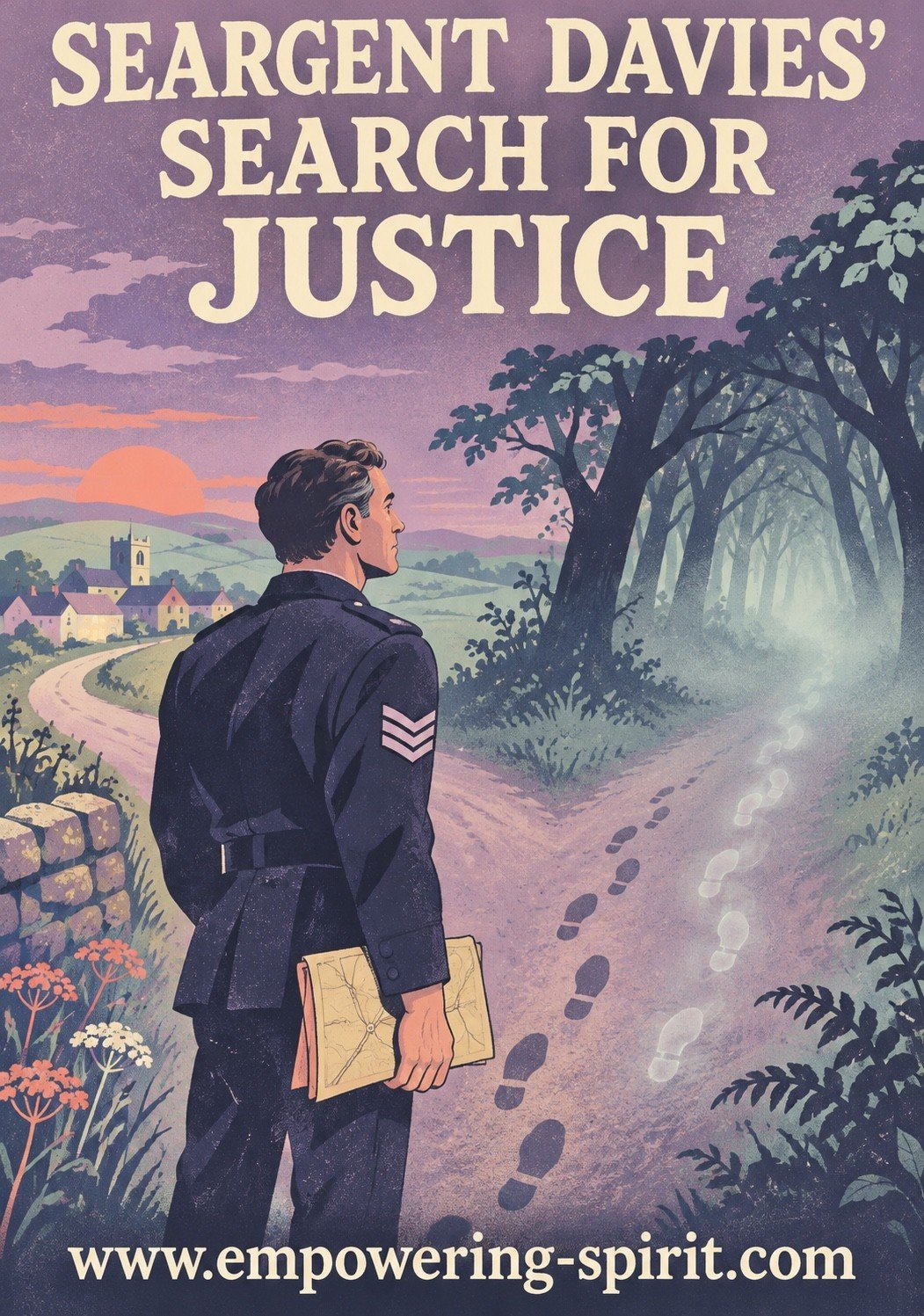
Seargent Davis’ Search for Justice
Click here to go back to the Hub Page
In the early autumn of 1749 the Braemar country looked calmer than it was. Four years had passed since Culloden, but the hills were full of men who could no longer carry arms or wear their old dress without risk, and soldiers at Dubrach moved among people who gave them civility before trust.
Sergeant Arthur Davies of Guise’s regiment did not mind the cold welcome. He had a good Scots name and an English uniform, and he understood that the district kept its judgement to itself. Children at Dubrach were less guarded. They came to watch him clean his valuable gun or count the silver buttons on his waistcoat, and he let them look. He was newly married and fond of children, a man who liked being observed a little. He carried his prosperity openly: fifteen and a half guineas in a green silk purse, a silver watch, two gold rings, silver buckles at his shoes and knees, and a gun that had been a gift from an officer. One of the gold rings had a distinctive knob on its bezel.
His wife met him at the door that morning. “You have your watch?” she asked.
“I have my watch, my rings, my buttons, and a purse too heavy for a man crossing a hill,” he said.
She did not smile. “That is not a comfort. Come home at a proper hour.”
“I always do,” he said, and kissed her.
He left with four soldiers to meet a patrol coming from Glenshee. When the track divided, he sent the men on and turned aside, meaning to cross the hill and perhaps shoot a stag before joining the patrol. In Glenclunie he came upon John Growar carrying a bundle. Growar dropped it and tried to push it into the heather with his foot. The bundle opened enough to show the forbidden tartan. Davies stopped.
“I did not see that coat,” he said. “Take it home and burn it. Another soldier may not be so lazy.”
Growar said nothing. Davies watched him go, then walked on alone into the hills. He did not rejoin his four soldiers, and he never reached the patrol from Glenshee.
When Arthur Davies did not come back that night, his wife stood for a long time at the door of their quarters, listening to the ordinary sounds of the glen. She had known him to be late, but she had never known him to stay away without warning. The soldiers said weather or hunting had delayed him. By the following morning she did not believe it.
Four days after the disappearance, his captain took soldiers into the hills. They examined tracks, ravines, peat ground, burns, and likely hunting routes. The men came back tired and empty-handed. There was no body, no purse, no gun, no message. The hills kept their secret.
Rumours moved through the district. Some whispered that Davies had deserted with his savings. His wife answered that suggestion with contempt. “He would not have gone without me,” she said. “He would not have left his watch unless someone took it from him.” Others named Duncan Clerk and Alexander Bain Macdonald. But there was no body, and no witness willing to repeat what the hills might have seen.
The search ended. The soldiers returned to their posts. Davies’s wife remained at Dubrach without a husband, an explanation, or even remains to bury. Months passed, and the hills kept their secret.
Late in May 1750, Alexander Macpherson was sleeping in a summer sheiling in the upper country when a man dressed in blue appeared beside him. Macpherson opened his eyes and thought at first that it was a living man he knew. He rose and followed the figure toward the door.
At the door the man turned. “I am Sergeant Davies,” he said.
Macpherson stopped. The figure told him to go to a peat moss about half a mile from the patrol road, where his bones lay, and said that Donald Farquharson would help bury his remains. Then it was gone. Macpherson stood in the doorway for some time before he sat down again.
The following day he went to the place. He found human bones in the peat. Nearby lay mouse-coloured hair tied with a ribbon, fragments of blue cloth, and a pair of brogues stripped of their silver buckles. He did not touch them. He knelt only long enough to be certain of what he was seeing, then left the way he had come.
Frightened, he spoke first to John Growar. Growar listened without surprise and told him to keep his mouth shut. “You have seen nothing,” Growar said. “If you have found something, forget where.” Macpherson then consulted Shaw of Daldownie. Shaw heard him out and recommended a private burial. Bringing the bones before the authorities, he said, would only give the district a worse reputation. Macpherson saw the force of that, but he did not act. He neither buried the bones nor went to Donald Farquharson.
The apparition returned. This time it repeated the command that the bones be buried, and it named the men who had killed Sergeant Davies: Duncan Clerk and Alexander Bain Macdonald. It spoke in Gaelic. That bothered Macpherson less than the names themselves. But later, when the story reached Edinburgh, it would bother the court. Sergeant Davies was not known to understand the language in which his ghost had made its accusation.

During another night at the sheiling, Isobel MacHardie woke to the sound of the door. A naked, human-like figure entered in a stooping posture. She did not look closely. She pulled the bedding over her head and lay still until the room was quiet.
The next morning she asked Macpherson what had troubled them in the night.
“It will not trouble us again,” he said.
He went then to Donald Farquharson, whose father had formerly lodged Sergeant Davies. Donald listened to the story and shook his head.
“I do not believe in ghosts,” he said.
“Believe the bones,” Macpherson answered. “Come and see the place.”
Donald agreed, though he expected nothing. Together they returned to the peat moss. Donald knew the hair, the blue cloth, and the brogues well enough. He said little while they buried the remains. When the earth was back in place, they stood a moment and then walked down without speaking.
The bones were buried. The purpose the apparition had declared was fulfilled, and it did not return to demand another burial. But the missing valuables told their own story. Davies’s green silk purse, his money, watch, rings, silver buckles, buttons, and valuable gun were gone. The accusation against Clerk and Macdonald remained. In the Highlands after Culloden, knowing whom people suspected was not the same as finding anyone willing to testify.
Clerk and Macdonald were not arrested until September 1753. In June 1754 they were tried in Edinburgh. The prosecution’s case looked difficult to dismiss. Clerk’s wife had been seen wearing Davies’s distinctive ring, the one with the knob on its bezel. After the sergeant disappeared, Clerk had enough money to take a farm. Both Clerk and Macdonald had been armed and on the hill that day. Then Angus Cameron testified that he had witnessed the killing. He said he had been hiding in a hollow with another man when they saw Clerk and Macdonald attack the soldier in the silver-laced hat. They struck and shot him. Cameron and his companion fled. Fear of exposing his own activities had kept him silent for months.
The defence attacked the delay and the frightened witnesses. Then it turned to the ghost. Alexander Macpherson had to admit that an apparition had directed him to the bones and later named the accused. He also had to admit that the apparition spoke Gaelic.
“Sergeant Davies was an English-speaking soldier,” the advocate said. “Why would his ghost address you in a language he apparently did not know?”
Macpherson had no answer. What should have explained the discovery of the remains now made the prosecution sound absurd. The defence ridiculed the supernatural evidence and used it to cast doubt on everything surrounding it. Despite the ring, the sudden money, the armed men on the hill, the recovered body, and Cameron’s eyewitness account, the jury found the prisoners not guilty.
Clerk and Macdonald left the courtroom as free men. Macpherson remained by the witness area, watching the empty dock.
This story is based on a true account included in Andrew Lang’s The Book of Dreams and Ghosts. You can read the original account in the free Project Gutenberg edition. And if you are interested in fresh and modern content about dreams that came true, you can find them in my book “Dreams That Wake You Up”, a collection of real dreams and real outcomes, directly from my clients, printed with their consent.
For more articles and stories from us, click here to go back to the Hub Page


One thought on “Seargent Davis’ Search for Justice”