The Knight of Swords
Click here to go back to the Tarot Course Hub
Sharp Words, Fast Moves, Dangerous Certainty
👉 If you haven’t yet, it really helps to start with the general Court Cards article.
There, you’ll see how Pages, Knights, Queens, and Kings work in readings — and the Knight of Swords becomes easier to understand as the active, forceful expression of the Swords suit.
The Knight of Swords has formerly been seen as a rather negative card, embodying rather negative character traits. Modern interpretation have watered it down, and as always, I advice you to go with the interpretation that works best for you and gives you the most accurate outcomes. I personally think that we need negative court cards. The tarot needs a way to point out difficult situations, difficult characters, and to call us out when we’re acting in a risky way, maybe even sabotaging ourselves. We need to allow the tarot to show the full range of life’s challenges in order to receive truth rather than comfort alone. Of course, messages should always be delivered gently and the whole point of a reading is to give hope. To show the light at the end of the tunnel, to navigate life’s challenges in the best possible way and of course, to rise awareness and help us avoid mistakes. We need to give the tarot a chance to call out villains. And the Knight of Swords is one of those.
The Knight of Swords points to the moment when thought becomes attack, speech becomes a weapon, and conviction starts moving faster than wisdom. The Knight of Swords has courage, intelligence, and skill … but they also have an edge. They push forward. They confront. They argue. They cut through resistance, sometimes because the truth needs defending, sometimes because they simply cannot tolerate being blocked.
Upright, this card can show capability, bravery, defense, and the willingness to stand up in a difficult situation. It can describe someone who speaks clearly, acts quickly, and refuses to back down. In certain readings, that may be exactly what is needed: a sharp mind, a strong argument, a person who can enter conflict without flinching.
But the Knight of Swords also carries the energy of enmity, anger, war, destruction, resistance, and ruin. That is not an accident. Some cards are uncomfortable because they describe uncomfortable forces. The Knight of Swords can be the person who escalates the room, pushes an argument too far, humiliates someone publicly, or storms into a situation with the emotional sensitivity of a thrown knife.
This card can also show someone becoming the center of attention through conflict. A speech, confrontation, accusation, debate, public statement, or dramatic verbal attack may become the turning point of the situation.
Reversed, the same energy becomes even more unstable. Courage turns into recklessness. Skill collapses into inability. Movement becomes aimless. Speech becomes impulsive. The person may still charge ahead, but without strategy, maturity, or control. It is a sword swinging in the dark.
- Sharp Words, Fast Moves, Dangerous Certainty
- Symbolism in My Deck
- 🗝️ Keywords — Knight of Swords
- 🛠 Practical Use — The Knight of Swords in Readings
- 🌌 Astrology & Elemental Correspondences
- ♄ Saturn — Coldness, Hard Lines, and Mental Rigidity
- ♀ Venus — Social Consequence, Values, and the Cost of Conflict
- ♂ Mars — Attack, Aggression, and Verbal Force
- ☿ Mercury — Speech, Thought, and Tactical Intelligence
- ♊ Gemini — Quick Thinking, Debate, and Restless Perception
- ♎ Libra — Conflict, Justice, and the Broken Balance
- ♒ Aquarius — Detachment, Ideology, and Cold Objectivity
- 🌬 Air — Thought, Language, and Mental Conflict
- 🔮 Astrology in a Reading
Symbolism in My Deck
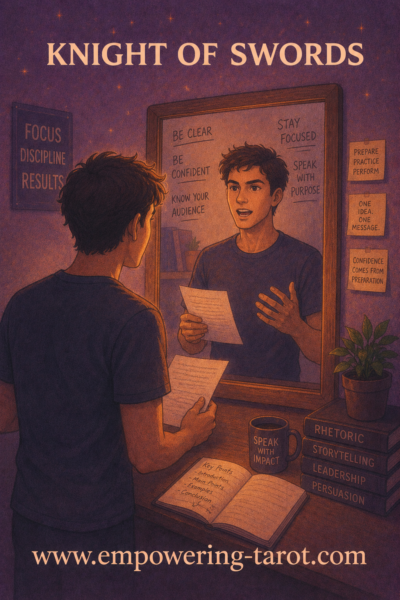
In my deck, the Knight of Swords appears as a young man practicing a speech in front of the mirror.
This is the logical next step after the Page of Swords.
The Page was a little boy with a toy sword, surrounded by speech bubbles: loud, curious, mentally restless, still learning how words work. The Knight has grown. He is no longer simply talking while playing. He is preparing to speak with impact.
The mirror shows self-awareness, rehearsal, and performance. This Knight knows that words can change the room. He is not merely thinking; he is sharpening his message. He wants to be convincing. He wants to land the point. He wants to win the moment.
The speech practice shows the power and danger of this card. A prepared speech can defend someone, expose a lie, make a necessary argument, or give courage a voice. But it can also become a planned attack, a verbal ambush, or an attempt to dominate the narrative.
The young man shows that this energy is still not fully mature. There is skill here, but also pride. There is courage, but also anger. There is capability, but not always restraint. He may believe he is fighting for truth while secretly enjoying the force of his own words.
This image captures the heart of the Knight of Swords:
a sharp mind
a prepared argument
the courage to confront
and the danger of turning speech into combat
The Knight of Swords reminds you that words can protect, defend, expose, and liberate — but they can also destroy what could have been solved with more patience.
🗝️ Keywords — Knight of Swords
Upright Knight of Swords
Skill
Courage
Capability
Defense
Address, speech, confrontation
Sharp communication
Mental force and verbal attack
Being the center of attention
Standing up in conflict
Resistance and counteraction
Enmity, anger, hostility
War, destruction, ruin
Unstoppable movement
A young person — or part of you — who charges forward with fierce conviction
Reversed Knight of Swords
Recklessness
Inability
Impulsiveness
Aimless action
Unpredictable behavior
Extravagance, overdoing it
Anger without strategy
Cruel or careless words
Picking fights without purpose
Charging ahead without understanding the consequences
A collapse of self-control
Using intelligence destructively
A person who creates chaos and then cannot manage the fallout
💭 Reversed doesn’t mean “the opposite” of upright. It’s the same Knight-of-Swords energy — just blocked, distorted, or out of control. Think of it as the shadow side of mental force: the sword still moves, but the hand holding it has lost discipline.
Page of Swords – the curious mind
The Page of Swords is still learning how to use words, thoughts, and information:
asking questions, observing, researching, talking loudly, and testing ideas.
It is the child with the toy sword: mentally sharp, but still practicing.
Knight of Swords – the mind in attack mode
The Knight of Swords takes that mental energy and charges forward with it:
speaking, confronting, arguing, defending, accusing, or forcing an issue into the open.
It is the young person before the mirror, preparing words that are meant to land.
Simple cheat sheet:
Page of Swords: “I am watching, questioning, and learning.”
Knight of Swords: “I am confronting, arguing, and charging forward.”
When you’re unsure, ask yourself:
“Is this card showing the restless learner still gathering information (Page) –
or the fighter who has already drawn the sword and entered the conflict (Knight)?”
🔍 Meaning — Knight of Swords (Upright)
The Knight of Swords is aggression in motion. He is the person who feels as if life is a battlefield and every conversation, obstacle, delay, or disagreement is another enemy to defeat. He does not move gently. He charges.
This Knight is permanently in attack mode. He is sharp, restless, combative, and driven by the feeling that something must be fought, conquered, exposed, or cut down. He does not fear consequences in the usual sense. Not because he imagines there will be none, but because he is willing to pay the price if he believes the fight is necessary.
That is what makes him so dangerous. And, in rare cases, so effective.
The Knight of Swords lives with an inner readiness for conflict. He can endure pressure. He can take blows. He can keep going where others would collapse, retreat, or surrender. When everything seems lost, this is the person who suddenly becomes stronger. The worse the situation gets, the more alive he feels. Adrenaline sharpens him. Resistance feeds him. The word “give up” is not part of his vocabulary.
But his path is rarely clean.
He often leaves devastation behind him: broken trust, severed ties, scorched conversations, people who feel attacked, humiliated, or pushed aside. Sometimes he suffers most from his own destruction, and still he accepts it, because in his mind he did what had to be done.
This is not a soft card. It can be heroic, but it is not peaceful. It can win battles, but it may lose the village in the process.
❄️ The Knight of Swords as an Atmosphere
As an atmosphere, the Knight of Swords brings frost. The mood becomes cold, tense, critical, and sharp-edged. Something that may have felt pleasant, warm, or manageable suddenly becomes intellectualized, dissected, and attacked from all sides.
This is the negative side of the Air element: not clarity as a blessing, but clarity as a blade.
The Knight of Swords can bring sober realization, but more often he arrives with discord, quarrels, biting mockery, calculated meanness, and bitter irony. Words become weapons. Intelligence becomes ammunition. Distance becomes cruelty.
In this atmosphere, people are not trying to understand each other. They are trying to win.
This card can therefore indicate separations, verbal battles, hostile discussions, accusations, sharp criticism, and conflicts where someone uses their mind not to solve the problem, but to dominate the room. It can be the person who always has the perfect comeback, the cruelly accurate observation, the sentence that cuts exactly where it hurts.
There is intelligence here, yes. But intelligence without kindness can become surgical cruelty.
⚔️ The Knight of Swords as a Person
As a person, the Knight of Swords may be brilliant, fast, and fearless. He sees weak spots immediately. He detects contradictions, hypocrisy, dishonesty, and bad logic with almost predatory precision. If he is on your side in a crisis, he may be the one who saves the day because he is willing to act when everyone else is still panicking.
But as a personality, he is difficult.
He can be overly critical, suspicious, sarcastic, spiteful, and quarrelsome. He may approach everything as if it were a debate to be won or an enemy to be exposed. Even when he is right, he may deliver the truth in a way that makes healing almost impossible.
The Knight of Swords often believes he is simply being honest. In reality, he may be using honesty as a sword and then acting surprised when everyone around him is bleeding.
His mind is sharp, but his emotional warmth is limited. He may not care enough about how his words land, because in his view, the truth matters more than tenderness. The problem is that truth without humanity can become just another form of violence.
This is why the Knight of Swords is not merely “clear communication.” He is the danger of the mind when it becomes detached from the heart.
🃏 Practical Meaning in Readings
In practical readings, the Knight of Swords often warns that conflict is either already present or about to intensify. A confrontation may become sharper than expected. A discussion may turn into a fight. Someone may say something that cannot easily be taken back.
If the card describes the querent, it can mean they are entering a situation with too much aggression, too much tension, or too much desire to win. They may be right in principle, but wrong in method. They may have a valid point, but deliver it like an attack dog with a law degree.
At the same time, the Knight of Swords is not useless. Sometimes he is exactly what is needed.
There are moments when passivity is over. Moments when you must stand up for yourself, your goals, your values, or your truth. The Knight of Swords can say: stop waiting for permission. Stop letting others walk over you. Fight for what matters.
But he also warns that fighting has a cost.
This card can indicate that sacrifice will be necessary to achieve something greater. You may have to burn comfort, approval, peace, or even certain connections if the battle is worth it. The important question is whether the battle truly is worth it, or whether you have simply become addicted to the feeling of fighting.
The Knight of Swords asks for courage, but also discernment. Not every provocation deserves a war. Not every truth must be thrown like a brick through a window.
🔍 Meaning — Knight of Swords (Reversed)
Reversed, the Knight of Swords has run out of force. The fighter is exhausted. The sword is still in his hand, but his grip is shaking.
This reversal often shows burnout, mental overstimulation, and the collapse that comes after too much conflict, too much pressure, too much adrenaline, and too much fighting for too long. The person may still feel trapped in battle mode, but no longer has the strength to fight effectively.
This is where the Knight of Swords loses touch with reality.
He may become paranoid, irrational, reckless, or unable to judge situations clearly. Because he is exhausted, everything looks like a threat. Because he is overwhelmed, every disagreement feels like an attack. Because he has lived too long in a state of tension, he can no longer tell the difference between a real enemy and a shadow on the wall.
Reversed, this card can also show someone who keeps charging even though there is nothing left to win. The conflict has eaten the purpose. The battle continues only because stopping would force him to feel the damage.
🧊 Burnout, Entrapment, and Mental Distortion
The reversed Knight of Swords calls for slowing down, whether the person wants to or not. The pace has become unsustainable. The mind is too sharp, too fast, too flooded, and now it starts cutting in the wrong direction.
This card can indicate the feeling of being trapped: trapped in conflict, trapped in one’s own anger, trapped in a situation that seems impossible to solve without another fight. But more fighting may be exactly what makes things worse.
The reversed Knight of Swords asks for a reality check. What is actually happening? What are you assuming? Where has your mind filled in the gaps with suspicion, rage, or fear? Where have you lost the ability to pause before striking?
This is not a gentle “take a break” card. It is more like the moment after a sword fight when the room goes silent and you finally see the damage: the broken furniture, the blood on the floor, the person you did not mean to wound, the part of yourself that is now completely depleted.
If upright Knight of Swords says, “Fight if you must,” reversed Knight of Swords says, “Stop before you destroy yourself.”
⚔️ Essence of the Knight of Swords
The Knight of Swords is the cold warrior of the deck.
Upright, he fights, cuts, exposes, attacks, and refuses to surrender. He can be brave, effective, and necessary in a crisis, but he can also be cruel, impulsive, and devastating.
Reversed, he shows the cost of living too long in battle mode: burnout, distortion, paranoia, exhaustion, and the need to downshift before the mind turns against itself.
🛠 Practical Use — The Knight of Swords in Readings
The Knight of Swords is cold air at high speed. He is conflict, criticism, attack, strategic sharpness, and the moment when softness leaves the room. While the Page of Swords can still be immature, defensive, or nervously argumentative, the Knight of Swords is more dangerous because he has direction. His words are not merely clumsy; they are aimed. His criticism is not merely curious; it cuts. His intelligence is active, hostile, and often impatient with anything that looks emotional, warm, slow, or vulnerable.
In practical spreads, this card can sometimes bring a necessary cooling of an overheated situation. It can puncture delusion, break through naïve enthusiasm, and force a more sober look at what is really going on. But that is the milder and rarer expression. Most of the time, the Knight of Swords shows a hostile climate, emotional frost, biting words, hardened fronts, and battles in which someone may win the argument while destroying the relationship, the trust, or the room itself.
In career questions, the Knight of Swords often points to a sharp temperature drop in the work environment. What may once have been manageable tension becomes open hostility. Trenches break open, fronts harden, and people stop speaking with each other and begin speaking against each other. This can appear as biting criticism from superiors, aggressive competition between colleagues, confrontational meetings, icy emails, strategic blame-shifting, or business partners who suddenly approach the matter like opponents rather than allies.
Sometimes you yourself are the one becoming overly critical, suspicious, or combative. At other times, you are the one exposed to someone else’s sharpness. Either way, the work climate becomes colder, and that cold can damage structures that previously seemed stable. Deals may collapse because trust has been eroded. Projects may fail because people are no longer cooperating in good faith. Long-standing collaborations may end because the damage caused by criticism, mockery, or strategic hostility becomes too deep to repair easily.
In its milder form, the Knight of Swords can indicate a necessary cooling after an overheated phase. If a team has been carried away by blind enthusiasm, unrealistic promises, or fashionable nonsense dressed up as strategy, this card can bring the harsh but useful moment when someone finally says, “This does not hold up.” In that sense, he can serve clarity. But even then, his method is rarely gentle. He does not bring a warm, balanced conversation around the conference table. He brings the red pen, the cold eye, the inconvenient question, the sentence nobody wanted to hear. If other cards around him are constructive, that sharpness may prevent greater damage later. If the surrounding cards are hostile, he shows a professional battlefield where only the coldest and most tactically skilled may profit.
In introspective questions, the Knight of Swords marks a period of inner cooling. You may become suspicious of yourself, of others, of your values, of your former beliefs, even of everything that once inspired you. This is not gentle self-reflection; it is a frost period of the mind. Former convictions may become targets of bitter irony. Ideas you once held with warmth may suddenly seem foolish, naïve, embarrassing, or poorly examined. You may feel unusually conflict-ready, mentally armed, and impatient with anything that sounds sentimental or unproven.
This can be painful, especially if the sword turns inward. The Knight of Swords can describe harsh self-criticism, contempt for your own vulnerability, or the need to mock something before it can touch you. He may show the inner voice that says, “Don’t be stupid. Don’t be soft. Don’t believe that. Don’t trust them.” Sometimes this voice is cruel. Sometimes it has become cruel because it once had to protect you.
Still, this card is not useless in inner work. His cleansing function appears when he forces you to examine beliefs that were adopted too quickly, opinions that were fashionable but hollow, loyalties that were never questioned, or hopes that rested on air. The Knight of Swords can strip away false softness and expose where you have been too credulous. But you must be careful: skepticism is useful; contempt is poison. The card asks you to separate clear thinking from inner brutality. A sharp mind can liberate you from illusion, but if it turns into permanent mockery, it freezes the soul it claims to protect.
In relationship questions, the Knight of Swords is often one of the more painful cards. In romance, friendship, family, or close emotional bonds, he can show warmth suddenly freezing, affection turning into accusation, and tenderness being dragged into a cold, harsh light where it cannot survive. Feelings that once seemed alive and natural may become the object of analysis, ridicule, gossip, or contempt. Someone may begin to speak about the relationship as if it were a failed argument rather than a living bond.
This card can describe bitter fights, cruel remarks, public or private mockery, malicious interpretation, emotional withdrawal, and the kind of sharp-tongued conflict where the real goal is no longer understanding but victory. In a love reading, it can show someone who attacks vulnerability because they cannot tolerate their own. In family readings, it can show a climate where old resentments are weaponized. In friendships, it can indicate gossip, sarcasm, intellectual superiority, or a sudden turning of the mind against someone who was once loved.
The Knight of Swords is especially dangerous in relationships because he can make cruelty look intelligent. A cutting comment may sound clever. A sarcastic remark may get a laugh. A cold analysis may appear rational. But underneath, something tender is being humiliated. This is the card of the moment when a feeling is pulled out of its natural waters and left exposed on dry land, where it can only gasp. If the surrounding cards are supportive, a harsh confrontation might still reveal an uncomfortable truth that needed to be addressed. But most of the time, this card warns that words are becoming weapons and that the damage may last longer than the argument itself.
When the Knight of Swords appears in positions that reflect your unconscious attitude, he shows inner frost, bitterness, defensiveness, or revenge. You may be more hostile than you admit. You may feel attacked, betrayed, insulted, or outmaneuvered, and part of you may be preparing to strike back. If hatred feels too strong a word, then the card may still show coldness, sharp distance, contempt, or a tendency to defend yourself against warmer feelings through irony, mockery, or intellectual superiority.
In this position, the Knight of Swords is not necessarily telling you to soften. That depends on the situation. Sometimes your suspicion is justified. Sometimes someone really is trying to manipulate, flatter, pressure, exploit, or corner you. In that case, the card tells you to dress warmly because a cold wind is blowing directly at you. Do not let yourself be softened by sweet words if your instinct already knows something is wrong. Do not hand your vulnerability to someone who has not earned it. Stay alert, examine motives, and do not confuse charm with safety.
But this card also asks for honesty about your own blade. Are you defending yourself, or are you already attacking? Are you protecting your dignity, or are you enjoying the thought of retaliation? Are you seeing clearly, or has bitterness started to distort the whole room? The Knight of Swords in the inner position can be useful when danger is real, but destructive when the old wound starts treating every approaching hand as a weapon.
In positions that show how someone else sees you, the Knight of Swords indicates that you are perceived as cold, sharp, critical, and difficult to approach. You may come across as intellectually strong but emotionally unsafe. Others may see you as aloof, calculating, confrontational, or quick to strike with words. Even if you believe you are merely being honest, the other person may experience your honesty as harshness. Even if you believe you are being rational, they may experience your rationality as contempt.
In some contexts, this perception may be useful. If you are in a negotiation, conflict, legal matter, workplace rivalry, or situation where weakness would be exploited, being seen as sharp and unimpressed can protect you. The Knight of Swords can make others think twice before trying to manipulate you. But in emotional matters, this image is costly. Someone may feel that you cannot be reached, that you will mock their feelings, that you are more interested in being right than being close. The card does not say you are all these things in your essence; it says this is the impression your energy, words, or behaviour has created.
As advice, the Knight of Swords does not tell you to be sweet. He tells you to be sharp, distant, strategic, and awake. You are entering an environment where naïve trust may become dangerous, where flattery and pressure may be used as tools, and where you must not allow yourself to be impressed by either sugar or threat. Maintain distance. Think quickly. Listen for what is not being said. Do not be seduced by warmth that has no integrity behind it.
This is a card for situations where you need teeth. You may have to defend your interests clearly, reject manipulation, respond with precision, and make it unmistakable that you are not an easy target. If someone expects you to fold, the Knight of Swords advises you to let them see the blade. Not with a theatrical tantrum, not with messy rage, but with cool readiness. Be clever, tactically aware, and verbally prepared. If necessary, become the cunning fox rather than the sacrificial lamb.
But the higher discipline of this card is to use sharpness without becoming drunk on it. The Knight of Swords is powerful medicine in hostile territory, but poisonous as a permanent personality. As advice, he may be exactly right for the moment: stay cold, stay critical, show your teeth, and do not let yourself be outmaneuvered. But once the danger has passed, put the sword down. A blade is useful in battle. It is not something you should cuddle in your sleep.
🌌 Astrology & Elemental Correspondences
♄ Saturn — Coldness, Hard Lines, and Mental Rigidity
Saturn gives the Knight of Swords his severity. This is the influence of hard judgment, harsh conclusions, and the willingness to draw a line without much softness. Upright, Saturn can bring discipline, endurance, and strategic focus; reversed, it may show cruelty, bitterness, emotional frost, or a mind that has become too rigid to hear another perspective.
♀ Venus — Social Consequence, Values, and the Cost of Conflict
Venus may seem strange beside this card, but it shows what is damaged when the Knight of Swords goes too far: peace, affection, trust, and connection. Upright, Venus can bring the possibility of restoring fairness and relational balance after conflict; reversed, it may show charm used as a weapon, cutting words disguised as honesty, or relationships harmed by contempt.
♂ Mars — Attack, Aggression, and Verbal Force
Mars gives the Knight of Swords his combative charge. This is not passive thought — this is the mind turned into a blade. Upright, Mars can bring courage, swift action, and the ability to confront what must be confronted; reversed, it becomes hostility, impulsive attack, and the urge to win even when the victory leaves damage behind.
☿ Mercury — Speech, Thought, and Tactical Intelligence
Mercury sharpens the Knight’s intellect and gives him speed. This influence rules language, argument, analysis, and the ability to strike with precision. Upright, Mercury brings clarity, strategy, and fast comprehension; reversed, it may indicate manipulation, sarcasm, miscommunication, or speaking before wisdom has caught up with thought.
♊ Gemini — Quick Thinking, Debate, and Restless Perception
Gemini connects the Knight of Swords to rapid mental movement. Ideas arrive quickly, words move faster, and every situation becomes something to analyze, question, or challenge. Upright, Gemini brings curiosity and adaptability; reversed, it may show scattered aggression, gossip, contradiction, or arguments that multiply without resolution.
♎ Libra — Conflict, Justice, and the Broken Balance
Libra adds the theme of fairness, but in the Knight of Swords this balance is often under pressure. This card may appear when someone believes they are defending truth, justice, or principle — but may not notice how harshly they are doing it. Upright, Libra can bring necessary confrontation in the name of fairness; reversed, it may show hypocrisy, biased judgment, or using “justice” as an excuse for attack.
♒ Aquarius — Detachment, Ideology, and Cold Objectivity
Aquarius gives the Knight of Swords his distance. This influence can support objectivity, independence, and intellectual courage, but it can also detach the mind from the heart. Upright, Aquarius brings sharp insight and the ability to challenge outdated ideas; reversed, it may show emotional coldness, superiority, or ideological stubbornness.
🌬 Air — Thought, Language, and Mental Conflict
As an Air court card, the Knight of Swords operates through ideas, words, and perception. Air brings clarity, analysis, and communication — but when intensified, it becomes a storm. In balance, it supports truth, intelligence, and decisive thinking; in imbalance, it may bring anxiety, cruelty, overthinking, or conflict driven by words rather than wisdom.
🔮 Astrology in a Reading
When the Knight of Swords appears, its astrological ties emphasize sharp thought, confrontation, and the consequences of mental force:
- ♄ Saturn — Points to rigidity, coldness, or hard boundaries. In career readings, it may show a tense environment where criticism or pressure dominates.
- ♀ Venus — Highlights what conflict is costing emotionally or socially. In relationship spreads, it may suggest trust being damaged by harsh words, contempt, or lack of tenderness.
- ♂ Mars — Signals attack, urgency, or confrontation. In challenges, it warns against escalating a situation simply because anger wants movement.
- ☿ Mercury — Brings focus to speech and strategy. In communication matters, it asks whether words are being used to clarify or to wound.
- ♊ Gemini — Shows restless thought and verbal speed. In personal growth, it may indicate mental spirals, debates, or jumping between arguments without grounding.
- ♎ Libra — Raises questions of fairness. In conflict readings, it asks whether justice is truly being served — or whether someone is hiding aggression behind principle.
- ♒ Aquarius — Highlights detachment and ideology. In group or social situations, it may show someone prioritizing being right over being humane.
- 🌬 Air — Warns that thought has become weaponized. In difficult spreads, it calls for clarity, restraint, and the discipline to pause before the next cut.
Together, these correspondences reveal the Knight of Swords as the force of the sharpened mind in motion. He can defend truth, cut through illusion, and act with impressive courage — but when unbalanced, he leaves behind frost, trenches, and words that cannot be taken back.
If you’re dealing with conflict, harsh communication, criticism, or a situation where someone’s words have become weapons, you can book a personal tarot reading at www.empowering-tarot.com for guidance you can actually use — clear, honest, and grounded enough to help you see what is really happening.
You can also support this work through the tip jar in the sidebar (desktop) or footer (mobile). Every contribution — big or small — helps keep this work alive and is deeply appreciated.