Click here to go back to the Tarot Course Hub
Introduction
When you’re learning tarot, one of the hardest parts isn’t memorizing meanings — it’s getting enough realistic practice. Reading for yourself is useful, but eventually you want to stretch your skills on questions that sound like they’re coming from actual people with actual problems. And finding volunteers who will let you practice — without testing you or holding back — can be a challenge.
That’s where these practice exercises come in. You can work through them whenever you like, at your own pace — no sign-ups, no waiting for someone to say “yes.” Just you, your cards, and a situation that feels like a real client email.
Here’s how it works: you’ll receive a mock email from a fictional querent, written in the tone of the messages professional readers really get. (Every detail is invented) Your job is to step into the role of the tarot reader and answer their question as if this were the real thing.
You can absolutely use your own spreads — pull a single card, three cards, or a full Celtic Cross if you like. But for the structure of this course, we’ll first imagine you draw the Page of Swords on its own. Then, we’ll explore the reading again as if you’ve drawn the Page of Swords plus two other specific cards, which I’ll give you.
In both versions, you’ll find my sample answer hidden in a spoiler. These aren’t “correct” answers — tarot doesn’t work that way — but they’ll show you how one professional might work with the Page of Swords in real-life situations: mental spirals, communication, tension, and the courage to speak clearly.
Even though the scenarios are fictional, they mirror the tone and complexity of questions paying clients bring. So while you’re practicing, you’re also training for the real work.
Dive in, stay curious, and let each exercise sharpen not only your interpretations — but also your phrasing, your boundaries, and your reader’s voice.
Fictional client email
Subject: Tarot Reading — Should I Say Something or Let It Go?
Hi,
I work in a small office, and lately I’ve had the feeling that one of my colleagues, Mara, has been talking about me behind my back.
Little comments are getting back to me — things I supposedly said, decisions I supposedly made, and it’s not accurate. It’s nothing huge on its own, but together it’s starting to affect how people look at me. I’m also noticing that she gets strangely defensive when I enter a room mid-conversation.
Part of me wants to confront her and clear the air. Another part of me is scared I’ll come across as paranoid or petty, and that confronting her will just make everything worse. At the same time, I’m tired of feeling on edge every time I walk into work.
Should I address this with her, or keep my head down and ignore it?
Thank you,
Sophie
🎯 Your Exercise
For this reading, you draw the Page of Swords.
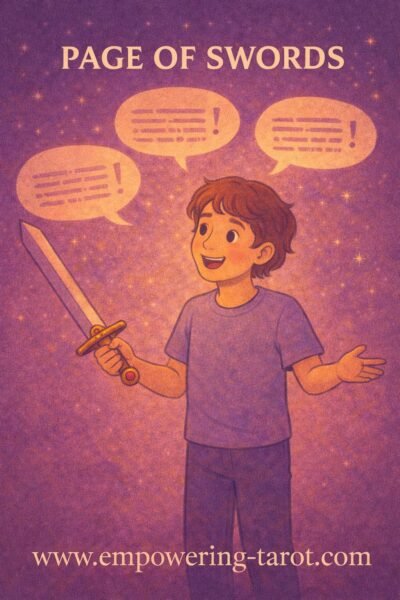
Imagine you’re writing back to Sophie as a professional tarot reader. The Page of Swords is sharp, curious, and alert, but also prone to overthinking and reacting too fast. Your job is to help her find a way to seek clarity without starting a war.
When you’ve written your version, open the spoiler below to see how I approached it. There’s no single “right” answer, but my example will show you one way to channel the Page of Swords in a situation involving gossip, tension, and truth-telling.
Hi Sophie,
Thank you for trusting me with this. Office dynamics can be incredibly draining, especially when you feel like something is off but you don’t have hard proof. That “on edge” feeling is real, and it deserves to be taken seriously.
The card that came forward for you is the Page of Swords. This Page is the observer of the tarot: alert, intelligent, and quick to spot inconsistencies. It tells me your instincts are picking up on tone, timing, and subtle shifts that your mind has been quietly tracking for a while.
At the same time, the Page of Swords can be impulsive with words. It wants to rush in and “fix” things with a sharp conversation, and then realize later that some sentences landed more harshly than intended. So the card’s message neither “ignore it” nor “confront her now.” Rather get clear and choose your words with care.
This Page suggests a middle path: First, gather yourself. Write down what’s actually happened. Write down concrete examples, not just impressions. Then, if you decide to speak to Mara, do it from curiosity rather than accusation. Page-of-Swords energy works best when it sounds like: “I’ve heard a couple of things and I might be misunderstanding, can we please talk about it?”rather than: “You’re talking behind my back.”
You don’t have to swallow this and pretend you’re fine. But you also don’t need to walk in with your sword raised. The Page of Swords asks you to use your intelligence and clarity, not just your frustration.
So no, I don’t see you as “petty” for wanting to address this. I see you as someone who values truth and wants to feel safe at work. The invitation here is to speak up, but to do it in a way that reflects who you are at your best: thoughtful, direct, and fair.
Exercise 1.2
Now let’s add more layers.
This time, imagine you pull three cards for Sophie’s question:
- Page of Swords
- Five of Wands
- Justice
How does the message change when we see the Page of Swords in the context of conflict (Five of Wands) and fairness/ethics (Justice)?
Take your time, write your answer, and then compare it with mine below.
Hi Sophie,
Thank you for your message. The three cards I drew for you, the Page of Swords, the Five of Wands and Justice, give a very clear impression of what is going on around you and how you can move through it.
The Page of Swords reflects you directly. You are alert, thoughtful and sensitive to small shifts in tone and behaviour, and this card shows that you are not simply overreacting. Your perception is working, and it is picking up on something that deserves your attention.
The Five of Wands speaks about the general climate in your workplace. It points to petty tensions, subtle rivalry and small power struggles that never quite become open conflict, but still leave you feeling like you have to be on guard. It is the card of background noise and low level drama, where people talk around each other rather than to each other.
Justice arrives as your guiding principle. It is concerned with honesty, balance and acting in a way you can stand behind later. This card asks you to consider what response would feel fair to you, both towards yourself and towards others, and how you can protect your reputation without becoming part of the same behaviour that is hurting you.
Together, these cards say that you are not inventing this tension, that you are reading the situation clearly, and that your next step is to respond in a way that matches your own values rather than the office gossip culture. In practice, that could look like calmly correcting things when you hear something that misrepresents you, keeping your communication and decisions clear and traceable so your work speaks for itself, and, if it feels right, having a private, straightforward conversation that focuses on the actual impact of what is happening rather than on accusations.
The cards are not pushing you toward a loud confrontation just to prove a point. They show you finding your voice in a way that is calm, firm and fair. You are allowed to set a boundary and still remain completely in your integrity.
Exercise 2
From mental spirals to honest words
In questions about conflict or gossip, the Page of Swords can feel straightforward: it’s about truth, boundaries, and being careful with our words. But what happens when this Page shows up in a love reading — especially when someone is overthinking every message and stalking social media for “signs”?
That’s what we’ll explore next.
Fictional client email
Subject: Why can’t I stop checking his social media?
Hi,
My name is Mira. I’ve been in this… almost-relationship with Tom for the last six months. We text a lot, we see each other regularly, and there’s definitely chemistry, but we’ve never had a clear conversation about what we are.
Lately, I’ve caught myself obsessing. If he takes longer to reply, I overanalyze every word of his last message. I check when he was last online. I scroll his Instagram to see who he’s following. I don’t like this version of myself, but I also feel like I’m trying to protect my heart by staying “informed.”
Part of me wants to ask him directly how he feels and where this is going. Another part is terrified of scaring him off or hearing something I don’t want to hear.
What do the cards say about this situation and what I should do?
Thank you,
Mira
🎯 Your Exercise
For this reading, you draw the Page of Swords.
Think about how this Page behaves in love: curious, mentally active, sometimes anxious, sometimes a little too “online.” How might you talk to Mira about her spirals, her need for information, and her fear of direct communication?
Write your version — then open the spoiler to see mine.
Hi Mira,
Thank you for being so open about this. A lot of people do exactly what you describe, refreshing chats, checking last-online times, scrolling through profiles, but very few actually say it out loud. The fact that you can name it already shows you’re ready to handle this in a kinder way toward yourself.
The card that comes up for you is the Page of Swords. It fits your energy right now: alert, observant, always on the lookout for small signs. This Page is constantly gathering information, almost as if it believes that, with enough thinking and watching, it can stay one step ahead of disappointment.
The problem is that this way of protecting yourself never really lets you feel safe. The more your mind searches for clues, the more it finds things to dissect, and the less space there is for any sense of calm. You are reading between the lines again and again, but the simple truth is that you still do not know what he actually wants, because you have never heard him say it directly.
The Page of Swords in this position invites you to take all that mental sharpness and use it in a straightforward, honest conversation instead of in silent monitoring. That does not mean grilling him or turning the talk into an interrogation. It can sound gentle and clear, something like:
“Hey, I really enjoy what we have. I’d like to understand how you see this and what you’re looking for, so I can be honest with myself too.”
Of course that feels vulnerable. Of course it comes with the risk of hearing something you did not hope for. But it is also the way out of living in permanent detective mode. The Page of Swords is associated with truth, and sooner or later truth has to come from spoken words, not from guesses based on online behaviour.
So the real choice in this reading is whether you want to go on collecting hints and clues, or whether you are ready to ask for clarity and give yourself some peace.
Exercise 2.2
Now let’s see how the story unfolds with a full three-card pull.
For Mira’s situation, imagine you draw:
- Page of Swords
- Nine of Swords
- Two of Cups
How do these three cards together describe her mental spirals, her fear, and the actual emotional connection underneath?
Write your own interpretation first, then compare with mine.
Hi Mira,
For your question, I drew the Page of Swords, the Nine of Swords and the Two of Cups, and together they describe your situation very clearly.
The Page of Swords reflects how you are behaving at the moment: your mind is constantly active, thinking, tracking, checking, reading between the lines. You are trying to protect yourself from disappointment by staying alert to every tiny signal.
The Nine of Swords shows the price you are paying for that. It points to anxiety, overthinking, restless nights and the sense that your thoughts are running the show instead of you. This card is not announcing some catastrophe, it is showing that the real pain is coming from what your mind is doing with the uncertainty, not from a confirmed fact.
Then the Two of Cups steps in and brings an important nuance. There is genuine connection here. You are not inventing the chemistry or the emotional pull. This card speaks of mutual attraction and the potential for a real relationship, but only if both people are willing to show up clearly and honestly.
Taken together, the cards say that there is something real between you, but the way you are dealing with not knowing is exhausting you. The way out is not more watching, it is more truth. To find out whether this will grow into a relationship or remain an almost-relationship, you will need to move out of quiet monitoring and into an open conversation.
In practice, that means easing up on the constant scrolling and checking, not as punishment, but as an act of care for your own nervous system. It also means getting honest with yourself about what you truly want: are you looking for a committed relationship with him, or mostly for relief from the uncertainty you are in right now. When you feel ready, you can ask him plainly where he stands and what he is looking for.
The cards cannot guarantee a specific outcome, but they are very clear on one point: you deserve clarity rather than ongoing mental torment. If there is a future here, it will be built on mutual openness, not on guessing games. If there is not, that truth will still be a gift, because it will give you your time, your energy and your freedom back.
🔍 Closing Thoughts
The Page of Swords is often seen as “just” the card of gossip or sharp words — but as you’ve seen in these exercises, it’s much more layered than that. It speaks to the way our minds defend us by collecting information, the temptation to react too quickly, and the courage it takes to turn spirals and suspicion into clear, honest communication.
The more you practice with realistic scenarios like these, the easier it becomes to recognize when Page-of-Swords energy is healthy curiosity — and when it’s tipping into anxiety, defensiveness, or overanalysis. That awareness will make your readings deeper, kinder, and more precise.
Remember: you can reuse these fictional emails whenever you like. Draw one card, three cards, or a whole spread and see how the story shifts. Each round helps you refine not only your interpretations, but also your tone and boundaries as a reader.
✨ Support & Continue Your Journey
If you enjoyed working through these Page of Swords exercises and would love to experience this style of clear, compassionate reading for your own situation, you can book a personal tarot reading with me at www.empowering-tarot.com — guidance tailored to your life, not just the cards.
If this free course has supported your practice, you can also help keep it alive by leaving a tip via the tip jar in the sidebar (desktop) or at the bottom of the page (mobile). Every contribution, big or small, genuinely makes a difference and helps me keep creating resources like this for the tarot community.
Thank you for spending your time here and sharpening your craft with me. Your clarity, honesty, and curiosity are exactly what make a Page of Swords reader powerful. 🗡️📚
Click here to go back to the Tarot Course Hub