
The Friend in the Chair
Click here to go back to the Hub Page
The argument started, as their arguments often did, when George stretched his legs toward the fire and said, “You refuse to consider the only interesting part of the question.”
Henry looked up from the book he had been pretending to read. “Which question is that?”
“Whether anything of a man survives his body. You say no. You say it the way other men say the moon is made of rock, as if someone had measured it.”
“No one has measured the moon,” Henry said. “But no one has measured a soul either, and yet you are ready to give it room in the world.”
George smiled. “I am not asking for room. I am asking how you would know if you were wrong.”
“I would know if a dead man stood in front of me and spoke. That is the only proof I would accept.”
George leaned forward, elbows on knees. “Then we should arrange a test. If one of us should die before the other, let him appear to the survivor. That would settle it.”
Henry laughed. “You are proposing to haunt me from the grave. That is the most superstitious thing you have ever said.”
“It is superstition only if I believe it will happen. I am proposing an experiment, Henry. You like experiments.”
There was a pause. The fire fell in on itself and sent up a small shower of sparks. George was still grinning, but he was not making a joke. Henry closed his book.
“Very well,” he said. “Write it down. But I will not have it read like a scene from a romance.”
George found a clean sheet of paper and wrote the terms in his clear, unhurried hand: whichever of them died first should, if the thing were possible, appear to the other and make the fact known. Henry read it over twice. He could find no grand language in it, which pleased him. George then took out his penknife and pricked the side of his thumb. A small red bead appeared. He pressed it beneath his name.
Henry took the knife and did the same. It stung, and he watched his own blood darken the paper. He said, “I hope this is the last time I bleed for a question I cannot be expected to answer.”
George bound his thumb with a handkerchief and said, “If neither of us ever dies, we shall look very foolish for having signed it.”
They both laughed then, but the laughter did not quite reach the paper lying between them. George folded it and put it in his coat.
The years after university were not unkind to their friendship; they were simply busy. George took a post in India. Henry remained in Edinburgh, then moved with his work. Letters arrived at long intervals, full of news that came too late to be answered. The letters became fewer. Eventually there were none. Henry did not think of this as neglect. He thought of it, when he thought of it at all, as the ordinary way of things. By December of 1799, the agreement and the man who had signed it had both passed from his daily mind.
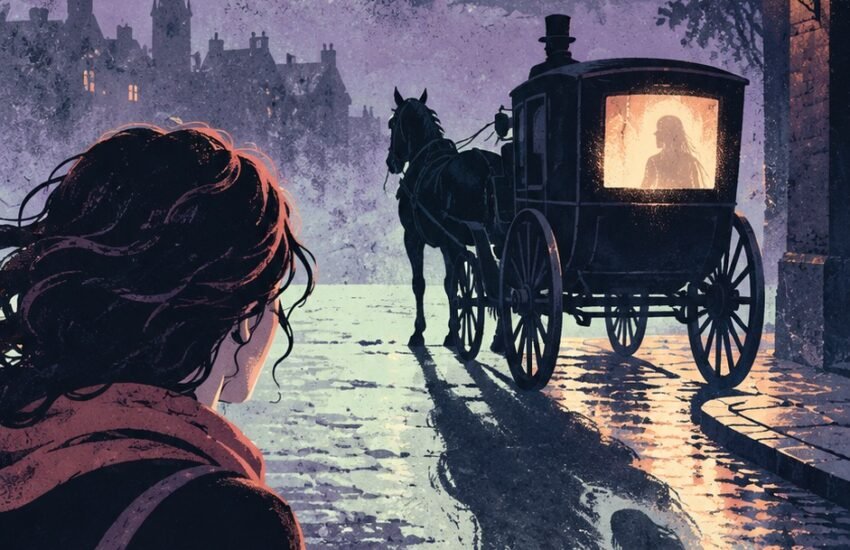
By the time the inn’s sign appeared through the narrow beams of the carriage lamps, Henry had lost all feeling in his feet and most of his patience. The road had been frozen, rutted, and slow. His travelling companion, a younger man, said only that a bed would be enough of a kindness. They reached the door a little after one in the morning. The innkeeper was awake, and the rooms he showed them were plain but warm. Henry asked for a hot bath before he slept. The companion went to his own room without another word.

The servants filled the tub and left. Henry undressed and lowered himself into the water. The heat was almost too much at first, then it became the only comfortable thing he had felt all day. He shut his eyes. He did not mean to sleep, and afterward he did not believe he had. His clothes lay folded on the chair beside the bath.
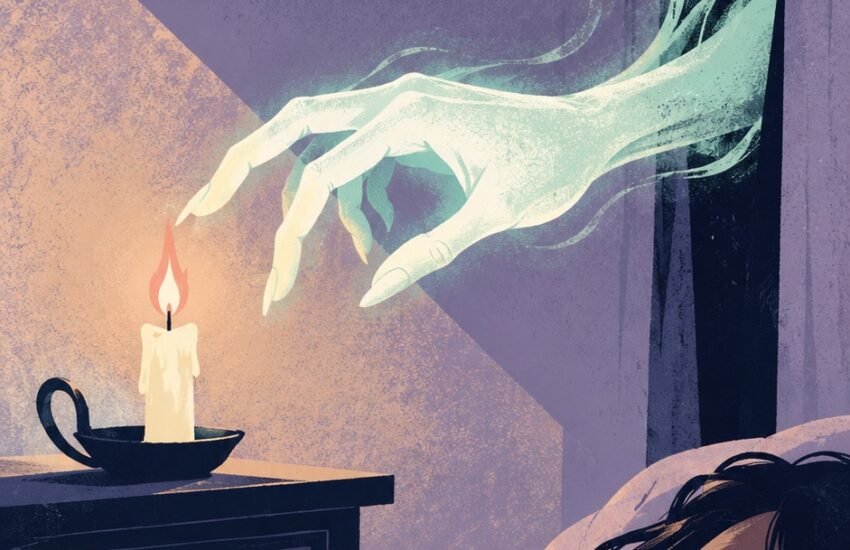
He turned to reach for them, and George was sitting in the chair.
George looked exactly as Henry remembered him from Edinburgh. He was solid, wholly present, dressed in a dark coat with the collar turned up. One hand rested on his knee. His face was calm and familiar. He looked at Henry steadily, without urgency, without any sign that he knew how strange his presence was. He did not speak.
Henry knew him at once. There was no gradual recognition, no moment of doubt. The recognition was the whole event. His body acted before his mind could form a thought. He remembered nothing of leaving the bath. When awareness returned, he was lying on the wet floor beside it, one arm flung out, the boards cold under his back. The chair was empty. The room was as it had been. The door was shut.
He lay there for a long moment, breathing. Then he got up carefully, dried himself, and dressed. His hands were unsteady, but he made himself move slowly. He checked the door. The bolt was in place. He checked the clothes on the chair, the floor beside the tub, the space behind the curtain. There was nothing. George was gone.
He sat down at the little table by the window and wrote in his diary while the details were still sharp. He wrote the date, 19 December 1799. He wrote of arriving at the inn after one in the morning, of taking a hot bath, of turning toward the chair and seeing George sitting there, solid and silent. He wrote that he had come to himself on the floor beside the bath, and that the chair was empty. He added that the old agreement from university had come into his mind afterward, though he had not heard news of him, and could think of nothing during the journey that had called him up.
Then he wrote that he must have fallen asleep in the bath and dreamed the whole thing. The heat, the exhaustion, perhaps the hour, had produced an unusually vivid dream. He remembered being awake, but memory could be mistaken. He closed the diary and put it in his bag.
The next morning he found his companion at breakfast. The man asked if he had slept. Henry said well enough. He did not mention the bath or the chair.
The letter from India was waiting when Henry returned to Edinburgh, folded among a stack of papers that had gathered while he was away. He opened it after supper, more from duty than curiosity. The writer was not a friend of his but a man connected with George’s affairs. The letter reported, in four flat sentences, that George had died. It gave no account of the manner of death. Henry set the letter down. Then he read further down the page and saw the date.
George had died on 19 December 1799.
Henry stared at the date. It meant nothing for a moment, then it fastened itself to a particular page in a particular diary. He went to his desk, unlocked the drawer, and took out the diary. He opened it to the entry he had written at the Swedish inn. It was still exactly as he had left it. The date at the top, in his own hand, said 19 December 1799.
He read the entry again from beginning to end. It described the late arrival, the hot bath, the figure of George in the chair, the empty chair afterward. It mentioned the old agreement and his own insistence in the same entry that he must have dreamed it. The letter gave no hour of death. There was no way to know what hour the dream, if it was a dream, had come. He tried for a few minutes to calculate the difference in longitude, the time a letter took from India, but the calculation was useless. The only fact the two documents shared was the date.
He sat for a long time. The old agreement returned to him with full clarity. Not as a ghost, but as a memory of that cold room in Edinburgh, the small red bead on George’s thumb, the paper folded into George’s coat. He had not thought of it in years. And yet the two dates lay in front of him, matching exactly.
He told himself that he had been asleep in the bath. He had been cold and exhausted, and the heat had done the rest. Dreams came every night. Among so many dreams, one must sometimes correspond with a real event. Coincidence was not evidence. He said this to himself several times, quietly and firmly, as if he were preparing to argue it before a court.
He did not believe it entirely. But he did not believe the alternative either. He closed neither the letter nor the diary. He placed a finger beneath the date in his own entry, then drew it across to the date in the letter. The two sheets lay side by side on the desk, both marked December 19, 1799.
This story is based on a true account included in Andrew Lang’s The Book of Dreams and Ghosts. You can read the original account in the free Project Gutenberg edition. And if you are interested in fresh and modern content about dreams that came true, you can find them in my book “Dreams That Wake You Up”, a collection of real dreams and real outcomes, directly from my clients, printed with their consent.
For more articles and stories from us, click here to go back to the Hub Page