
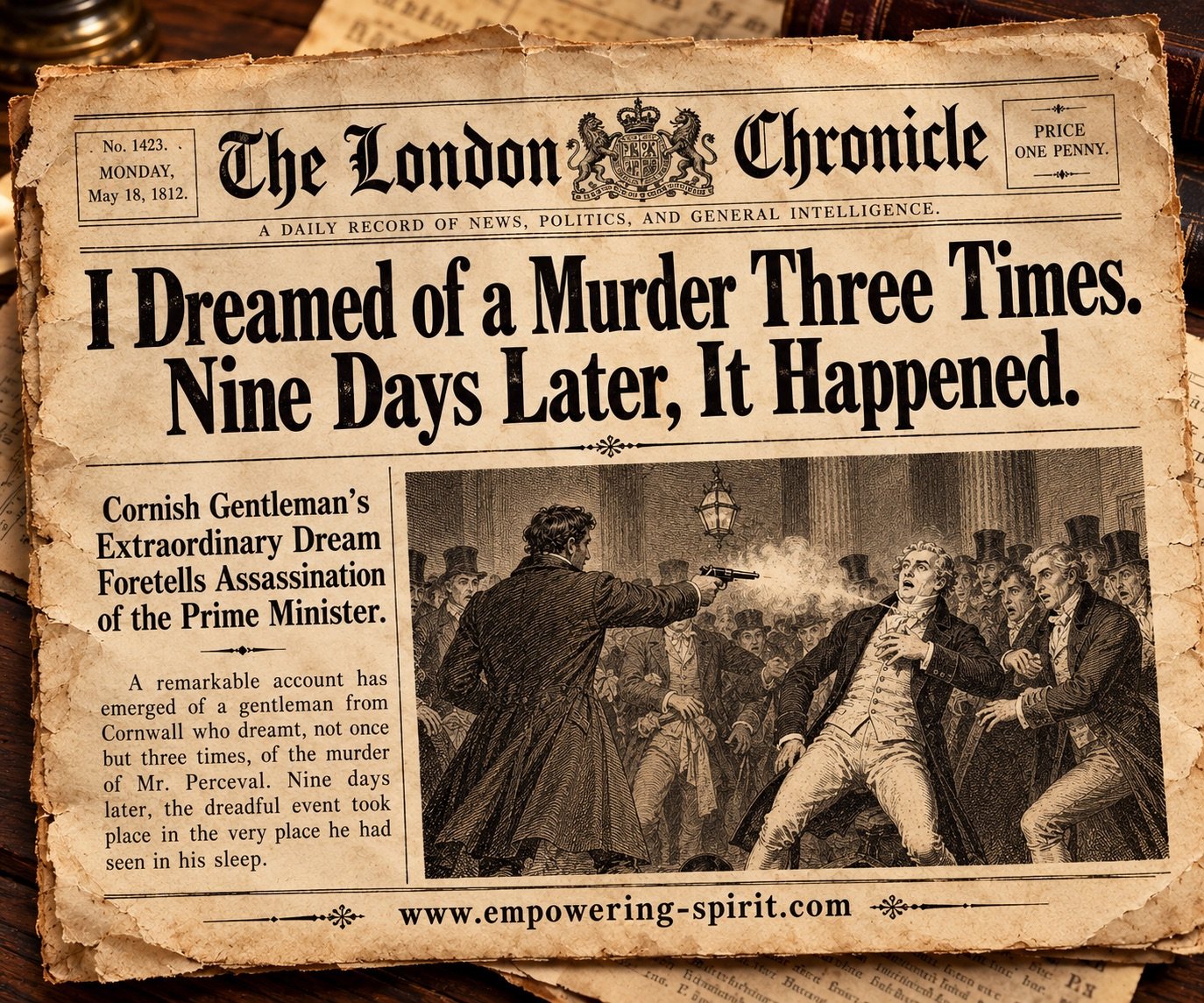
I Dreamed of a Murder Three Times. Nine Days Later, It Happened.
On the night between May 2 and May 3, 1812, Mr. John Williams of Scorrier House, in the county of Cornwall, woke up shaken and sweating for the third time that night. His heart was beating violently, drops of sweat were running down his forehead, and although he had been lying in his own bed, surrounded by the familiar comforts of his home, he could hardly believe what he had just experienced.
For the third time, he had witnessed a murder in his sleep. And for the third time, every little detail had been exactly the same.
Unable to settle his mind, Mr. Williams rose from his bed, lit a lamp, and quickly opened a drawer to retrieve some paper and a pen. He went into the kitchen, sat down at the table, and began writing down what he had just experienced in the middle of the night.
“Three times this night I have been shaken from my sleep,” he wrote, “and three times I have awakened after dreaming of a murder. The dream did not state it directly, but as I am not an ignorant man, I understood that the victim was Mr. Perceval.”
He paused for a moment, setting his pen down on the table. Would anybody believe him? Or would they think he had lost his mind? Perhaps he ought to travel to London and warn the gentleman himself. Surely, if he had witnessed a murder three times in a single night, and each time with precisely the same details, there must be a reason for it.
Then again, it had only been a dream.
He picked up his pen and continued writing.
“Before I lay down to sleep, I was concerned only with my own affairs, paying little thought to anyone but myself. The supervision of the extensive mines here in Cornwall occupies much of my time, and I have hardly any leisure to concern myself with political matters. It is therefore all the stranger that I should have dreamed of a gentleman whose affairs have never occupied my waking thoughts.
In my dream, I found myself in the lobby of the House of Commons, a place well known to me. A small man, dressed in a blue coat and a white waistcoat, entered the room, and immediately I saw another gentleman, whom I had noticed upon my arrival. This second man wore a snuff-coloured coat with metal buttons.
Without warning, he drew a pistol from beneath his coat and pointed it at the smaller gentleman.
The pistol was discharged, and the ball entered beneath the man’s left breast. I saw the blood issuing from the wound, his countenance changed instantly, and he fell to the ground. Upon asking who the unfortunate gentleman might be, I was informed that he was the Chancellor. I understood him to be Mr. Perceval, the Chancellor of the Exchequer.
Several gentlemen who had been standing nearby immediately seized the murderer, and it was at this moment that I awoke.
I told my wife what I had witnessed, but she treated the matter lightly and advised me to go back to sleep. I followed her advice, and before long I found myself dreaming again.
Yet scarcely had I fallen asleep when the same scene presented itself to me. The same gentlemen, the same clothes, the same pistol, and the same dreadful wound. Everything happened exactly as it had before, without the slightest alteration.
I awoke a second time, considerably unsettled, and told my wife again. She once more urged me to compose myself and dismiss the matter from my mind. Although I was troubled, I eventually managed to fall asleep.
And then, for the third time, the same murder took place before my eyes.
Now I have risen from my bed, and I am sitting here, writing down what I have seen. I cannot rid myself of the feeling that I ought to travel to London and communicate this dreadful warning to the gentleman concerned. It seems the proper thing to do, and yet I fear what others might think of me. Who would believe a man who claims to have witnessed a murder in his dreams?”
The following morning, Mr. Williams was still troubled by the question of whether he ought to warn Mr. Perceval. He had plenty of business to attend to, and a journey to London would take him away from his responsibilities for several days, but the thought of doing nothing while a man’s life might be in danger troubled him even more. He could hardly turn up at the House of Commons and demand to speak to the Chancellor because of a dream, yet the prospect of remaining silent and later discovering that something dreadful had happened was equally unpleasant.
At the Godolphin mine, where he had business to conduct that day, he decided to seek the advice of his friends. Surely, among several sensible gentlemen, somebody would know what ought to be done about such an extraordinary experience. He told them about the murder, the clothes the two men had worn, and how the same scene had appeared to him three times in a single night. Then he admitted that he was seriously considering a journey to London to warn Mr. Perceval.
His friends listened with interest, but when it came to the proposed journey, they were quick to discourage him. Imagine the embarrassment if he travelled all the way to London, introduced himself to the authorities, and announced that the Chancellor of the Exchequer was in danger because he had dreamed about his murder! They warned him that he might be laughed at, or worse, regarded as a fanatic, and that the whole affair could bring him considerable trouble.
Mr. Williams could hardly deny that they had a point. He was a respectable gentleman with a responsible position, and the last thing he wanted was to become the subject of ridicule. Eventually, he agreed to abandon his journey, although the decision brought him little comfort. During the following days, he anxiously watched for news from London, paying particular attention to anything concerning Mr. Perceval, and hoping that the dreadful scene he had witnessed would remain nothing more than an unpleasant memory.
For several days, his fears appeared to have been unnecessary. Mr. Perceval continued attending to his duties in London, and life in Cornwall went on much as usual. Perhaps his wife and friends had been right all along, and he had simply allowed a particularly vivid nightmare to disturb his peace of mind.
Then, on the evening of May 13, his son returned from Truro with news that made Mr. Williams wish he had never gone back to sleep that night.
“O father, your dream has come true!” the young man exclaimed. “Mr. Perceval has been shot in the lobby of the House of Commons!”
One can only imagine how Mr. Williams must have felt when he heard those words. For more than a week, he had carried the memory of the murder with him, wondering whether he ought to have warned the unfortunate gentleman, and now his son was standing before him, telling him that the very thing he had feared had actually happened.
On May 11, 1812, Mr. Spencer Perceval, the British Prime Minister and Chancellor of the Exchequer, had entered the lobby of the House of Commons when a man named John Bellingham approached him and fired a pistol into his chest. Mr. Perceval collapsed, the murderer was seized, and the Prime Minister died shortly afterward. It was a shocking crime that would make headlines throughout the country, especially since no British Prime Minister had ever been assassinated in office before.
And Mr. Williams had dreamed of it three times.
Some time later, when business brought him to London, Mr. Williams happened to pass a print shop where a drawing of the assassination was displayed in the window. Naturally, he stopped to look at it. There was the lobby he had seen in his dream, the gentleman in the blue coat and white waistcoat, and the murderer in his snuff-coloured coat with metal buttons. Even the positions of the people standing nearby appeared familiar to him, and when he examined the picture more closely, he was astonished by how precisely it resembled the scene he remembered.
He purchased the drawing and took it home with him, convinced that he now possessed something extraordinary: a picture of a murder he had witnessed in his sleep before it had happened.
By then, his friends and acquaintances had plenty to talk about. After all, Mr. Williams had told several gentlemen at the Godolphin mine about his dream before the assassination, and they could hardly forget the conversation now that the Chancellor of the Exchequer was dead. The story spread, and years later, a gentleman named C. R. Fox would even recall having heard about the dream as a boy, before the news of Mr. Perceval’s murder had reached Cornwall.
But while Mr. Williams was struggling with his extraordinary experience in Cornwall, something equally peculiar was said to have happened hundreds of miles away, in a small Scottish village near Annan.
On Sunday, May 10, 1812, people in Bude Kirk were apparently talking about the murder of Mr. Perceval. The news had somehow reached the village, and as news tends to do, it passed from one person to another, until several inhabitants had heard that the British Prime Minister had been assassinated.
There was just one rather remarkable problem with this piece of information.
Mr. Perceval was still alive.
He would be murdered the following day, on Monday, May 11, in precisely the place the rumour concerned. And when the actual news of the assassination reached Scotland, people naturally began wondering how anybody in Bude Kirk could have heard about it before the murderer had even drawn his pistol.
The incident caused such a stir that the newspapers began investigating. The Dumfries and Galloway Courier reported the extraordinary rumour, and the story was later picked up by The Times. A minister named Reverend Yorstoun even travelled to Bude Kirk to ask the villagers about it, and according to the Perth Courier, he returned satisfied that the rumour had indeed been circulating on the Sunday before the murder.
Imagine being one of those villagers, remembering that somebody had told you about the Prime Minister’s assassination on Sunday, only to discover on Tuesday or Wednesday that the murder had actually taken place on Monday. Would you have assumed that the dates had become confused somewhere along the way? Would you have suspected that somebody had played a peculiar joke? Or would you have begun wondering whether there was something more mysterious behind the whole affair?
One possible explanation was that Mr. Williams’s dream had somehow found its way from Cornwall to Scotland. He had spoken about it openly with his friends, and perhaps one of them had repeated the story to somebody else, who had then told another person, until the original account of a gentleman dreaming about a murder had turned into a rumour that the murder had already happened. It would certainly explain why the villagers were talking about Mr. Perceval before the assassination, although nobody ever managed to trace such a chain of conversations.
Other people were less convinced that the Scottish rumour had existed at all. The Times eventually dismissed the report as unfounded, and with that, the mystery became even more difficult to untangle. Had the villagers genuinely heard about a murder that had yet to take place, or had their memories become confused after the shocking news arrived?
As for Mr. Williams, his dream continued to fascinate people long after Mr. Perceval had been buried. His extraordinary experience appeared in the newspapers, and in 1832, twenty years after the assassination, he signed a written account describing the three identical dreams, his intention to warn the Chancellor, and the terrible news his son had brought home from Truro. By then, he had had plenty of time to think about what had happened, and one can imagine that he had also spent a considerable number of evenings wondering what might have happened if he had listened to his instincts instead of his friends.
Would the Prime Minister have believed him? Would the authorities have taken his warning seriously, perhaps assigning somebody to watch the lobby of the House of Commons? Or would they have dismissed him as a peculiar gentleman from Cornwall who had travelled hundreds of miles because of a nightmare?
Nobody can answer those questions today, just as nobody can explain with certainty what caused Mr. Williams to dream of the assassination or how the strange rumour in Bude Kirk began. More than two hundred years have passed, and the story remains one of those wonderfully peculiar historical mysteries that make you wish you could travel back in time, sit down with the people involved, and ask them a few questions.
Dreams can be remarkably powerful, especially when they return night after night and refuse to leave us alone. Most of us have experienced at least one dream that felt so real that we continued thinking about it long after waking, and perhaps you have even dreamed about something that later happened in your own life. If you enjoy exploring what your dreams might mean, have a look around our Dream Interpretation Library, where you can discover the symbolism behind hundreds of different dream images, or pick up our book Dreams That Wake You Up to learn how to decode your own dreams step by step.
And if you ever find yourself waking up three times in one night after dreaming about exactly the same dreadful event, perhaps you will remember the story of Mr. John Williams of Cornwall.
After all, he had been quite certain that somebody ought to be warned.
The only thing he could never decide was whether that somebody would believe him.
One thought on “I Dreamed of a Murder Three Times. Nine Days Later, It Happened.”