Making Of The Ascended Millennial Oracle
I wanted to make an oracle for a long time. I’m not the kind of person who procrastinates or looks for excuses to avoid the work, but when it came to the oracle, I ran into some very real problems.
First: I am not good at setting print files. I know it’s something I could learn, but honestly? I’m just not interested enough to sit down and actually do it. That’s the truth. When I’m interested in something, nothing can hold me back. I will pour in the hours, obsess, and learn everything I can. But not with print layouts. My whole body says: I’ll pass on this one.
Second: I’m not the best painter in the world. I really tried. For years. I practiced drawing, tried to create nice art, and got to a point where I was pretty decent at copying other people’s art from pictures on the internet. But when it was just me and a blank page, with no template, just the empty sheet, a pencil and my brain, the best I could do was basic manga.
After about five or six years of constant trying, I had to admit it: I’m not talented enough to get where I wanted to go. Going on would have been delusional at that point. Not gonna lie. Practically, that means I am capable of outlining a sketch that someone else could use to bring my vision to life, but I can’t carry the whole visual side alone.
And then there’s the third problem: money. I don’t have a lot of spare cash to invest in my hobbies. I won’t pretend otherwise. Running this homepage, the theme, the plug‑ins … none of that is free. When you’re on a budget, you weigh every purchase. You ask yourself: “Do I want to spend this on art commissions, or do I need that money for other things, like new deco objects for my tarot photos so they look nice, a better phone to take better pictures, Canva or CapCut subscriptions?” Most of the time, those more practical upgrades win, and the oracle gets pushed back to “someday.”
A couple of years ago, I first started noticing those tarot web apps popping up everywhere on spiritual sites. The big players had them first. And I thought: “Maybe I can just hire some developer from Fiverr. Get them to build something simple, a database with tarot cards and my interpretations, a clean visual interface, a ‘draw now’ button, some randomizer code in the back, and boom: one card with a message from the universe. That would actually be nice.”
And the best part? No print files. No messing with layouts. This solved my biggest technical problem right there.
I even talked to a developer about it once. But then I delayed it again.
Then recently I discovered the Tarokina Plug-In for WordPress. And honestly? It felt like a door magically opening. This was exactly what I wanted, but polished, professional, nice-looking. Not some clunky self-made thing. For under 70 USD a year.
I saw it. I grabbed a brand new notebook. And I started getting to work.
And then there were the visuals.
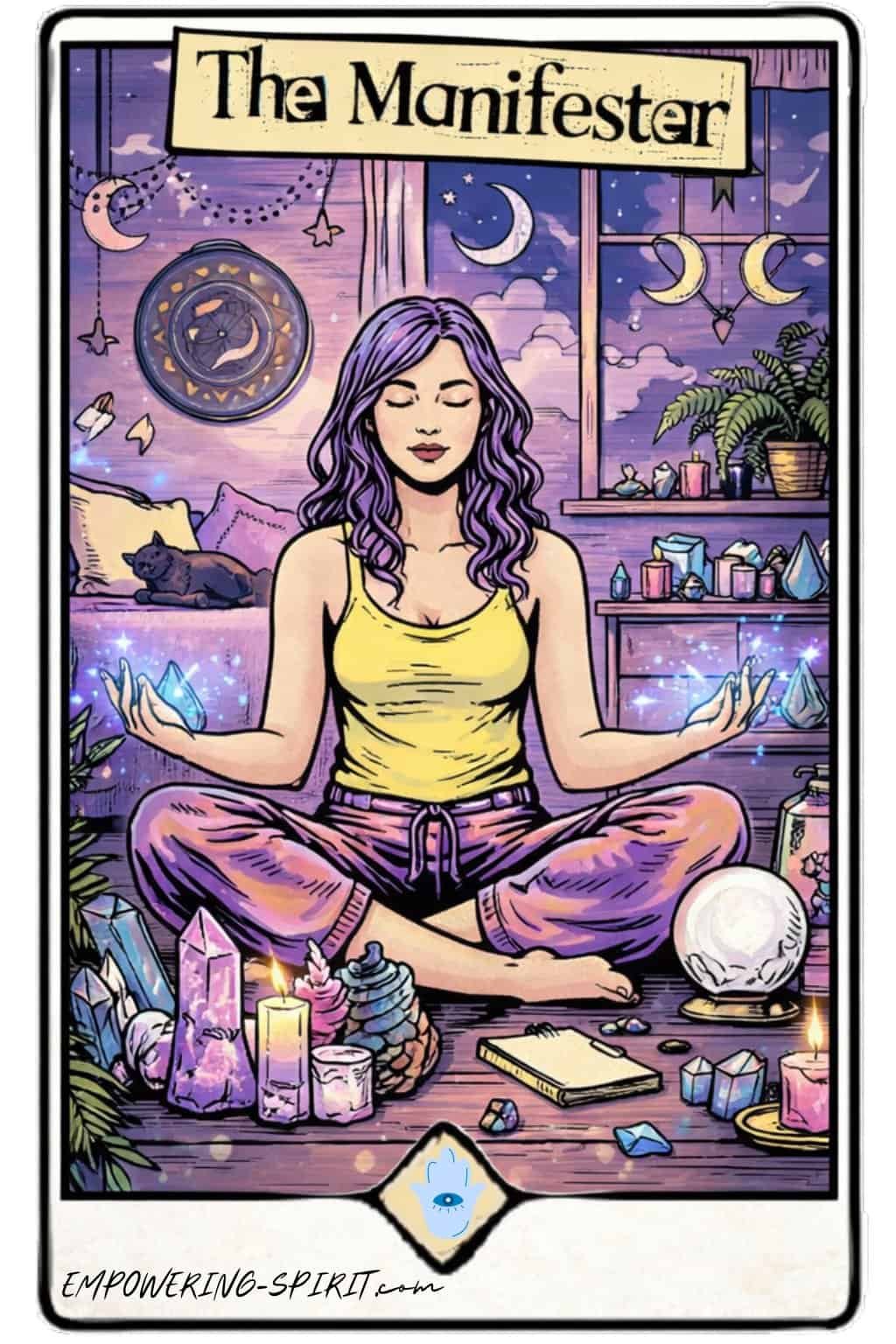
Obviously, my artwork is AI-made. I did three rough sketches on paper. Lineart (not good lineart by any means but it worked). I outlined the basic card shapes and that little rhombus at the bottom to set the style, grabbed some crayons from my daughter’s drawer and picked a color scheme. Fed them into AI, tweaked the prompts until I got something I could live with, set that as my template, and the rest came from written descriptions leaning hard on those first sketches.
Yes, I do feel bad about it. Yes, I know exactly how AI art works. It’s trained on stolen artwork. I absolutely know this. And I know people like me, using it for our projects, are filling the internet with noise that drowns out real artists who actually put in years of work. There’s no excuse for it. Just straight-up hypocrisy.
Yet I wanted my oracle. I wanted it cheap. And I wanted it now, not when I’d finally saved up enough to pay an artist properly. And I didn’t even want to print it. I wanted a web app. My decision came down to availability and affordability, knowing full well people judge those choices hard.
I just thought my oracle idea was genuinely cool. The hilarious symbolism, the modern truths that actually hit people where they live. I hoped others might enjoy it too. I hope people see it for what it is: a pretty cool oracle with sharp, relevant messages, rather than getting hung up on how it was made: with cheap tools instead of proper ones.
I just hope that doesn’t distract from the magic inside.
How the First Card Was Born: From “The Lover” to “The Fuckboy”
The first thing I did, before generating any images, was grab that new notebook, pull out an old fortune‑telling deck, and sit down on my ass to actually work.
For me, those old fortune‑telling decks have a kind of magic that tarot doesn’t. They’re pure prediction tools. They don’t talk in archetypes or psychology. They just say things like: “A man in uniform will deliver a letter that will inform you about a girl’s illness.” And honestly? I think that’s pretty cool. Just… not exactly up to date.
So I took the first card and really looked at it: “The Lover.” A man who looks very much like a Victorian fuckboy. Not reliable. It’s “The Lover,” not “The Husband”, and given how old this deck is, that alone says a lot.
I started asking myself: What actually sets “the lover” apart from “the husband”? What are his core attributes? What would the modern version of this energy be?
Since the word “fuckboy” had already run through my brain pretty early, I thought: fine. Let’s call it what it is.
Then I went deeper: what is a fuckboy, really?
A fuckboy is someone who refuses to commit (to you) but keeps you in a loop of constant hope that almost certainly turns out to be in vain. He’s unfair. He knows damn well you’re already fantasizing about your wedding dress. He knows damn well he has zero intention of making anything official, and still he stays, taking everything he can possibly get until you finally have enough and kick him out.
It’s not just about romance. It’s about hope that is in vain.
So in my notebook I wrote the first translation of an old card into my oracle language:
“The Lover = The Fuckboy. It’s time to give up on something that is just out of reach.”
That was the moment I knew what this oracle was going to do: take old fortune‑telling energy and translate it into modern, brutally honest language that doesn’t pretend you’re the problem when the situation is.
I went on like this, card by card. “Luck.” What does luck even mean in modern times? Landing a viral hit on TikTok. My husband once had one. Nearly 100,000 views. Guess what it was? A horoscope I wrote for my own TikTok channel. He asked me to rephrase it for him because he wanted to post one too. I have 1,100 followers. He has 120. My video stalled at 700 views. His went semi-viral.
Deeply unfair. Completely unexpected. Impossible to repeat. That was pure luck.
Then came “The Thief.” Thieves are still thieves, and time hasn’t changed that. But you know what the really nasty modern thieves are? Yahoo Boys. Those love scammers, mostly from Nigeria (sorry to my Nigerian friends, this is by no means an insult, but with 200 million people, some are just wicked, that’s pretty normal). They prey on lonely hearts and squeeze money out of them. I’ve had several clients who fell victim, mostly women from the UK. Sometimes when someone requests a love reading and the cards fall a certain way, instead of jumping straight in, I just ask: “Have you ever met them in person?”
Every time, my heart bleeds for those women. I want to cry. I’m grateful I could help spot it multiple times, but I’ve also seen how brutal the recovery is. The money loss hurts, especially when it’s savings for something specific. That takes time, but finances recover. The emotional damage to already vulnerable people? That’s insane. It destroys trust, self-worth, everything.
So yeah, in my deck, the bad guy is definitely the Yahoo Boy.
The Enemy became The Karen (internet’s universal enemy). The Widower became The Boomer. The Widow became The Cat Lady (obviously). The Judge became The Comment Section, because honestly, no one judges like Instagram comments do.
And there’s one card especially close to my heart: the original “Loss” card. I couldn’t stop giggling when I renamed it: “The Avocado Toast.”
“You could easily afford a house if you didn’t spend your money on overpriced Starbucks coffee and avocado toast.” OK Boomer. Whatever you say.
This one made me laugh out loud, and I hope it makes other people laugh too, and brightens their day just a little.
What was crucial during the whole process was making sure this wouldn’t turn into an insider joke. I could have referenced Hitchhiker’s Guide to the Galaxy (42) or Buffy the Vampire Slayer or something even more niche, but what’s the point? Half the readers wouldn’t get it. So it was essential to me to use humor that’s original but accessible, jokes the majority would understand without explanation.
I hope I’ve built that bridge well with the Ascended Millennial Oracle.
Then came the name.
I wanted to call it exactly what it was. I’d already created some cards with those astro-girlie-vibes aesthetics, and the humor was straight-up Millennial (or Gen Z). I pulled out my deck collection and looked through all those angel cards: the ones with their soft glows and celestial promises. And I thought: I might as well position my deck right there, but with a twinkling eye and a bit of a joke.
That’s how “The Ascended Millennial” was born. It was a playful wink at those angel decks, a little irreverence mixed with positioning. Referencing the heavenly archetype while setting the stage for the humor that runs through every card. Angelic vibes, millennial edge. Perfect.
Then I started thinking about the oracle cards I love—the ones where the guidebook is just too good.
They often reference angels or the “higher self” as messengers, delivering wisdom in that elevated voice. I wanted my Ascended Millennial to work the same way: a messenger for what I had to say, but in my style.
I knew exactly how I wanted the structure to feel: that glossy, expensive magazine vibe for women, like something straight out of Sex and the City. Start with a vivid situation description that pulls you in, then slide smoothly into the message. Humorous, never mean.
I’ve seen that new wave of tarot readers on Reddit, the ones who brand themselves as “truth-tellers” dropping “truth bombs.” Most of the time, they’re just being mean. I didn’t want that. I wanted people to read the guidebook intro, understand the symbol I chose, get the message, and walk away feeling seen, understood, empowered, uplifted, and energized for the day.
I hope I’ve pulled that off, but you can try it yourself right now, the oracle is live at the top of www.empowering-spirit.com.
When I finished my first guidebook-style section and message, something felt off. The intro paragraph wasn’t quite bridging the gap between the card’s image/title and the core message. Why this symbol for this exact message?
So I added a second section that goes deeper into the symbolism. After all, these are my symbols, my thought process, my connections. They’re not universally obvious, but once I explain how I got there, they make perfect sense.
I repeated that two-part structure for every card: guidebook intro + symbolism deep dive. Clean, consistent, complete.
After I had written it all out in a Numbers spreadsheet–every card, every intro, every symbolism deep dive—it was finally time to sketch my (admittedly rough) sketches, generate the images, download Tarokina, figure out how it worked, and set up the actual oracle.
Now I knew my traffic patterns cold. Most visitors are dream-traffic-people googling a specific dream symbol, landing on my page, staying an average of 1:40 minutes, reading that one article, and leaving (hopefully satisfied with an answer). They were never going to click to the front page. They were never going to stumble across the oracle.
So I downloaded another plugin, set up a pop-up, delayed it to 30 seconds after session start, and linked it straight to the oracle. (I also wrote about it in my newsletter, but I already know my opening rates are highly unreliable and unstable. Sometimes I wonder if those emails trigger spam filters randomly, but I haven’t figured that one out yet.)
Then I sat back and watched the conversion rate of my pop-up. It tracks every click, so I could see exactly how many people actually found their way to the new oracle.
But the best thing was yet to happen.
My 12-year-old daughter discovered it, about a week after I’d launched. And she started playing it. Over and over and over again.
That paid me back for every single hour of work I’d put in there. She was proud of her mommy.
(She even wanted to make her own oracle, but her being her, after half an hour she got bored and went back to watching Buffy the Vampire Slayer again. After we’ve gone through this rewatch-thing with Frozen and Moana, I really hoped she’d grow out of it eventually. But so far only the movies have changed, not the pattern. Parents, how long do children do this kind of thing? Will it ever stop? And why is Buffy being so mean to Spike? I mean, we’re all Team Spike here!!! Why the hell is this woman so mean?)
Okay, and this is how my first oracle came to life.
I really enjoyed the process. I definitely will make another one, I just don’t know when I’ll have time to sit down and tackle a project like this again. Despite it being a low-budget production, I poured my heart into it. It took several weeks of dedicated work.
I have so many ideas. I want the knowledge database to grow. I have books to write.
And I’m really curious about your opinions on the oracle. So if you’ve played it, feel free to write me at oracle[at]empowering-spirit.com and tell me what you think.