
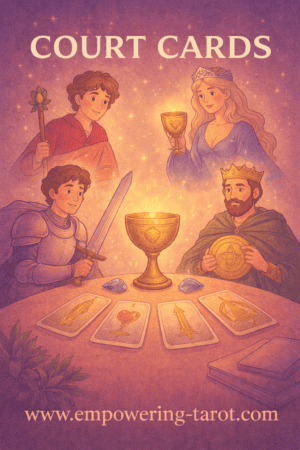
About the Court Cards
Click here to go back to the Tarot Course Hub
Court Cards in Tarot
Why They’re Not Just “Random People” (and How to Actually Work With Them)
Let’s start with the obvious:
Court cards confuse the hell out of most beginners.
Even readers who feel like they’re finally getting a handle on tarot — they’ve memorized the suits, they understand spreads, they’re feeling pretty good about themselves — will suddenly draw a Page, a Knight, a Queen, or a King…
…and everything just kind of stops.
There’s this awkward mental pause, and then comes the spiral:
“Wait—who is this supposed to be?
Is it me?
Is it my ex?
Is it my crush?
Is it that girl he used to see before me?
My boss? My mother-in-law?
Do I even know this person?
Am I about to meet them?
What the hell is going on?”
It doesn’t help that most tarot books don’t exactly clear things up. They’ll tell you that court cards can represent a person. Or a situation. Or yourself. Or “an energy.”
Which sounds helpful until you realize that means: this card could be everything and nothing at once.
That’s where the guessing game starts.
You find yourself mentally flipping through your contact list, trying to match a tarot card to someone’s hair color or sun sign. And before you know it, you’re not even reading anymore — you’re just projecting. Second-guessing. Making it up as you go and hoping something lands.
This chapter is here to gently pull you out of that mess.
You’re not doing it wrong. You’ve just been handed too many vague possibilities and not enough actual guidance.
By the time we’re done here, court cards won’t feel like the weird, mysterious “people cards” you’re supposed to figure out on your own. They’ll make sense. They’ll click.
You’ll know why they show up.
You’ll know how to read them.
And most importantly — you’ll stop feeling like you have to guess who they are, and start seeing what they’re actually trying to tell you.
Because court cards aren’t random strangers walking into your reading.
They’re something much more useful than that.
They’re the human layer of the tarot — the part that shows you how real people move through the energy the rest of the cards are describing. And once you understand that, they stop being a mystery.
They start becoming one of the most practical, grounded, and honest parts of the whole deck.
So… What Are Court Cards, Really?
Let’s just get the basics out of the way:
Each suit in tarot has four court cards —
Page, Knight, Queen, and King.
And we’ve got four suits:
Wands, Cups, Swords, Pentacles.
That gives us 16 court cards in total.
If you’ve been reading for a while, or if you’ve flipped through a few guidebooks, you’ve probably seen a few different ways people interpret them.
Some assign court cards by sun sign. Others by hair color and eye color. Some readers have specific people in mind — the Queen of Wands is always their sister, the Knight of Swords is always that one coworker.
And let me say this very clearly:
If that works for you? Please keep doing it.
If you’ve found a method that clicks — if your readings are accurate and people leave feeling seen and supported — there’s no reason to change it just because someone on the internet says it’s not “the right way.”
This course isn’t here to police how you read.
It’s here to give you an approach that tends to work for most people, most of the time, especially when you’re still building your confidence.
So yes — court cards can represent people.
But in my experience? Most of the time, they’re not about someone else.
They’re about you.
They’re about the role someone is stepping into, the energy that’s present, or the way a situation is being handled. They show how a person (often you) is currently moving through the world — not just what’s happening, but how it’s being lived.
Because the real question isn’t:
“Can court cards stand for people?”
We know they can.
The better question is:
What are court cards doing that the rest of the deck can’t?
And once you see that clearly, they stop being confusing — and start becoming one of the most useful tools in your entire deck.
Why Court Cards Exist (When We Already Have Aces to Tens)
Let’s pause for a second and clear up something that might already be forming as a quiet doubt in your mind.
Because if you’ve just been told that court cards aren’t necessarily people — and that you don’t need to assign each one to a specific friend, lover, coworker, or crush — you might be wondering:
“Okay… but then what are they even for?”
A completely fair question.
After all, the rest of the suit is already there, right?
Ace to Ten — that’s a full story. A beginning, a build-up, a struggle, a peak, and an outcome. What else is there to say?
So why throw in four more cards?
The answer is: because the numbered cards tell you what is happening — but they don’t always tell you how a person is living through it.
The court cards don’t repeat the pip cards.
They add the human layer.
If the Ace through Ten is the plot…
The court cards are the characters moving inside it.
If the numbered cards describe the weather,
The court cards show you how someone walks through the rain — whether they throw on a raincoat and get moving, or just stand there complaining about being wet.
Let’s take one of the clearest examples, because this is where people often think tarot is repeating itself:
Ace of Pentacles vs Page of Pentacles.
They both feel new.
They both feel like something beginning.
But the moment you look more closely, the difference becomes obvious.
The Ace of Pentacles is the offer.
It’s the scholarship that gets approved.
The “We’d like to hire you.”
The email saying the apartment is yours.
The green light.
The seed moment where something solid becomes possible.
The Page of Pentacles isn’t the offer.
It’s the person holding the offer.
The one who’s thinking it through. Turning it over in their hands. Studying the fine print. Wondering what it’s going to take to really follow through. Maybe doubting themselves. Maybe quietly excited. But either way, present. Engaged. Awake to the work ahead.
That’s why court cards matter.
They don’t just show who’s in the scene — they show how they’re reacting to what’s happening.
You can be handed an opportunity (Ace of Pentacles)…
and immediately start overthinking it (Page of Swords).
You might panic, act impulsively, and then try to fix it mid-run (Knight of Swords).
You might get dreamy and excited, but never move past the fantasy stage (Page of Wands).
Or… you might roll up your sleeves, get to work, and show up like you’ve been doing this your whole life (King or Queen of Pentacles).
Same offer.
Totally different human response.
That’s the gift of the court cards:
they turn tarot into something honest.
Without them, the cards might still describe what’s happening — but nobody’s responding to it.
It’s like watching a weather report where the forecast changes every day, but everyone keeps walking around in the same light jacket — no matter if it’s snowing, storming, or 36 degrees. No umbrellas. No sunglasses. Just humans, pretending the conditions don’t matter.
Court cards fix that.
They show you who’s paying attention.
Who’s prepared.
Who’s overwhelmed.
Who’s winging it.
Who’s quietly leveling up.
Because at the end of the day, we’re not just here to ask what’s going on.
We want to know how we — or someone else — is going to meet it.
Court cards tell the part of the story that most people are actually here for:
“What am I doing with this?”
“How am I showing up right now?”
Because at the end of the day, we want to understand the way we’re reacting and what we make out of the situations that life hands us.
The Safest Place to Start
Here’s how I teach court cards — not as a hard rule, but as the gentlest, clearest place to begin.
If you’ve just pulled a court card and you’re not sure what to do with it — if your gut’s not saying anything loud yet, or you’re staring at the spread wondering, “Okay… but who even is this?” — this is the starting point that will serve you well almost every time:
Read the court card as the energy the querent is embodying in the situation.
That might be you.
That might be the person you’re reading for.
Either way, it’s not about fixed labels. It’s not about finding their “soul card” or boxing them into a personality.
It’s just:
Here’s how they’re showing up right now.
Here’s the role they’re stepping into.
Here’s the energy they’re carrying, consciously or unconsciously, in this moment.
This approach isn’t flashy, but it’s solid. It’ll hold your reading steady while you’re still building experience. Especially in the beginning — when you’re not yet sure if the card points inward or outward, if it’s a reflection or a reaction — this is your safest bet.
Because most of the time, that’s exactly what the court card is doing.
It’s showing how someone is moving through the situation — not watching from the outside, but participating in it.
Later on, as your intuition deepens and your confidence grows, you’ll get that quiet gut feeling:
“Wait, no — this time it’s about the other person.”
Or: “This is a dynamic.”
Or: “This one’s situational.”
And you’ll learn to trust those moments — to shift when the reading calls for it, to be more flexible, more instinctive. That’s part of growing as a reader.
But when you’re just starting out?
When you’re practicing?
When you’re looking at a court card and you honestly don’t know what it’s doing there?
Start here.
Read it as the querent’s energy in the moment.
It’ll give you clarity, direction, and a clean reading — far more often than not.
And even when you’re no longer “new” —
you’ll probably find yourself returning to this approach more often than not.
Because the truth is: it works.
You’re Not Just One Court Card
Here’s another quiet trap a lot of people fall into — especially early on.
You pull a court card. You recognize yourself in it. You think, “That’s me.”
And next time another court card shows up, you think, “Well, it can’t be me again — I was the Queen of Cups last time, so this one must be someone else.”
But here’s the thing:
Court cards aren’t personality labels.
They’re not Hogwarts houses.
You’re not “assigned” to one and stuck with it forever.
They’re roles. Archetypes. Energies.
And they shift — just like you do — depending on where you are in your life, what you’re going through, and what the situation is asking from you.
You can be the Page of Pentacles when it comes to love — a little cautious, taking your time, still figuring out what stability means.
And at the very same time, you might be the Queen of Cups in your work — fully present, nurturing, connected to your purpose and the people around you.
You can be the Knight of Swords in a conflict — fast-talking, frustrated, trying to fix things with words that come out too sharp.
And maybe, in your creative life or your personal vision, you’re showing up like the King of Wands — bold, clear, no longer apologizing for your ideas.
Different area of life.
Different energy.
Still you.
So if a court card appears again and your first thought is,
“Well, this must be someone else because I already had that one,”
pause for a second.
It might just be you — again — but in a different context. A new chapter. A new side of yourself stepping forward.
Tarot isn’t here to box you in.
It’s here to reflect your movement, your growth, your shifting responses to life.
Court cards follow that movement. They grow with you.
When a Court Card Is Someone Else
Now let’s get real about something else, because this part matters too:
Sometimes — yes — a court card is another person.
For some readers, that’s actually how they read all court cards. They pull one and immediately assign it to someone outside the querent: a boss, a love interest, a rival, a friend. And honestly? For some people, that works just fine.
If you’re one of those readers and you get consistent, accurate results doing it that way — beautiful. Keep doing what works. I’m not here to tell you to fix what isn’t broken.
But for most people, most of the time — especially when you’re still building confidence — that approach can lead to a lot of confusion, projection, and drama that isn’t actually in the cards.
Just because a court card shows up doesn’t automatically mean someone else just entered the story.
Usually, for a court card to clearly point outward — to a partner, a third party, a coworker, a parent, a crush, whoever — the reading itself will let you know. Strongly.
Maybe the spread position literally says “their intentions” or “the other person.”
Maybe the entire question is about someone else’s behavior.
Maybe the cards around it all echo that this isn’t about the querent — this is something external.
And maybe — just maybe — the whole reading doesn’t make sense unless you allow for the fact that a second person is holding some major weight here.
But even then — even when the card points to someone else — it’s still not giving you their passport photo.
It’s not telling you what they look like, what sign they are, or what their name is.
It’s telling you how they’re behaving.
It’s showing their role.
It’s showing the power dynamic they’re bringing into the situation — and whether they’re acting like a Page, a Knight, a Queen, or a King.
Most of the time, though?
Court cards are way more useful when we start by asking:
“How am I showing up here?”
Let’s say you’re doing a love reading. There’s three court cards in the spread. And you’re wondering, “Is this a third person? A rival?”
If there’s no Three of Cups, no Three of Swords, no clear position for a second love interest, and no external confirmation in the cards?
Then the court card is probably not your competition.
It’s probably your own energy — the way you’re showing up in the connection, in a specific kind of situation. Maybe even the way you’re sabotaging it without realizing.
Same goes for questions like “What’s blocking me?”
If the spread says something’s opposing you and a court card shows up, most beginners will think: “Aha — this is someone else standing in my way.”
But more often than not?
It’s you.
It’s your Knight of Wands energy running wild.
Your Queen of Swords detachment.
Your Page of Pentacles fear of committing.
Your inner King of Cups who has built emotional control into a fortress nobody can get through.
Again — not always. Sometimes, yes, it is a colleague. Or a family member. Or a lover from the past showing up uninvited in the present.
But you’ll know when that’s the case.
The cards will say it loud.
And your gut will follow.
Until then, the safest and most grounded place to start is always here:
What if this is me?
What if this card is trying to show me something I’m doing — or not doing — that’s shaping this story more than I want to admit?
When you can ask that, your readings get sharper. Truer. Cleaner.
And no court card will ever confuse you again.
How to Level Up (Without Spiraling)
So let’s say you’ve been working with the safest, most grounded approach:
you’ve been treating court cards as the querent’s energy, every time, without overthinking it.
You’ve gotten confident.
You’re no longer panicking when a Queen or Knight shows up.
You know how to read them as roles, as patterns, as energy in motion.
Beautiful. You’re ready to go a little deeper now.
Here’s the next step — and it’s not a big leap. It’s just this:
When a court card shows up in a reading, and you feel that little flicker of doubt —
“Wait… is this actually about someone else?” —
you don’t push that thought away anymore.
You let yourself explore it.
Gently. Slowly. With curiosity.
No panic. No need to get it “right.”
You simply ask:
“What if this card is still about the querent — but what if it’s not?
If it’s not them… who might it be?
And what does the rest of the spread have to say about it?”
This isn’t about guessing.
It’s about listening — to the spread, to the question, to the position, to your body.
Let’s break it down in a soft, intuitive way.
Start with the default.
If you’re not sure — go back to what you know works.
Ask yourself:
“If this is the querent, how does that fit what’s going on?”
Try it on. See if it clicks.
You might feel that quiet little “ugh… yep, that’s them.”
That feeling is gold. Trust it.
But if it doesn’t sit right —
if it keeps poking at you like, “No… this feels like someone else entirely” —
then start looking for confirmation.
Does the spread position point to another person?
Are we sitting in the “partner” seat, or “the other side of the story”?
Is the whole reading focused on a relationship dynamic or someone else’s actions?
Is the surrounding energy consistent with an outside force?
Do we have cards that suggest a love triangle, like the Three of Cups or the Three of Swords?
Is there tension showing up in the Swords or Wands that doesn’t feel like the querent’s own baggage?
Sometimes the court card doesn’t even represent a person at all.
It might be a situation that carries a very human tone — like a moment of idealism, or control, or caution, or power play.
Think about it like this:
- The Page of Cups might not be a sweet, shy person — it might be a daydream, a soft hope, a beginning so delicate it hasn’t grown legs yet.
- The Knight of Pentacles could describe a stuck process — something reliable but slow, something that’s just not picking up speed.
- The Queen of Swords might show up not as a person, but as a moment of cool, necessary detachment — a vibe that’s present in the space, even if no one’s fully owning it.
These cards are human-shaped, yes. But that doesn’t mean they always belong to a single person.
Sometimes they’re the atmosphere. Sometimes they’re the tone.
And your job isn’t to pin them down — it’s to read what they’re doing.
Still unsure?
Ask.
That’s what your deck is for.
But — one important note here — if you do pull a clarifier, ask something the deck can actually answer.
Please don’t ask:
“Is this me or someone else?”
Because what will you even do with that?
Pull the Eight of Pentacles and then… what? Is that a yes? A no? Your boss? Your ex?
You’ll just end up staring at it, confused.
Instead, try something the deck knows how to respond to:
“What role is this court card playing here?”
“What energy is at work in this card?”
“What does this card want me to notice or address?”
Your clarifier won’t hand you a character sheet.
But it might show you a mood. A lesson. A theme.
Something that helps you feel into where the court card belongs.
Let’s say you pull a Three of Cups — suddenly, the Queen of Wands might not be you, full of confidence. She might be her. The third person. The one who’s part of the triangle.
Or the Five of Swords, Seven of Swords — these scream betrayal.
And here’s the thing:
If you had done the betraying, you’d know.
So if that card lands and your stomach sinks at the thought of someone else crossing a line… trust that.
A Two of Cups as a clarifier might gently point you back to connection.
Maybe that Queen of Swords isn’t cutting someone off — maybe she’s holding space for a conversation that still matters.
A Devil card might shift the court card entirely into pattern territory — codependency, avoidance, control.
You won’t get a name.
But you’ll get enough to make an informed, intuitive guess.
And that’s more than enough.
Because clarity isn’t always a sentence.
Sometimes it’s a deep breath, followed by:
“Yeah… I see it now.”
And here’s the best part:
The more you allow yourself to explore these questions — slowly, compassionately — the stronger your instinct will get.
You’ll start to know.
Not guess, not panic, not hope — just know.
At first, you’ll go back to the safe method. That’s okay.
But over time, you’ll feel the difference between:
“This is me, reacting to the storm”
and
“This is someone else, bringing the storm in.”
And just like that, your court card readings will stop being basic…
and start becoming brilliant.
A Gentle Word About Hair/Eye-Color Systems
If you’ve made it this far, chances are high you’re genuinely invested — not just pulling a few cards and calling it a day.
So let’s take a respectful moment to acknowledge one of the oldest fortune-telling systems out there:
Hair and eye color assignments.
You’ve probably come across it at some point:
- This suit = blond hair and blue eyes
- That one = dark hair, brown eyes
- Another = redheads or green eyes
… you get the gist.
Let me say this clearly and with love:
👉 If you’ve been using this system for years and you get excellent results with it, please keep it.
I am not here to pry your favorite tool out of your hands.
Tarot is practical.
If your method consistently speaks truth into people’s lives — it’s valid. Full stop.
The reason I don’t teach this method as part of the core framework in this course is simple:
- For many readers, it becomes confusing very quickly.
- It can reduce a card that holds rich psychological insight into a shallow guessing game about appearance.
- And most importantly: For most people in most parts of the world, this system is useless.
Hair color and eye color might vary wildly among Europeans and white Americans — and sure, some white folks tan, some burn, some go brown, some go red.
And yes, among Black folks, some skin tones are lighter, some darker. There’s diversity everywhere — but when it comes to hair and eye color specifically, let’s be real:
If you’re reading cards in Japan, India, Thailand, Nigeria, or Brazil — or honestly, most of the globe —
then saying “this card means a person with light brown hair and blue eyes” is not just unhelpful.
It’s irrelevant.
Most people around you will have brown eyes and black or dark brown hair.
Trying to pin court card meanings to physical traits in that context turns a reading into a wild guessing game. It’s frustrating.
And worse — it can subtly limit the power of what the cards are actually trying to say.
In this course, we anchor court cards in something more universally useful:
Energies. Roles. Patterns of behavior.
Things you can recognize no matter who is sitting across the table — or what they look like.
Still, if the physical description system works for you and your people, there’s no need to abandon it.
Just let this course give you another way in.
A Quick Note on Zodiac Signs as an Overlay
Another system that readers often come across is the astrological overlay:
- Wands = Fire signs (Aries, Leo, Sagittarius)
- Cups = Water signs (Cancer, Scorpio, Pisces)
- Swords = Air signs (Gemini, Libra, Aquarius)
- Pentacles = Earth signs (Taurus, Virgo, Capricorn)
Some readers love this — and honestly, sometimes it really does align spookily well with someone’s birth chart or sun sign.
In my world, this system lives in the “nice extra” category.
You’re absolutely welcome to bring it in, especially if astrology already feels natural to you.
But don’t let it stress you out.
You are not doing tarot “wrong” if you don’t match every Page or Knight to a zodiac sign.
Your real foundation is always:
- What’s the element behind this suit?
- What’s the role being played?
- How is that energy moving through this specific situation?
Everything else — hair color, eye color, zodiac overlays — is spice.
And you’re the chef.
🌟 Choosing a Deck When Court Cards Scare You
One last gentle tip before we move on.
If you’re still building confidence — and court cards tend to trip you up — then be a little strategic about your deck choices.
Some decks make the learning curve steeper than it needs to be. Others do half the work for you just through their imagery.
Here’s what to watch for:
Some decks…
- stick to the traditional Page / Knight / Queen / King format — often with very gendered, sometimes stiff roles
- swap in titles like Daughter / Son / Mother / Father, or Princess / Prince — which can help or confuse, depending on how it’s done
- feature animals or archetypes instead of people — which can be beautiful, but might make it harder to feel into human energy
- lean very heavily masculine or feminine in all their court imagery — sometimes helpful, sometimes limiting
☝️ None of this is wrong.
But if court cards are already a challenge, these choices can either support you… or tangle you up.
💡 Choose a deck where the court cards actually feel readable to you.
Where:
- the Page looks like someone who’s curious and still learning
- the Knight looks like someone who’s moving or reacting
- the Queen looks like someone who’s holding, nurturing, guiding
- the King looks like someone who’s leading, deciding, or taking charge
That way, the card is already doing part of the talking — and you’re not left squinting at 16 interchangeable faces wondering who’s who.
✨ If the court cards in your deck feel muddy, abstract, or like wallpaper… they probably won’t feel clearer just because you start reading with them.
So make it easy on yourself. Pick a deck that makes the courts feel alive.
Your intuition will thank you.
🌟 Before We Dive Into the Individual Court Cards
In the next part of the course, we’ll slow down and walk you through each group, one by one:
- the Pages — the curious beginners, the fresh-eyed feelers
- the Knights — the movers, the chasers, the sometimes-too-much
- the Queens — the holders, the feelers, the masters of inner space
- the Kings — the stewards, the visionaries, the ones who lead from center
We’ll look at how each of them shows up in real life:
- in love
- at work
- in conflict
- in moments of growth and healing
- and in the quiet places inside you, where nobody else is watching
And anytime a court card lands in a spread and your stomach does that little oh no clench — pause. Breathe.
And remember the one thing that will serve you again and again:
👉 Start with yourself.
Court cards are mirrors first, and “other people” second.
Hold onto that, and everything we build from here will feel a lot more stable under your feet.
You’ve got this.
Let’s begin.