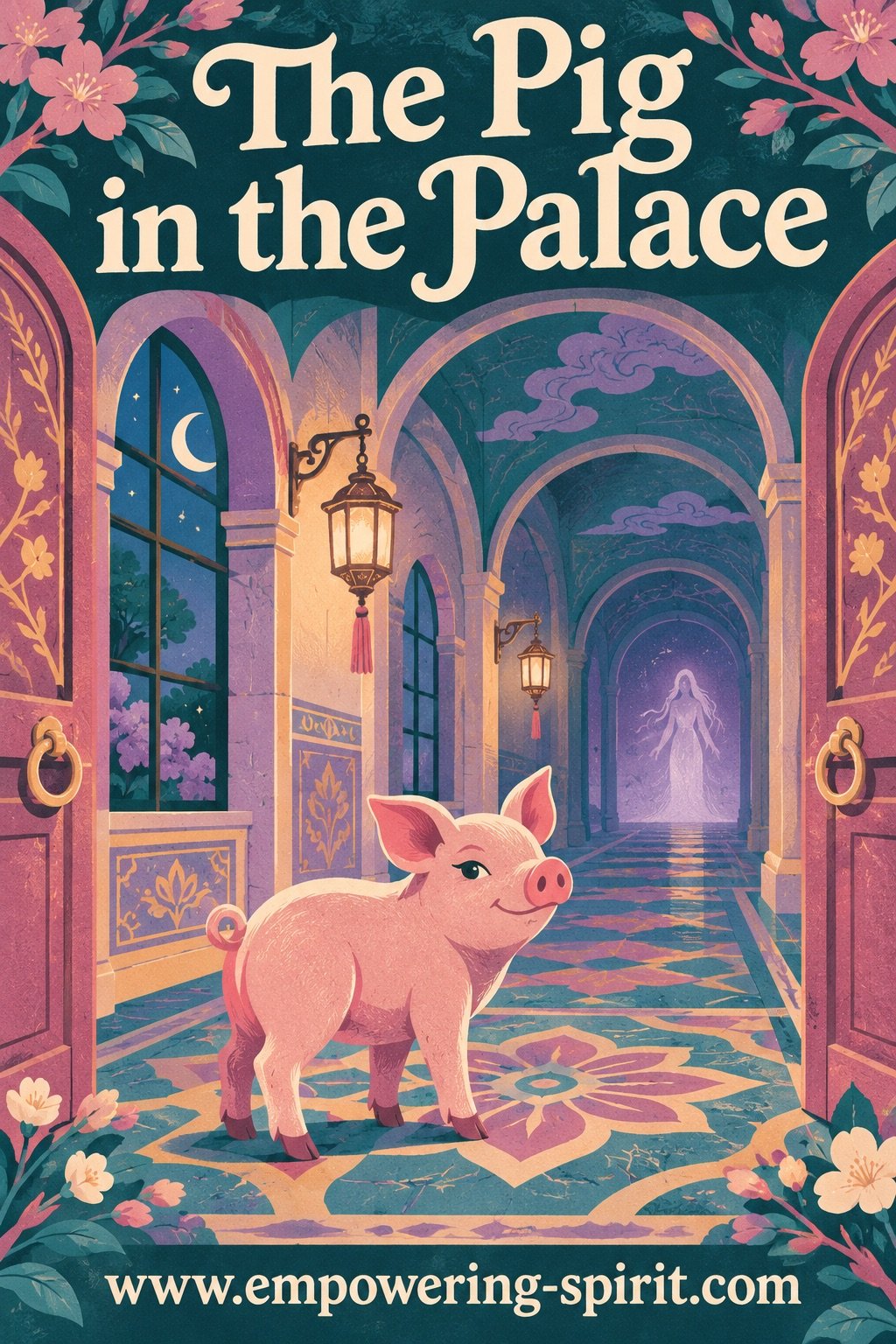
The Pig in the Palace
Click here to go back to the Hub Page
In the dream, Mrs. Atlay pushed open the dining-room door and found a pig standing beside the table. The room was otherwise as it should be: long table set for breakfast, chairs in place, morning light across the floorboards. The pig was large and muddy, with a pale patch over one shoulder, and it had its head under the tablecloth. It was chewing something. Mrs. Atlay stood in the doorway and watched it. The pig did not bother to look up. It shifted its weight, grunted once, and continued nosing among the chair legs as if it had been invited. The sight was so absurd that Mrs. Atlay began to laugh, and the sound of her own laugh woke her.
She lay still for a moment in the gray light of the bedroom, smiling. The pig had been entirely ordinary. That was the strange thing: it had not been a dream pig, all bristling shadow and meaning. It had been the sort of pig that gets into a kitchen garden and leaves half-moon tracks across a clean floor. She put the dream away as she dressed, but it stayed near enough to make her smile again as she hooked her collar.
Downstairs, the children and their governess were already gathered in the hall before family prayers. The youngest girl was swinging on the banister. The boys were elbowing one another near the table where the prayer books lay. The governess stood with her hands folded, saying something in a low voice that none of them appeared to hear.
“Good morning,” Mrs. Atlay said. “I have dreamed the most ridiculous thing.”
“What did you dream?” asked the eldest boy at once.
“A pig in the dining room.”
The children turned to look at the closed door behind her. The youngest girl stopped swinging.
“A pig?” she said. “A real pig?”
“Very real, and very muddy. It was standing beside the table with its head under the cloth. It had helped itself to something, I think. It was chewing.”
“Did it sit in one of the chairs?” asked the eldest boy.
“I should hope not. It had no better manners than the rest of you at breakfast.”
The boys laughed. The governess said, “Children, please. Prayers in a moment.”
“Was it a big pig?” asked the younger boy.
“Large enough to be in the way.”
“Could it have eaten the toast?” asked the youngest girl.
“It very well might have. I did not see the toast. The dream was not particular about toast.”
Mrs. Atlay glanced at the dining-room door. It was still shut, as it always was before breakfast. “It was only one of those foolish dreams that seem important until you see a teapot. If dreams must fill my dining room with livestock, they might at least provide an animal with better manners.”
The governess gave the youngest girl a gentle push toward the prayer books. “That is enough about pigs. Let us begin.”
The family gathered in a loose half-circle. Mrs. Atlay took her place beside the children. The governess read the psalm. The eldest boy kept his eyes on the closed dining-room door. The youngest girl covered her mouth with one hand. When the governess read the word “swine” in the lesson, the younger boy made a small sound in his throat and then pretended to cough. The governess looked at him over the book. He bowed his head.
No one left the hall. The house was quiet except for the governess’s steady voice. Mrs. Atlay listened, and now and then she looked at the door herself, but only because the children kept doing it. It was an ordinary morning. The dream was already fading.
When the prayers were finished, the eldest boy said, “Shall I go first and see if there are any pigs?”
“Please do,” said Mrs. Atlay. “And if there are, ask them what they have done with the butter.” She crossed to the dining-room door and opened it herself.
A pig was standing in the dining room.
It was not the pale pig from her dream, but there was no mistaking it. A real pig stood beside the table, its haunches against a chair that had been pushed crooked. Its head was under the tablecloth, and the cloth was dragged sideways so that a plate had slid toward the edge. There were muddy smears on the floorboards in a loose path from the service door. A small basket of bread lay on its side, and one roll was missing. The pig was chewing.
The children crowded around Mrs. Atlay.
“A pig!” the youngest girl cried.
“Stand back,” said the governess, putting one arm across the doorway. “Stand back, all of you.”
“But it is a pig,” said the eldest boy, as if she had not noticed.
The pig backed out from under the cloth and turned its head. It had a long, muddy flank and small, pale eyes. It did not look at Mrs. Atlay, exactly. It looked at the open door behind her and stood very still.
“Fetch one of the men,” Mrs. Atlay said to the governess. “At once. And keep the children out of the dining room.”
The governess went. The children pressed forward again. Mrs. Atlay shut the door to a narrow gap and stood with her hand on the handle, though the pig had not moved. It stood with its head slightly lowered, chewing the last of the roll.
The men came in with their sleeves rolled, one carrying a broom and the other a length of rope. The pig saw them and walked, not quickly, around the far side of the table.
“Close the other doors,” said Mrs. Atlay. “And mind the furniture.”
The man with the broom tried to turn the pig toward the service door. The pig turned the other way and went under a chair. The chair went with it for a step or two, then tipped over. The younger boy laughed. The man with the rope made a loop and crouched. The pig walked through the empty space between the two men and stood at the sideboard, looking at itself in the polished wood. It left a long smear of mud along the base.
“Take hold of it,” said Mrs. Atlay.
The man with the broom set it down and took hold of the pig’s hind leg. The pig squealed once, a loud flat note, and pulled away so sharply that the man sat down on the floor. The children howled with laughter. The governess said, “Hush, now.” The man got up, red-faced, and the two of them made a more determined effort. They cornered the pig against the service door and, after a brief struggle in which the pig backed under another chair and then trod on the fallen bread basket, they got both arms around its middle and half-led, half-carried it out of the dining room.

The noise of it went down the stone passage, then faded.
Mrs. Atlay opened the dining-room door fully. The children ran in and stood looking at the muddy marks on the floor. The tablecloth hung askew. One chair lay on its side. The bread basket was crushed.
“Did you dream that, Mama?” asked the youngest girl.
“I did not dream the part where it stepped on the basket,” said Mrs. Atlay. “But yes, the rest is close enough.”
The governess was already on her knees picking up the chair. The eldest boy said, “You must be a prophet.”
“I am not a prophet,” said Mrs. Atlay. “I am the wife of the Bishop of Hereford, and I am very tired of pigs.”
The man with the broom came back carrying a pail and a cloth. “It is back in the yard, ma’am. The yard man says he saw it safe in its sty after you came down this morning. He put the bar over the gate himself. There is a board loose at the back. Sometime after that it pushed through and came in by the kitchen door. He will nail the board before dinner.”
Mrs. Atlay looked at the floor. “It could not have been loose before?”
“The yard man says not, ma’am. He was in the yard at a quarter to eight, after you came down. The pig was in then.”
The children had stopped laughing. The eldest boy said slowly, “Then you dreamed it before it happened.”
Mrs. Atlay took the cloth from the servant and began to wipe at a muddy mark on the table leg. “I dreamed a pig. The pig got loose. One of those things had to come first, and it happened to be the dream.”
“But you told us before prayers,” said the eldest boy. “Before it was loose.”
“I told you nonsense, and the morning supplied a pig.”
The younger boy said, “What will you dream tonight?”
Mrs. Atlay straightened and handed back the cloth. “Something house-trained, if I have any choice in the matter.”
The servant finished mopping the worst of the floor. The other man had taken away the broken basket and brought a clean cloth for the table. The governess straightened the chairs. The family stood in the hall while the room was put to rights. Through the open door, Mrs. Atlay could see the sun now crossing the sideboard and the dark smudge the pig had left near its foot. She would have to ask someone to polish that.
At last the table was set again, and they went in to breakfast. The children clambered into their chairs, and for a while no one spoke. The youngest girl stared at the door. The eldest boy kept his head turned toward the service passage. The porridge came in, and tea, and a plate of fresh toast. Mrs. Atlay sat down and lifted the teapot.
The eldest boy said, “It will not come back, will it?”
The younger boy said, “I wish it would.”
“You would not wish to share your toast,” said Mrs. Atlay.
She poured the tea. The children began to eat, but the youngest girl still watched the door. The muddy marks were mostly gone, but a faint dark line remained along the edge of the sideboard. Mrs. Atlay looked at it and shook her head.
“If another dream must come true,” she said, “I should prefer one involving something house-trained.”
The children laughed. The governess hid a smile behind her cup. The breakfast went on, and now and then one of the children looked toward the door, half hoping, but no pig returned. The room settled into its ordinary morning sounds: spoons against bowls, the hiss of the tea kettle from the kitchen, the creak of the eldest boy’s chair. Mrs. Atlay ate her porridge and decided that the whole thing had been, after all, an unusually silly way to begin the day.
This story is based on a true account included in Andrew Lang’s The Book of Dreams and Ghosts. You can read the original account in the free Project Gutenberg edition. And if you are interested in fresh and modern content about dreams that came true, you can find them in my book “Dreams That Wake You Up”, a collection of real dreams and real outcomes, directly from my clients, printed with their consent.
For more articles and stories from us, click here to go back to the Hub Page