The Knot in the Shutter: A True Story of Déjà Vu
Click here to go back to the Hub Page
William Hone put the last sheet of correspondence in the drawer and wiped the nib of his pen on a scrap of cloth. The candle had burned low and made the room feel smaller than it was. He set the writing board under the desk, blew out the light, and undressed in the ordinary dark.
He fell asleep without particular trouble. The dream began without ceremony. He was walking up a short flight of stairs and into a room he did not know, a plain room with a table in the middle, several wooden chairs set against the walls, and one window facing the street, its shutters closed. The table was bare. No one waited there. Yet he had the brief certainty that a moment before he had been sitting in the chair nearest the window, alone, listening for a step on the stair. It was the kind of certainty dreams supply and never explain. Then it passed.
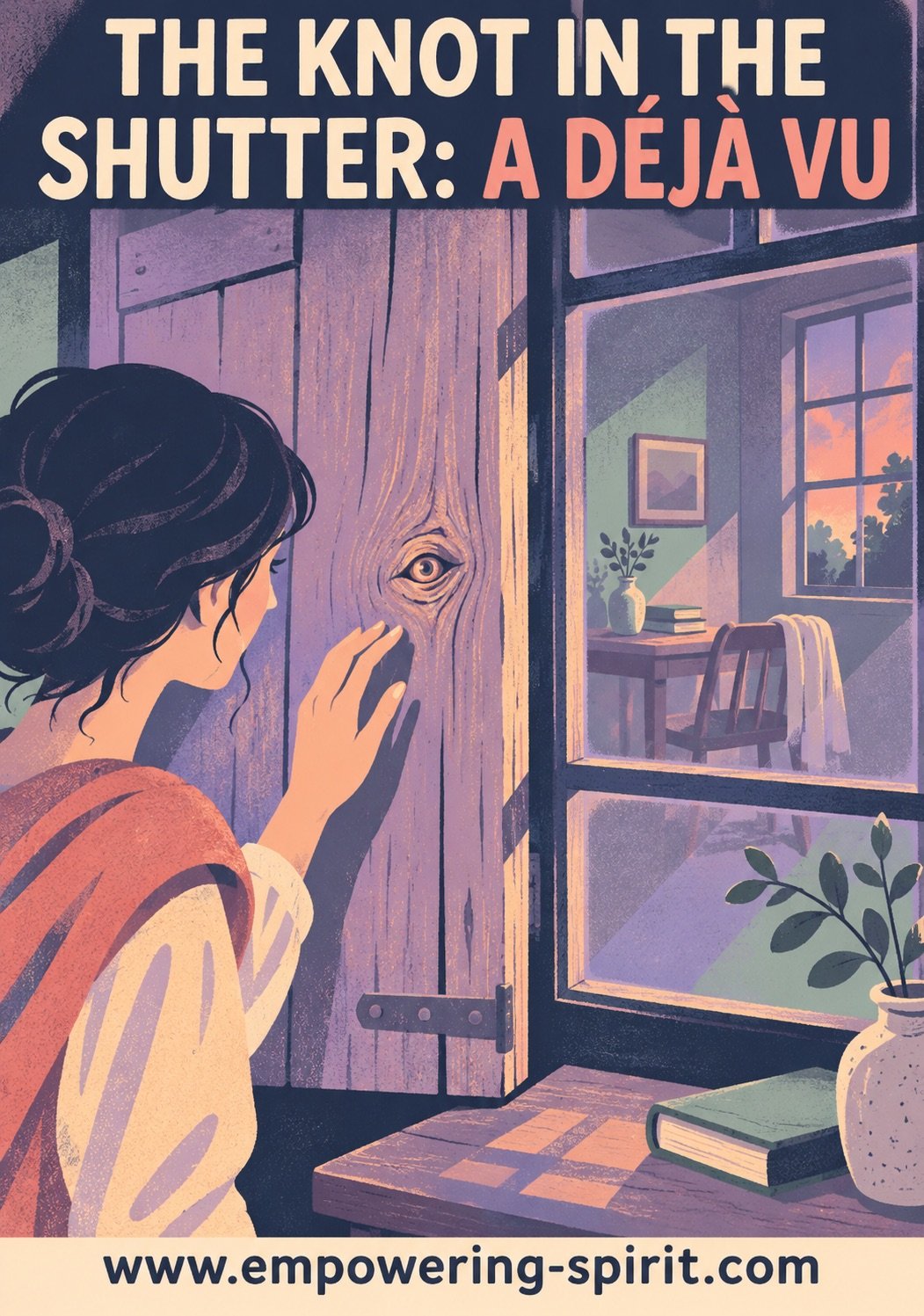
He crossed to the window and opened the left-hand shutter. The room behind him stayed silent. The wood of the shutter lay flat under his hand, and a knot below the middle rail caught his attention: two dark rings side by side, joined by a short raised line of grain. There was nothing else remarkable about it. It was a flaw in the wood. But his dreaming eye took it in with close attention, and the image stayed.
When Hone woke, the room was still dark, and he was annoyed. The dream had the kind of vividness that people took for a sign, and he did not believe in signs. He lay still and tried to let the particulars soften. The table, the chairs, the closed shutters remained clear. The knot remained clearest. He told himself that dreams were abundant and that the mind selected details for no better cause than chance.
But he had argued often enough that memory was a poor witness. It altered what it held. So he got up, lit a fresh candle, and opened the notebook he kept for business notes. On a blank page he drew a small diagram of the knot: two circles side by side, joined by a short channel. Beneath it he wrote: Inner face of left-hand shutter, a hand’s breadth below the middle rail. Two rings joined by a short raised line. Grain turns contrary to the surrounding lines. The description was shorter than the dream deserved. He closed the notebook and went back to bed.
Weeks passed, then months. The drawing stayed near the back of the notebook, unlooked at. Hone noticed it once or twice when he searched for an address, but he did not turn the page. Vivid dreams were common enough, and he had work to finish. If the image had begun to seem less urgent, that did not surprise him.

Then a matter of a printing account took him across the river to a street he knew only by name. The house was narrow and red-brick, with a dark doorway and a smell of paste and coal smoke in the passage. A servant showed him up to the first floor and asked him to wait in a room at the front of the house.
Hone stepped inside and stopped. The table stood in the middle of the floor. The chairs stood against the walls in the same positions. The window faced the street, and its wooden shutters were closed. The proportions of the room were not merely similar. They were exact. He shook off the sensation and walked farther in. Rooms resembled one another. Every shaded parlor in London had a table, a few chairs, and shutters that needed paint. A man might dream a dozen such rooms and later meet a dozen that seemed to correspond.
But he had not simply dreamed a room. He had recorded a detail. The thought arrived without drama, and he disliked how steady it was.
The left-hand shutter was folded shut against the right. Hone took out his notebook and turned to the back. The sketch was as he remembered it: two circles joined by a short line. The written description gave the position exactly: inner face of the left-hand shutter, a hand’s breadth below the middle rail. He looked up at the closed shutter and marked the likely place through the dark paint, a little below the crosspiece. If the knot was absent, the rest was resemblance and a too eager memory. If it was there, he would have to think further.
He did not hurry. He kept the notebook in his left hand and crossed to the window. The catch gave easily under his thumb. The shutter opened toward him, and the pale morning light from the street came through the glass beyond. The knot was there. It was two dark rings joined by a short raised line of grain, fixed in the wood a hand’s breadth below the middle rail. The direction of the grain around it matched his drawing.
Hone stood with the shutter pulled toward him and turned his attention from the wood to the page and back again. The agreement was close in every particular. He put his finger on the knot. It was smooth and dry under his touch.
Behind him the door opened. He did not turn at once. The servant said, “Will you take anything while you wait, sir?”
Hone closed the notebook over the drawing but kept his other hand on the open shutter. “No,” he said. “I have what I came for.”
The servant went out. Hone remained at the window, comparing the sketch he had made before he had ever walked down this street with the flaw in the wood before him. He could explain a great deal by chance. He could not explain how the chance had occurred before the sight that would have explained it. He closed the shutter slowly, fixed the catch, and laid his palm again over the place where the two rings joined. The wood was ordinary. The fact was not.
This story is based on a true account included in Andrew Lang’s The Book of Dreams and Ghosts. You can read the original account in the free Project Gutenberg edition. And if you are interested in fresh and modern content about dreams that came true, you can find them in my book “Dreams That Wake You Up”, a collection of real dreams and real outcomes, directly from my clients, printed with their consent.
For more articles and stories from us, click here to go back to the Hub Page