
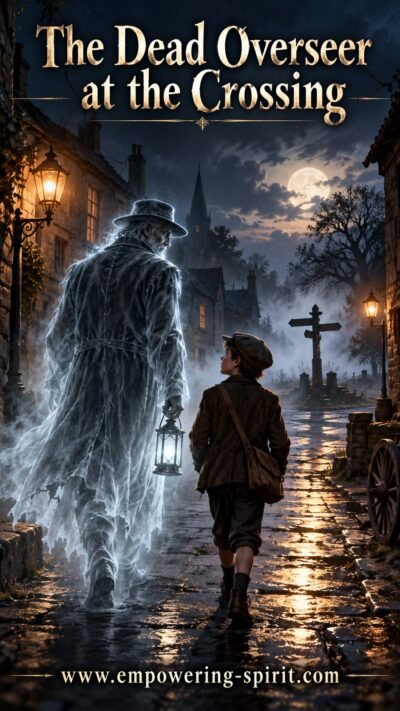
The Dead Overseer at the Crossing
Click here to go back to the Hub Page
The boy came out of the shop into the late afternoon and turned away from the shortest way back through Wexington. The errand had not taken long, and he still had a little time before dinner. He liked the longer route because the shops there were finer and the windows were full of things he could not afford. The street was ordinary, with carts moving and a few women standing at the corner near the pump. The gas lamp outside the shop had not been lit yet.
At the bookseller’s window he stopped. There was a new engraving of a harbor, and beside it a book with a red cloth cover and a cracked spine. Below them lay a map with the coast picked out in green. He stood looking for a long minute, aware that his stomach was empty and that the edges of his thoughts felt soft. He had not eaten since morning. That explained it.
A voice beside him said, “You’ll make yourself late.”
He turned. The man standing there was the overseer from the shop, solid and familiar in his dark coat. He had always been dark in the face, with a heavy brow and a mouth that turned down at one corner. He looked much as he always had, perhaps a little tired. The boy felt no surprise.
“I was just looking at the new prints,” he said.
“You can look later,” the overseer said. “Walk with me.”
The boy stepped away from the window and fell in beside him. They went at an easy pace, past the ironmonger’s and the shop with the tall window full of tinware.
“Did the glazier come about the back window?” the boy asked.
“He came. He says the frame wants new putty before the wet weather.”
“I told the bookkeeper that a week ago.”
“The bookkeeper won’t pay until the rain is in.”
“No,” the boy said. “He won’t.”
They walked a little way without speaking. The boy stepped around a loose cobble and happened to look down. The overseer’s boots were black and plain, but the laces had been threaded straight up the sides instead of crossed over the tongue, and they were tied in a small hard knot at the top. The boy had never seen a pair laced that way. He looked at them for another step, then back at the road.
“The new crates came in this morning,” the boy said.
“I saw them. Tell the porter not to stack them by the back door, or we’ll have them in the way all week.”
“I’ll tell him.”
They walked on toward the crossing at the bottom of the hill, still talking easily about the shop.
At the crossing, the boy was saying something about the shop cat when a cart loaded with empty milk cans rattled through the stones in front of them. The cans clashed, and he turned his head to watch it pass.
“It’s a wonder they don’t deafen themselves,” he said.
No one answered.
He looked back. The overseer was not there. The boy turned in a half circle. The street was not crowded, and the nearest side lane was thirty yards away. The cart had passed, and the sound of it was already fading. No one stood in the doorways nearby.
“Sir?” he said.
It was a question he had not meant to ask aloud. He stood still. A woman carrying a basket came down the pavement and passed him, and he moved closer to the wall to let her by. The boy looked once more along the crossing, but there was nowhere the man could have gone. He wanted to be back in the shop. He walked the rest of the way quickly, keeping close to the buildings.

He went in through the side door. The fellow worker he liked was sitting on a crate near the wall, rubbing oil into a stiff hinge. He looked up.
“You look as if you ran the last bit,” the man said.
“I saw the overseer,” the boy said.
The man looked up. “The overseer’s dead.”
“I saw him just now, on the long way. He walked with me from the bookseller’s to the crossing.”
“You saw someone who looks like him.”
“It was him,” the boy said. “He asked about the glazier and told me not to let the porter stack the crates by the back door. He was wearing his own boots.”
The man wiped his hands on a cloth. “What are you talking about?”
“The laces,” the boy said. “They were threaded straight up the sides, not crossed. I noticed them when we came down by the cobbles.”
The man stared at him for a moment. “You’re hungry. Go and get your dinner.”
“I’ve been hungry before. It was him.”
The man shrugged. “I wouldn’t tell the bookkeeper, if I were you.”
“No,” the boy said. “I won’t.”
He did not see the overseer again. In the years that followed, he never once felt that odd soft emptiness in his thoughts, and he never saw another person who could not be accounted for. What remained, longer than the man’s voice or the shape of his dark coat, was the lacing of his boots: the straight laces and the small hard knot at the top.
About this story
This retelling is based on The Books of Dreams and Ghosts by Andrew Lang. We’ve adapted the language and storytelling for modern readers while preserving the central elements of the original.
Curious about the original? Click here to read the historical collection on Project Gutenberg.